Showing posts with label Nychogomphus. Show all posts

Sunday, 5 June 2016

Nychogomphus lui, a Hanoi specialty

In 2011 Sebastien Delonglee already published photos of several enigmatic gomphid species that occur in the Hanoi region. Eventually one of these could be identified. It was Nychogomphus lui, described by Zhou, Zhou and Lu in 2005.

Apparently this species inhabits large slow rivers and the Red River is perfect for it. But it is a bit like Gomphus flavipes in Europe, another inhabitant of large rivers. That species too is best found by looking for exuviae of freshly emerged specimens. Nychogomphus lui emerges at the end of May and in early June. Sebastien has seen them for instance from a window perched in a tree! But how to reliably find them? In other years I could not. But this spring we discussed the area along the Red River where the Anax indicus appeared. It had some open forest areas close to the river. Might this be a good place?

Sebastien recently texted me to say he had seen a female. Soon after he found two more, on different days, all fresh. So today I went to the area, sweating it out (37 degrees in the shade). And found Nychogomphus lui, both a male and a female, perched in the shade close to the ground. Both were fresh. So this is the way to find them! Maybe they visit the river at dusk when mature, as other species of Nychogomphus do. Or maybe they mate elsewhere and the males do not return. We hope to find out.

For now this is the only place in Vietnam where the species has been found, but it may be more widespread. Generally we avoid the large rivers of Vietnam when we look for Odes, so it may be overlooked.

The female as I first found it, perched on a leaf. The color of the eyes shows she is very young, as is also evidenced by the shine of the wings.
She has amber wing bases. The wind was bothering her, so after this shot she took off

But when I turned around there was this wonderful fresh male! He had appeared while I was taking pictures of the female. Note the waved inferiors and black tipped superiors.

The same male in dorsal view


Tuesday, 6 October 2015

Some interesting gomphids from Quang Nam

On 25-27 September I visited Quang Nam Province around P'rao on the HCM Highway. I ran into quite a few interesting gomphids and I would like to share here some of them. Price for most interesting on the 25th goes to a Leptogomphus species. Recently I had a conversation with Haruki Karube on Leptogomphus uenoi, for which he recently published the male. Before that the species was only known for females and one could argue that the male leads a secretive life. But we concluded that maybe it was just overlooked, as the appendages are rather similar to those of L. perforatus. Well, I caught a Leptogomphus and in hand concluded it was probably L. perforatus, but somehow the ring of the inferior appendages seemed closed and I decided to collect it. Lucky too, for at home it dawned on me this was L. uenoi! The outer edge of the inferiors is straight, but the inside edge curved.

Leptogomphus uenoi male, a typical Leptogomphus species

But look at the appendages! A neat ring and almost straight outer edges.
 On the 26th I bumped into a multitude of interesting species. I was very happy to see quite a few Nepogomphus walli. Males were congregating in a fern at a particular stretch of the stream. I had so far only seen this species in Cao Bang Province.

Nepogomphus walli in hand, with its typical yellowish wollen base of the superiors

One of the males perched, this one not on a fern

Also interesting was the Lamelligomphus sp. that I had seen in spring much further north, in Nghe An Province. It was quite common here.

Lamelligomphus sp., a smallish species with interestingly very dark S2. Some individuals had a small yellow spot posterior of the auricle. It is similar to L. hainanensis, but has no protrusion of the inferiors.
A real surprise was the Nychogomphus flavicaudus on a larger river, where 3 males were hovering in the middle of the day. There were no differences with the specimens from Cao Bang I recorded in spring. Same size and same pattern on the thorax (only an antehumeral spot).

Male Nychogomphus flavicaudus, at least, if flavicaudus is a valid species
The last cool species I want to introduce here is Burmagomphus divaricatus. I had only recorded a freshly emerged specimen in Cao Bang in spring, but here I saw several adult males.

Here is one of the males in hand. The pattern on the dorsal side of the thorax is a little variable.

Another, similar, male perched

And the appendages in dorsal view

Sunday, 16 August 2015

Nychogomphus flavicaudus - New for Vietnam

It always pays to wade into rivers towards dusk and look for gomphids in spring and early summer. There are many species that only appear close to dusk and either patrol or hover over the water. On June 17 I therefore waded into a river close to Cao Bang City and noticed several medium-sized gomphids hovering over the water. But the current was strong, so it took quite a while before I finally was able to net first one and then a second. In hand it was immediately obvious this was an exciting species, because of the shape and colour of the appendages.

Basically it was very similar to a species I had seen earlier at Cat Tien National Park, Nychogomphus duaricus. Although that is much further south, this species has also been recorded from Yunnan in China. But checking Chao it dawned on me that this was in fact Nychogomphus flavicaudus, a species thought to be endemic to Hainan.

Having said that, these species are extremely similar, so I will not be surprised if DNA-analysis would indicate they are in fact the same species, or subspecies. The most noticeable differences are 1) the antehumeral pattern (a humeral spot and a separated humeral line or series of small spots forming a broken humeral line in N. duaricus and only an antehumeral spot in N. flavicaudus) and the size (abdomen around 36mm and hindwing around 27mm in N. duaricus, abdomen around 40mm (total body length 54mm) and hindwing 33mm in N. flavicaudus). It must be noted that Asahina (1986) points out that specimens of N. duaricus from Malaysia also miss the antehumeral line. But if we follow current practice, then the specimens from Cao Bang must be considered N. flavicaudus.

This brings the number of Nychogomphus species in Vietnam to three. The other is N. lui (see Sebastien's site. I have not been lucky enough to bump into this species that inhabits large rivers and occurs in the suburbs of Hanoi).

Top 2 specimens are N. flavicaudus from Cao Bang. Bottom specimen is much smaller N. duaricus from Cat Tien. Shape of appendages is virtually the same between the two species. Tips of superiors are somewhat more flattened in N. flavicaudus specimens, but not to the same degree in both, so the consistency of this trait is questionable.
Male Nychogomphus flavicaudus. Note the antehumeral spot, but complete lack of antehumeral stripe.
Appendages in dorsal view
Appendages in lateral view
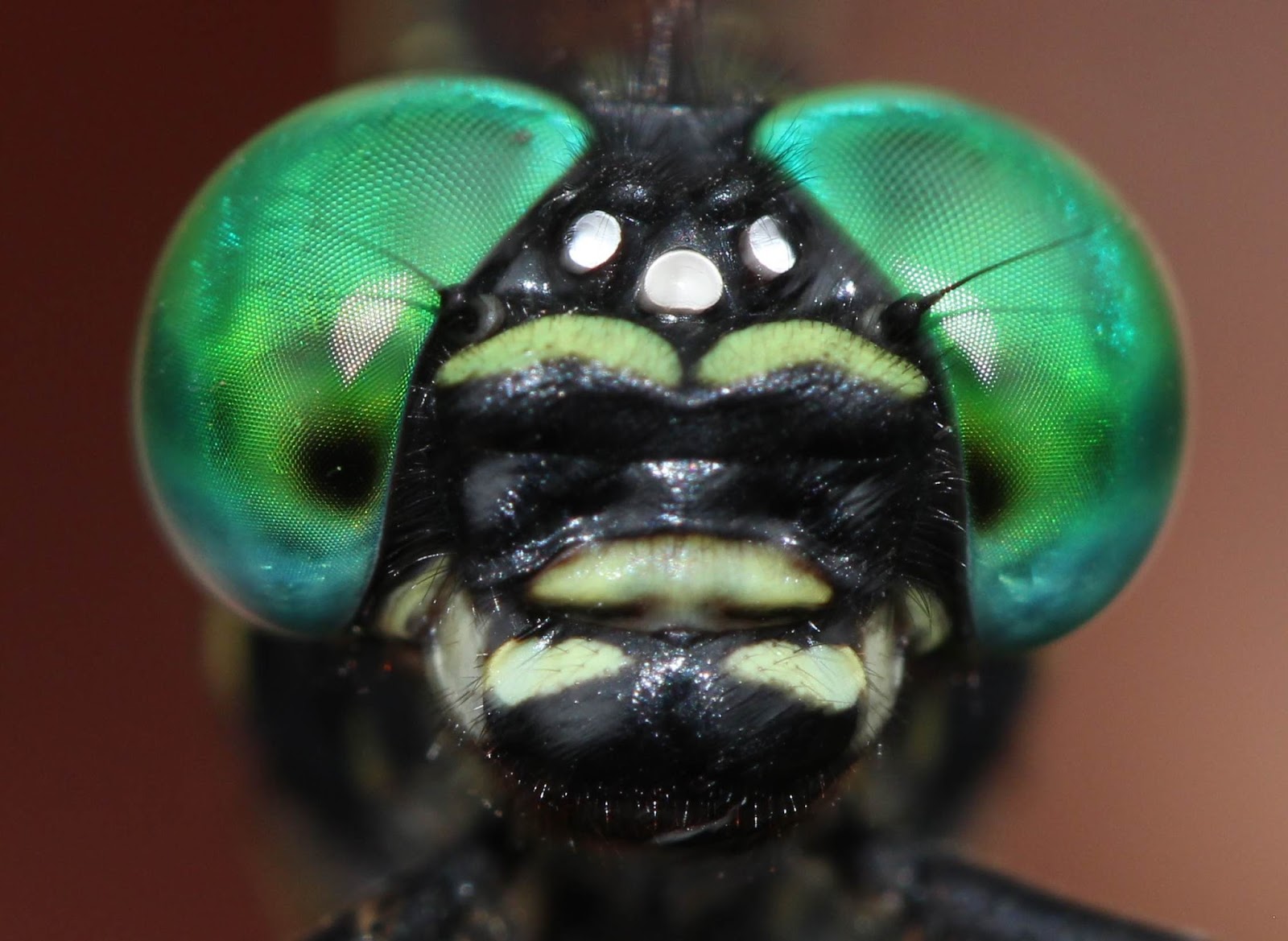
Facial pattern similar to N. duaricus, but extent of yellow patches somewhat reduced


Saturday, 9 August 2014

Two Gomphids from Cat Tien

During my short stay in Cat Tien National Park I encountered only two species of Gomphidae. James Holden had seen one more species (a Burmagomphus), but clearly gomphids are thinly spread in this season. Maybe they are more common at other times. Ictinogomphus decoratus is a widespread species also known from southern Vietnam. I saw it a few times at the old fishponds. The other species also occurs over a wide range, from eastern India all the way to Laos, but to my knowledge had not been recorded before in Vietnam. This is Nychogomphus duaricus. A distinctive species with appendages somewhat similar to Phaenandrogomphus tonkinicus, but with very different colors, bot yellowish brown overall, but black and whitish. This species I saw repeatedly at the small garden pond at the lodge, but whether they also reproduce at the pond I cannot say. Both males and females were perching along the edge of the pond on bushes or weeds, is all. I did not see them anywhere else.

Nychogomphus duaricus, a distinctive species with its bicolored appendages. This is the male.

Appendages in close-up, lateral view

The facial pattern, with extensive yellow spots on the labrum.

The female, perched by the side of the pond

The male of Ictinogomphus decoratus, the second species of the genus I see in Vietnam. This is a widespread species known from a large area in South-East Asia, including the Philippines, China, Indonesia and nearby Laos.

Appendages in lateral view

And in dorsal view

And its facial pattern, including the interesting round yellow spot on the occiput.