Showing posts with label Epophthalmia. Show all posts

Friday, 25 November 2022

An updated list for my three visits to Phu Quoc in 2015 and 2016

During my stay in Vietnam I was able to visit Phu Quoc island, located off the coast of Cambodia to the west of the Vietnamese Mekong delta, several times. It has a very interesting Odonate fauna compared to the rest of Vietnam, with several rare species, not seen elsewhere in Vietnam. I visited the island from 28 December 2015 to 2 January 2016, again from April 12 and April 15, 2016 and finally from August 19 to 21, 2016. Some species are very local and also occur only in the dry or in the rainy season, so not everything can be seen in any one trip. I already published a list after my first trip. This list is updated here to include all records, to which I added the months in which species were recorded by me in Roman capitals. But first a few photos of good species not published here previously.
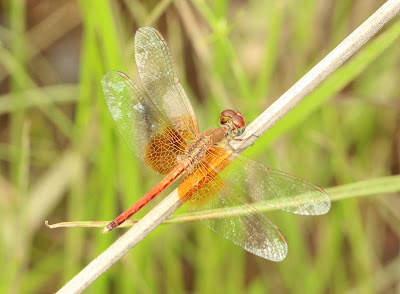
Neurothemis intermedia male, 19 August 2016 

A second Neurothemis intermedia male from August 19, 2016

A target species I had been looking for on all my trips, which had been recorded by Bui (2008). Apparently this rare species is a summer species on the island. I only saw a single female, Lyriothemis mortoni.

The fascinating Platylestes platystylus, also on the island of Phu Quoc., August 20, 2016


Immature male of Brachydiplax sobrina, August 20 

And nearby an immature female, much harder to find generally

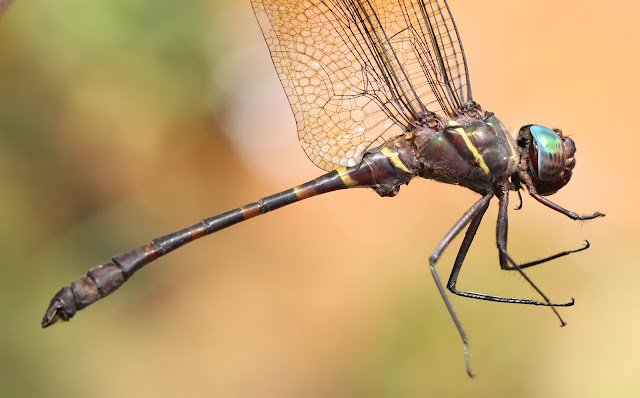
Monstrous Epophthalmia vittigera, a wonderful male, caught on August 21, 2016

A lovely Ceriagrion calamineum, previously recorded from the island, but misidentified as C. aurantiacum in Bui (2008). Finally found on 21 August 2016.

Agrionoptera insignis male over a dark pool, August 19, 2016. The only specimen I saw on my three visits.

The List:

Lestes praemorsus* VIII
Platylestes platystylus* VIII
Vestalis gracilis I, IV, VIII, XII
Libellago hyalina I, IV, VIII, XII
Heliocypha biforata I, IV, VIII, XII
Euphaea cyanopogon**** I, IV, VIII, XII
Rhinagrion viridatum XII, VIII
Podolestes coomansi***** IV
Aciagrion borneense I, XII
Agriocnemis minima* IV, VIII, XII
A. nana* IV, VIII, XII
A. pygmaea I, VIII, XII
Amphicnemis valentini**** VIII
Archibasis viola I, IV, VIII, XII
Ceriagrion calamineum** VIII
C. cerinorubellum IV, VIII, XII
C. malaisei* VIII
C. olivaceum* I, IV, XII
Ischnura senegalensis I, IV, XII
Mortonagrion falcatum*** I
Onychargia atrocyana IV, VIII
Paracercion calamorum* IV, VIII
Pseudagrion australasiae* IV, VIII, XII
P. microcephalum I, IV, XII
P. rubriceps IV, XII
P. pruinosum I
P. williamsoni I, IV, VIII, XII
Coeliccia kazukoae** I, IV
Coeliccia yamasakii IV
Pseudocopera ciliata* IV, VIII, XII
Copera vittata** I, IV, VIII, XII
Prodasineura verticalis** I, IV, VIII, XII
Anax guttatus I, VIII, XII
Gynacantha basiguttata* I, VIII
G. bayadera* I
G. subinterrupta* I
Heliaeschna crassa*** IV
Ictinigomphus decoratus meleanops I, IV, VIII
Paragomphus capricornis* XII
Epophthalmia frontalis* I
E. vittigera* VIII
Acisoma panorpoides IV, VIII, XII
Agrionoptera insignis* VIII
Brachydiplax chalybea* IV, VIII, XII
B. sobrina* IV, VIII
Brachygonia oculata IV, VIII
Brachythemis contaminata I, VIII, XII
Cratilla lineata IV
Crocothemis servilia I
Diplacodes nebulosa I, IV, VIII, XII
D. trivialis I, IV, XII
Hydrobasileus croceus I, VIII
Indothemis limbata*** I, VIII
Lathrecista asiatica I, IV, VIII
Lyriothemis mortoni VIII
Nannophya pygmaea IV, VIII, XII
Neurothemis fluctuans I, IV, VIII, XII
N. tullia IV, XII
N. fulvia IV, VIII, XII
N. intermedia* IV, VIII, XII
Orchithemis pulcherrima IV, VIII
Orthetrum sabina I, IV, VIII, XII
O. pruinosum* XII
O. chrysis I, IV, VIII, XII
Pantala flavescens I, VIII, XII
Potamarcha congener I, IV, VIII, XII
Pseudothemis jorina** I
Rhodothemis rufa* IV, VIII, XII
Rhyothemis aterrima* IV
R. obsolescens IV, VIII
R. phyllis I, IV, VIII, XII
R. variegata I, IV, XII
R. triangularis IV, VIII
Tetrathemis irregularis IV, XII
Tholymis tillarga I, IV, VIII, XII
Tramea transmarina euryale* I, VIII, XII
Trithemis festiva IV, XII
T. aurora I, IV, VIII, XII
T. pallidinervis I, IV, VIII
Urothemis signata I, IV, VIII
Zygonyx iris I, VIII
Zyxomma petiolatum* IV, VIII, XII

*       Refers to species first recorded on the island, although some are very common
**     Coeliccia kazukoae had already been found by Floris Brekelmans, but is not rare. Prodasineura verticalis had been recorded as Prodasineura sp. Copera vittata had been misidentified previously (as C. marginipes), but is a very common species. Pseudothemis jorina had been recorded but misidentified (presumably) as P. zonata. Ceriagrion calamineum had been misidentified as C. aurantiacum.
***   Refers to species recorded for the first time for Vietnam (as far as I know)
****  Refers to a species novum, but misidentified in previous surveys.
*****Recorded by Flores Brekelmans, not by me, but published on this blog

Saturday, 10 October 2015

A few hours in Vientiane, Laos and a new species for the Laotian list.

This Thursday I had a few hours to spare in Vientiane and took a cab to the outskirts of the town. Thank God the surroundings are not close to being as polluted as around Hanoi and I was able to find 38 species in a short time. Vientiane is about as far south as Ha Tinh in Vietnam, which is about the southern edge of my general research area (northern Vietnam). But its species are quite different, much more southern. There was a lot of overlap with the commoner species in Cat Tien National Park, for instance. I was happy to catch a Epophthalmia frontalis male. Yokoi & Souphanthong actually list 31 Macromiidae, 28 of them Macromia. Which is rather astounding. But anyway, I was happy with my frontalis. And I was able to take pictures of male Lestes elatus and female Ceriagrion cerinorubellum. I had seen both these species in Cat Tien, but had not seen these sexes. Below a few pictures. And another very common species in some inundated and apparently deserted rice fields was an Aciagrion. I had to go back to Ris (1911) and Fraser (1933) to find out what may be the differences between Aciagrion occidentale and A. borneese. The appendages look rather similar and the A. borneese I had from Da Nang had been eaten by vermin. But in the end the description of Fraser pointing out that S8 is blue with a black triangle on it in A. occidentale, whereas A. borneese has a broad dorsal black stripe over the whole segment, provided the clue. Photos from India confirm the pattern on A. occidentale, and I therefore conclude that the specimens I saw were A. borneese, on the premise that the pattern is consistent over the complete range of these species. Interestlingly Yokoi & Souphanthong do not list either of these species for Laos. A. borneese is a very common species in Thailand and that country is of course right opposite the river at Vientiane.

Let's start with the addition to the Laotian list, Aciagrion borneese. Note dorsally black S8 and S10, whereas S9 is marked by a thin blackish dorsal line.
Another male with the distinctive pattern

Female Ceriagrion cerinorubellum. Possible to confuse with C. auranticum because of the green eyes and orange-brown cranium. However, S3-7 are blackish above and blue-green laterally, not orange, and S9 misses the clear darker marking.

Lestes elatus female

And the male, which I had failed to find in Cat Tien.

And finally a fine male Epophthalmia frontalis


Tuesday, 23 December 2014

Epophthalmia frontalis - this is what makes me tick

On November 13 we were checking the fishponds in Cat Tien. A large Cruiser-type dragonfly was doing the rounds on one of the ponds. I was able to make a few vague inflight shots. Enough at home to see that it was one of the southern Epophthalmia types. But which one? Vittigera, vittata or frontalis? It was only a few days later that I could catch two males and on the 17th I caught also a female. Facial pattern and appendages quickly ruled out vittigera, but the literature on vitiate/frontalis is less straightforward. The yellow spot on cleft in front of the vertex is restricted to the cleft, says Fraser (1936), and separated into two round spots in frontalis. But Asahina (1969) does not make that distinction. His drawing of male frontalis has exactly the same spot as our specimens. It is not altogether clear whether these two species are truly different, rather then geographical variants. If so, E. vittata is the senior synonym. But appendages of male, lamina of female, facial pattern all fit perfectly with E. frontalis, so for the time being I settle on that species. James Holden had reached the same conclusion already before, when he had seen the species in the summer. Although it had been absent in August, it was quite common now, with several males on the same ponds.

First few record shots. Note the reddish-brown abdominal tip.
Another record shot of the same individual
One a two males caught. In E. vittigera the superior appendages have quite a different shape. This is the male of E. frontalis.
Another male of E. frontalis.
The male face with large yellow spot in the cleft, yellow spots on either side of the frons , cream-white undulating line over the postclypeus and cream spots on the bases of the mandibles and on the labrum.
The face of the female is somewhat different, in that all marks are in yellow and there are only two spots on the postclypeus.
The fantastic female, note the dark wing bases.

Distintive brown appendages, superiors shorter than epiproct.

And in dorsal view, appendages slender and relatively straight.


Friday, 11 October 2013

Two common cruisers: Macromia pinrantani vietnamensis and Epophthalmia elegans

Basically there are two common cruisers in Northern Vietnam, but likely there are also uncommon ones, so I should remain on my toes whenever I spot one. These two species are rather similar in flight, but in hand are quite different. Macromia pinrantani has one lateral thorax stripe and a plain reddish-brown face (I apologize to anyone with a reddish-brown face, I do not mean to say you look plain). Epophthalmia elegans has, apart from a name that screams to be misspelled, two lateral stripes on the thorax and a real warface with stripes and markings. Both share the rather similar appendages of the Macromids. E. elegans is a common species of open waters, commonly seen patrolling along the verges of reservoirs, ponds and lakes. M. pinrantani on the other hand is a typical species of forested streams, where it cruises up and down over long distances, checking nooks and crannies for partners.

Macromia pinrantani vietnamensis, male

Macromia pinrantani vietnamensis, female

Appendages of M. pinrantani vietnamensis, male

Rather plain brown face of the male

Epophthalmia elegans, male

Appendages of male in close-up, note blunt uppers

Appendages in dorsal view

Warface of E. elegans. The last thing you will see as its prey.