Thursday, 12 May 2016

Another Sinorogomphus, but not very different

While visiting the mountains along the Laotian border close to Da Nang in the first week of May I caught a Sinorogomphus that looked very similar to S. sachiyoae. But the lateral pattern on S2 was somewhat different and upon close inspection the shape of the tips of the superior appendages was also different, if not a lot. I thought it had to be S. sachiyoae, but after consultation of the literature it turned out to be a species described already in 1969 by Asahina: Sinorogomphus vietnamensis. A nice and interesting addition to my list. In fact I observed the species in Quang Tri, Quang Nam and Thua Thien - Hue Provinces.

Male Sinorogomphus vietnamensis. Note the pattern on S2 and the fact that the superior appendages seem to touch the inferiors.
The female is even more like S. sachiyoae.

In dorsal view the appendages are quite similar

But in lateral view the tip of the superior appendage is longer and bends downward towards the epiproct.


Wednesday, 11 May 2016

A new species of Asiagomphus*

*Updated January 1, 2020 based on the publication in 2018 in Zootaxa of my study of the genus Asiagomphus in Vietnam, which included the description of this species as Asiagomphus kosterini.

April 17 I was checking streams near Tuyen Lam Lake at Da Lat. It started as a sunny day and around 9.30 I spotted the first gomphid, perching in the middle of the stream on a stone. It was immediately obvious from the extensive yellow on the terminal segments that this was something I had not seen before. It took some effort, but eventually I was lucky enough to be able to net it. In hand my suspicions that it was an Asiagomphus species were confirmed. A very interesting species, with extremely extensive yellow markings and widely expanded S7-9. Patterning was otherwise in line with Asiagomphus and the appendages were also typical of the genus. But it is not any of the other 4 species (at least) I have seen in Vietnam and it is not any of the known species from South-East Asia either. A wonderful species and new to science! It was rather common at the stream, with at least 10 different males observed and a few females seen ovipositing.

I eventually published this species as Asiagomphus kosterini, one of a total of eight species of Asiagomphus I could confirm in Vietnam.

Asiagomphus kosterini. Note the extensive yellow markings on S7-9. A beautiful and striking species.
A male in dorsal view, showing the massive club
And in lateral view
The appendages and terminal segments in dorsal view


Tuesday, 10 May 2016

The world of Protosticta

Once you start looking at Protosticta species, you will find there is a whole world out there! Only recently I published a paper with Toan giving details on the currently known 9 species from this genus for Vietnam. Two of these are large and different: Protostica grandis and P. ngoai. One has very typical appendages: P. spinosa. The remaining 6 are very similar. I had not yet seen several of these, but on May 5 in Quang Tri province I found an area where I kept bumping into one of these: P. caroli (first described by Jan van Tol in 2008). It can be identified by the only partially pale S9, the stubby inferiors (compared to for instance P. socculus) and the prothorax of which always the posterior lobe is extensively dark, which extends onto the central lobe. But really one needs a microscope to settle its identity for sure.

In the same area, but on a drier slope, I ran into what seemed a "very" different species. A little smaller, it was crispier, in that the white rings on the abdomen were really white, the prothorax had only on oval black spot in the posterior lobe, it has all white S9 and under the microscope there are also important differences in the appendages (like a missing lobe). Careful checking at home showed it was none other than P. socculus.

Relatively boring P. caroli. It shares with P. socculus the broad black line over the metapleural suture. S9 is only two-thirds pale, but not truly white, and the abdominal rings are likewise not very crisp.

Another specimen, similarly with limited white on S9.
A male in hand. This specimen has minimal dark markings on the prothorax, but still all dark posterior lobe, dark extending onto central lobe in two triangles, remainder off-white. The colour of the thorax is a dull dark green. 

P. socculus. Note the very white abdominal rings, the crisp white prothorax with contrasting posterior lobe

A close-up of the prothorax. Note also that the colour of the thorax is a different green.


Sunday, 8 May 2016

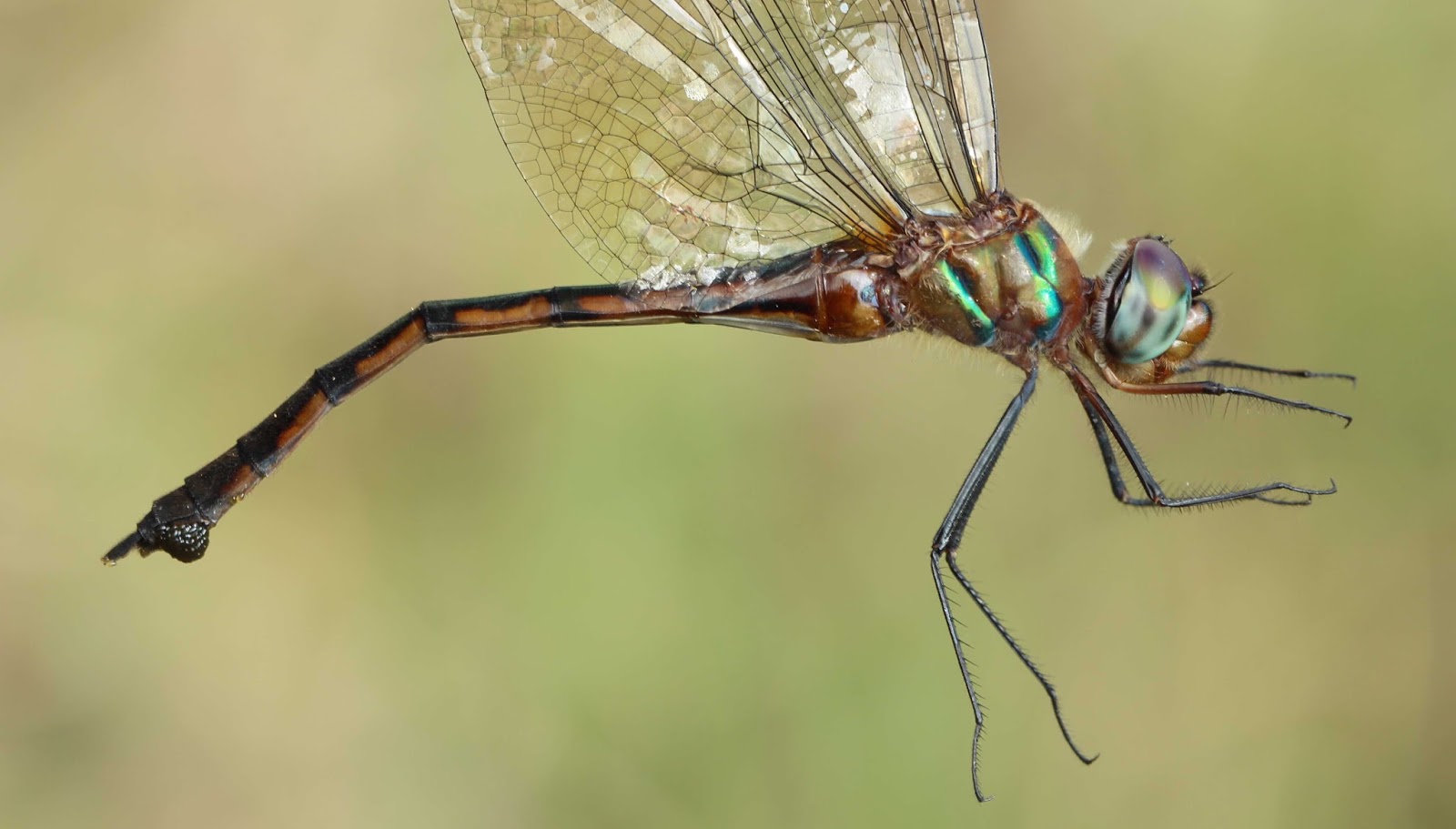
Macromidia kelloggi - a relatively solid Macromidia

In 2015 Karube published a record of Macromidia kelloggi from Bach Ma National Park close to Da Nang. This was far from known localities in China, but Karube postulated that the species in fact occurred widely in northern Vietnam. Because it has yellow antehumeral spots it is quite easy to separate from the common Macromidia rapida, but although I checked many, I never saw this species mixed in.

But today I was staking out Chlorogomphids (in vain) at Tam Dao when around quarter to four in the afternoon, so bright day, although it was cloudy with only intermittent sunshine, when a sturdy Macromidia tried to zip past me. But alas, it ended up in my net. Not only was it immediately obvious that this was not M. rapida because of its sturdiness and different appendages, it also had yellow antehumeral spots! Macromidia kelloggi, I presume? Indeed, indeed! A largish species, total length 60mm and hind wing 39mm.

Macromidia kelloggi. Note the yellow antehumeral spot (although small for the species)

Black base to ivory superiors and brown edged and tipped epiproct

Rather unlike the appendages of M. rapida (see under that species)

Thursday, 28 April 2016

Hemicordulia tenera - an emerald at Da Lat

April 17 I caught a medium-sized emerald along the edge of Tuyen Lam Lake, at one of the swampy corners of the lake where a small stream runs into it and creates boggy conditions. It was ovipositing in a pool surrounded by grasses. It is always a happy occasion to bump into emeralds, no matter where you are in the world. They tend to be scarce. In Vietnam I have only seen Procordulia asahinai, but that was at Sa Pa. Da Lat is a different world, of course. It is of course possible that there are undescribed emeralds in Vietnam and I did my best the day after to find the male, but I could not. As far as patterning and the vulvar laminae are concerned there is no reason why this would not be the female of Hemicordulia tenera, a species that occurs for instance in nearby Thailand. Here are a few pictures.

Female Hemicordulia tenera. She has long legs, that is for sure.

Scan of the same female, showing the venation.


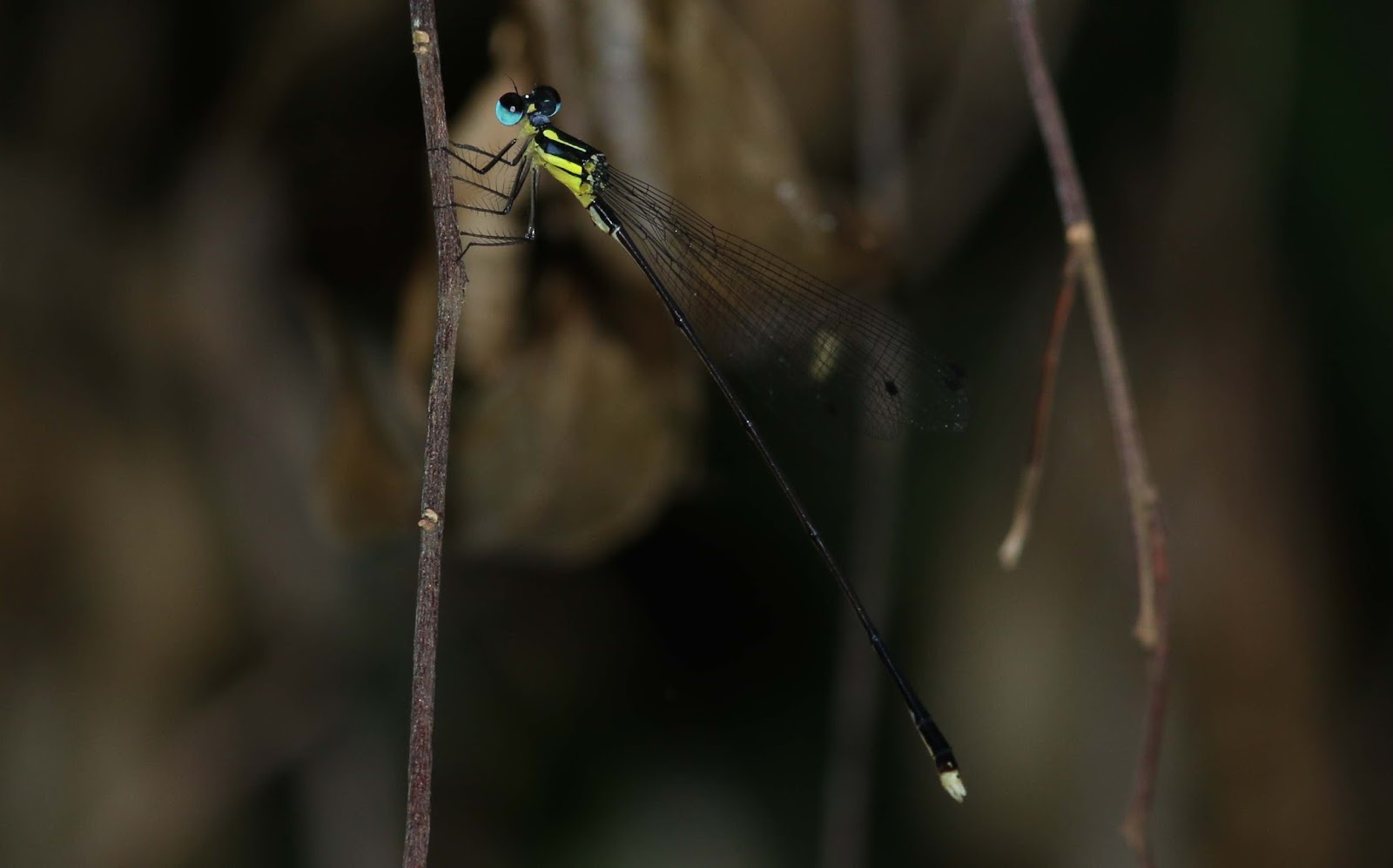
Coeliccia species from the south*

*Adjusted on January 20, 2017. Paper was published on C. mattii so I added its name here.

Just a few weeks ago Rory Dow published Coeliccia suoitia from the Da Lat area. I revisited the location where I had observed them in December last year and this time (April 16) found the undescribed female and a single male. Finding the female proved that the female I had included in my December post was not the female of C. suoitia at all. I deleted the photo from the post, in case you did not notice. The real female has similar colours and pattern to the male and has two lateral horns to the prothorax. This is very interesting and supports Rory's assumption that this species is not a regular Coeliccia at all.

Female Coeliccia suoitia

At the same location and same date I also caught a single male and observed another of a different species and it is likely that the female I photographed in December concerned this species. It is mostly yellow-and-black, and it has been suggested it is a form of Coeliccia montana. I doubt that very much. It is larger and has a different thorax pattern. It shares pruinosity on the prothorax, but in addition also has a pruinose spot on the mesepimeron. And it has paler and differently shaped appendages, with less yellow on S9-10. I was informed by Wen-Chi Yeh that he has a similar specimen from the general Da Lat area, which shares all these peculiarities. For the moment this remains a Coeliccia sp. novum, to be described when we can bring the various materials from this area together in a paper.

Coeliccia sp. novum, note pale appendages and lack of yellowish on S9

C. montana-like pruinose prothorax, but note pruinose spot on mesepimeron and yellow, not whitish coxae.


At a different location at the bottom of a very wet small valley in undisturbed forest a smallish Coeliccia caught my eye on April 18. It seemed to have a pale blue thorax, like Coeliccia poungyi, but upon close inspection it turned out that it had a largely pruinose thorax, so it did not have real blue, but the underlying colour was black. Non-pruinose parts were yellow. It was considerably smaller than the aforementioned species and clearly undescribed. But it turns out that Wen-Chi Yeh also collected it around Da Lat and specimens from Rory and Matti Hamalainen are stored at Naturalis, Leiden. This species was described in 2016 by Toan and me as C. mattii. The female is a lot like the female of the aforementioned species and also like that of Coeliccia montana, but smaller.

The other Coeliccia mattii male with pruinose thorax and prothorax and yellowish appendages

Two males and a female of Coeliccia mattii (top three) and Coeliccia sp. novum 1 (bottom), showing big difference in size.


The last Coeliccia I found new on my recent trip to Phu Quoc (on April 12) was Coeliccia yamasakii, a specialty of Phu Quoc (as far as Vietnam is concerned). I found only a single male and 3 females at a single location. Although it should be more easy to find, it was in fact very hard to find and I guess that has to do with the extreme drought. But I was a happy chappy.
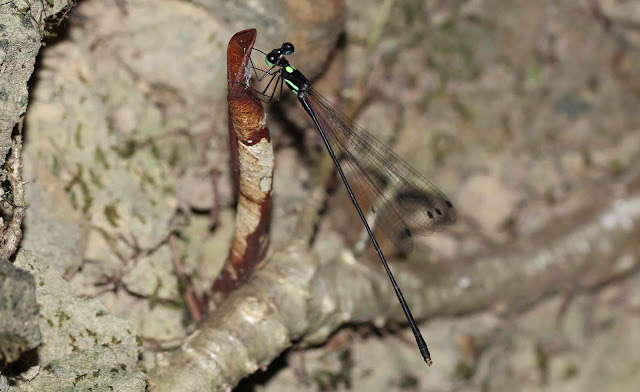
Coeliccia yamasakii male, recognizable by the small greenish yellow thorax spots and all dark abdomen with only the appendages paler. This is an adult, the subadults males have more extensive pale areas on the thorax and abdominal tip. 
The female of Coeliccia yamasakii, relatively blueish.

Tuesday, 26 April 2016

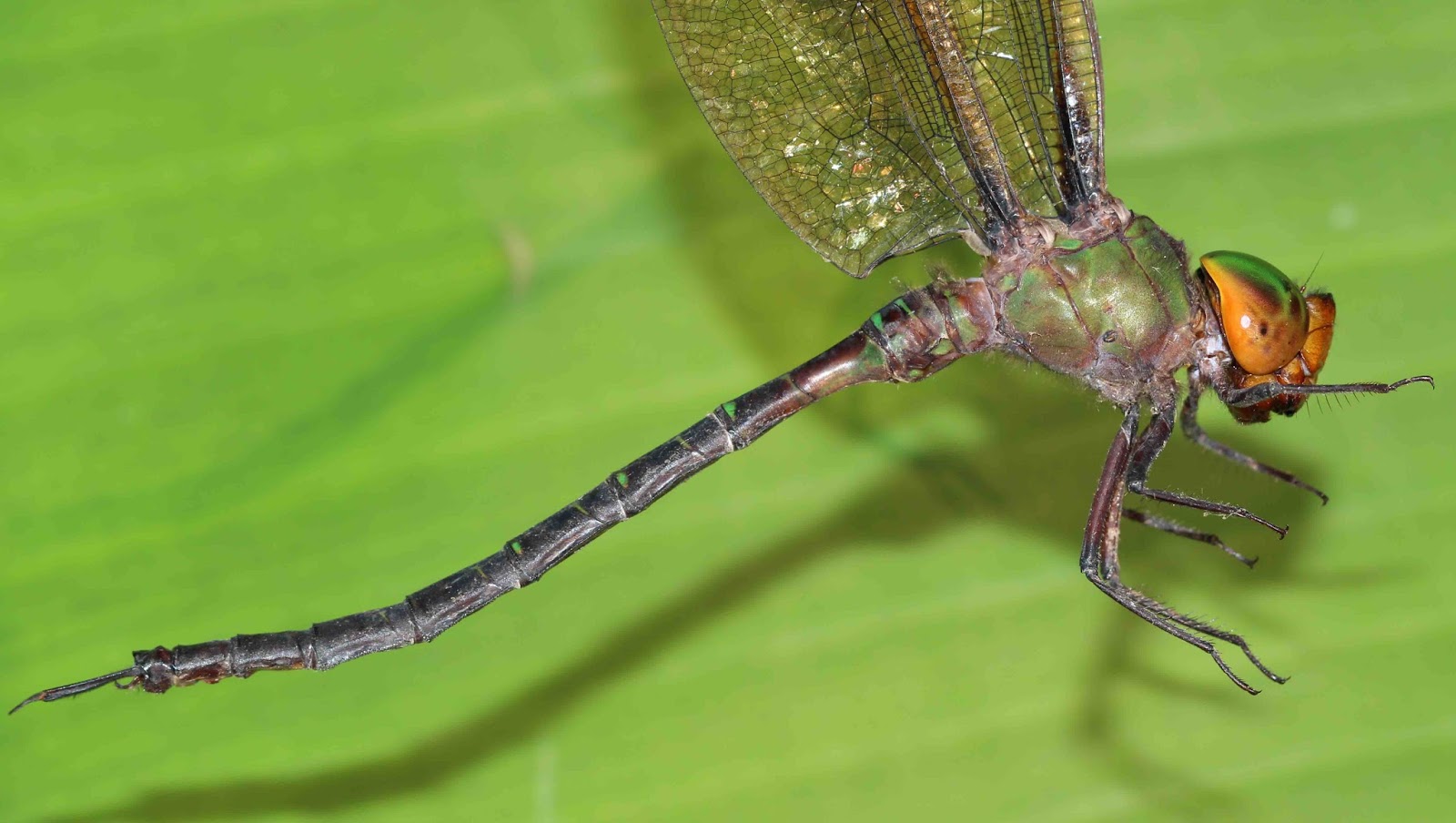
Heliaeschna crassa new from Phu Quoc

On April 14 I was trying my luck towards dusk at a small pool inside swamp forest on Phu Quoc. This was the pool where I had found Rhyothemis aterrima during the daytime and although nearby a dead dog had been dumped in a bag, it was not nearly smelly enough to keep me from staking out for Aeshnids. And as luck might have it, a large Aeshnid did in fact show up and even luckier, when I struck out for it I caught it. It was large and did not look familiar. The appendages looked a bit like what I remembered from Asahina and indeed: when I checked later it turned out to be Heliaeschna crassa. Having said that, this species may be a junior synonym of Heliaeschna idae. However, since convention calls the specimens in countries just west of Vietnam H. crassa, I will stick with that.

This species has long superior appendages that bend inwards towards the apex and are slightly expanded, but the epiproct is short and hooked upwards towards the posterior end. The face is ochre, with an indistinct dark spot on the postfrons that does not form a real T-spot. The eyes are also largely ochre in colour. The thorax is green with reddish lines over the sutures. The wings are pale brownish enfumed, but with dark brown along the subcosta becoming less distinct after the first 6-7 cells or so. Asahina actually describes the thorax as mainly dark reddish brown and the face as reddish brown. Maybe he worked with faded specimens?

The beautiful monster: Heliaeschna crassa. Note the largely ochre eyes.

And the ochre face, for that matter

Positrons with dark vague diamond

Appendages in lateral view, with hooked epiproct.


In dorsal view. Sadly the right appendage was damaged