Showing posts with label Agriocnemis. Show all posts

Monday, 23 March 2015

Flashback - trip to Cat Tien NP 6-9 February 2015

In early February we spent a few days in Cat Tien National Park. It was very dry. Not a drop of water in the forest - virtually. But the fishponds were still productive and the odd stream or trickle also provided some species, but everywhere in low numbers. Clearly middle of the dry season is not the best time for Odonata here. Consequently we did not find anything new for the park list. But some species were very present and one was Gynacantha basiguttata, of which we saw several along the road through the forest, now adults.

Another species that I had seen only once, and that previously eluded photographic capture, was Rhyothemis triangularis. I was able to take pictures of a freshly emerged specimen.

And lastly, one evening, as I was heading back to the lodge, I ran into a roost of Potamarcha congener. An exceptional spectacle!

Gynacantha basiguttata female, now fully mature. Note the dark smudges at the base of the wing along the subcosta.
The face of the same female
A little extra: male Agriocnemis nana. I saw only a few, but what a delight.
Roost of Potamarcha congener. How many in the photo? I count at least 50.
Fresh male Rhyothemis triangularis, the only one seen.


Friday, 19 December 2014

The fourth Agriocnemis for Cat Tien

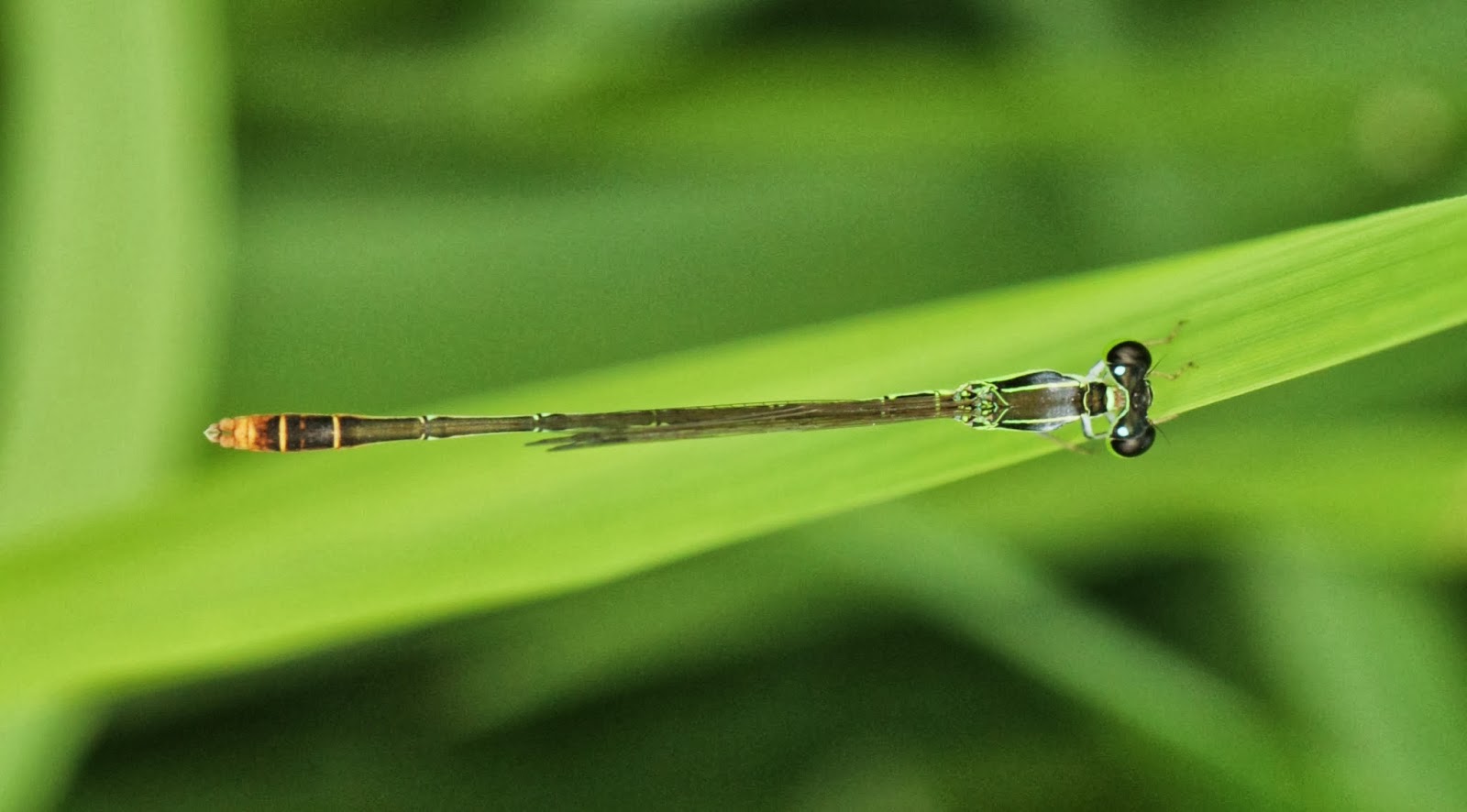
Back in 2011 I visited the Mekong Delta on a work related trip and saw some Agriocnemis specimens there that I identified as A. minima. Problem was I never saw them again. That trip was in the winter. Well, in November I was looking around in Cat Tien, where I had seen A. nana and A. pygmaea on the previous visit. Both were there at the beginning of the dry season. Another Agriocnemis, A. femina was also around, although I saw only a few. But one species was quite common near the fishponds. Yes, you guessed right. Agriocnemis minima. Clearly a dry season species, it had been completely absent in August but was common now. And not at all difficult to recognize either. Below a few pictures of this lovely tiny damsel. So, the fifth Agriocnemis is in the bag. The only one missing from Cat Tien is A. lacteola. Who knows, next time?

The male of Agriocnemis minima with distinctive green on black S2 and mottled orange S8-9. Note the yellow pterostigmata.
The adult female A. minima.
A young female A. minima. Note lack of black mid-dorsal stripe and unmarked prothorax.
Another young female 

Tuesday, 26 August 2014

A few more damsels from Cat Tien worth mentioning


During the first week of August I was the guest of Roy Bateman at the lodge there, helping with the dragonfly list for the reserve. A terrible time as far as the weather was concerned. I sadly lost one camera to the incessant rain and my lenses were foggy for a large part. Still, a few additional record shots…
Let's start with Pseudocopera ciliata. A common species, but the interesting thing is that as far as I know this species is monotypic. However, in northern Vietnam the apical half of the inferior appendages is white, like the remainder of the appendages, whereas in Cat Tien, and as far as I could verify from photos from Thailand also elsewhere in the south the apical half is black.

Close-up of the appendages


This little lady is a fresh female Onycharga atrocyana, photo taken in the rain, sorry.

And this little fella is Agriocnemis nana, a pretty whispy thing that I saw on several occasions, one at the pond in the lodge garden. Apparently a southern species

When I saw this immature Argiocnemis rubescens my heart skipped a beat. It is so different from the pruinose pale examples I saw in Bac Kan Province that it is hard to believe it is the same species, certainly if you also take a look at the mature version from Cat Tien.

For this is the very blue mature male. I saw many, and none should any trace of pruinosity. Like: really? The same species?

The immature male along a tarmac road in inundated grass

A mature male perched at the edge of a pool

Sunday, 6 October 2013

Agriocnemis pygmaea and Agriocnemis femina, a story of posterior lobes

October 5 we decided to go to Van Long once more, for both birds and odonata. It was a good day for Agriocnemis and I was lucky enough to find a field in the afternoon with many hundreds of both A. femina and A. pygmaea. Here a few of the photos. But before going into that, let's take a look at the prothorax, more specifically for posterior lobe, as it holds the key to the identification of the females. A. femina has a distinct posterior lobe, that can easily be seen in hand. The lobe of A. pygmaea is very much reduced in size and does not protude. Interestingly, in the males it is reversed. Both males have a distinct posterior lobe, bot that of A. pygmaea stands up almost vertically. This is not so important, as the caudal appendages are already such a clear clue.
The prothorax of A. femina has from the early stages darker markings that are another identification trait. For the males the shape and extent of the orange on the abdomen tip also helps, but this disappears with age. A. pygmaeae has on average thinner antehumeral stripes, but this is not always the case, and the blackish mark on the postgena (the back of the eyes) is generally vague in A. pygmaea and clear-cut in A. femina.

Standard adult Agriocnemis femina, male

A. femina, immature male

Another immature male

And yet another

Prothorax of A. femina, note flat posterior lobe


Prothorax of A. pygmaea, note upright posterior lobe

Agriocnemis pygmaea, male

Another male, note pattern on S8 and shape appendages

Female Agriocnemis femina, note dark markings on prothorax and clear posterior lobe

Dorsal view of prothorax of A. femina, female, with clear posterior lobe
Lateral view of prothorax of A. femina female, showing large posterior lobe

Dorsal view of A. pygmaea female prothorax, showing reduced posterior lobe


Similar in lateral view, showing almost not posterior lobe

Agriocnemis pygmaea, female, note posterior lobe

Another female

And another female

Copula of A. pygmaea. Apart from the appendages, visible, the lobe of the prothorax of the male is a give-away!

Saturday, 28 September 2013

Whispy things


If you look closely in grassy wet places, you cannot miss them, but if you do not look closely, you may well overlook them, the Whisps. Two species are especially common in Northern Vietnam (and in many other places): Agriocnemis pygmaea and A. femina. They also look a lot alike. A. pygmaea prefers grassy verges of streaming water, whereas A. femina is more commonly represented in wet, inundated grassland. But they can often be seen side by side. The best distinguishing feature are the long lower appendages of A. femina, and that species becomes whiter with pruinosity than A. pygmaea.

Very white Agriocnemis femina, male, showing long appendages

About as white as they get, Agriocnemis pygmaea, male, showing absence of long lower appendages

Another pruinose male A. femina

Less pruinose, but clearly long appendages, A. femina, male

Non-pruinose A. pygmaea, male
Non-pruinose A. femina, male

Female Agriocnemis femina
Same female in close-up, showing dark markings on prothorax


Wednesday, 25 September 2013

Agriocnemis lacteola

One striking little whisp is Agriocnemis lacteola. Like its brothers A. femina and A. pygmaea (both very common) it is not a rare species, although not as common as these other little whispy things. Talk about small! At least the almost pure white A. lacteola adult male catches the eye when it flies slowly from grass stalk to grass stalk on its search for even smaller prey. The females are much harder to recognize as they shade from all pinkish to greenish and look rather different from the males. I found it at Ba Be National Park (a few) and very commonly at Van Long Nature Reserve.

Agriocnemis lacteola, male

Another male

The greenish female

And the pinkish immature female