Showing posts with label Macromiidae. Show all posts

Friday, 25 November 2022

An updated list for my three visits to Phu Quoc in 2015 and 2016

During my stay in Vietnam I was able to visit Phu Quoc island, located off the coast of Cambodia to the west of the Vietnamese Mekong delta, several times. It has a very interesting Odonate fauna compared to the rest of Vietnam, with several rare species, not seen elsewhere in Vietnam. I visited the island from 28 December 2015 to 2 January 2016, again from April 12 and April 15, 2016 and finally from August 19 to 21, 2016. Some species are very local and also occur only in the dry or in the rainy season, so not everything can be seen in any one trip. I already published a list after my first trip. This list is updated here to include all records, to which I added the months in which species were recorded by me in Roman capitals. But first a few photos of good species not published here previously.
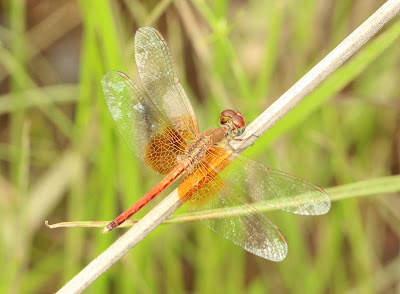
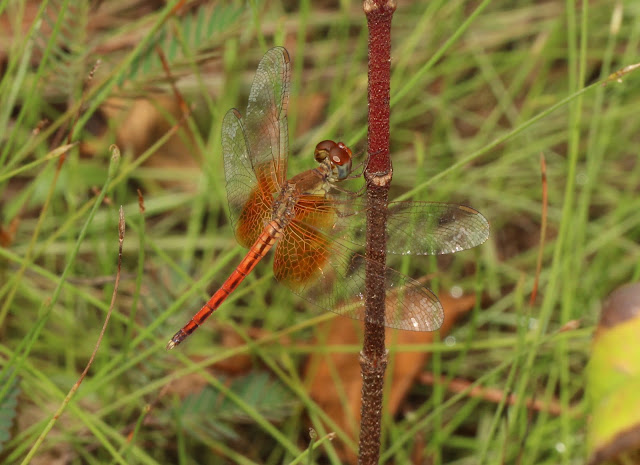
Neurothemis intermedia male, 19 August 2016 

A second Neurothemis intermedia male from August 19, 2016

A target species I had been looking for on all my trips, which had been recorded by Bui (2008). Apparently this rare species is a summer species on the island. I only saw a single female, Lyriothemis mortoni.

The fascinating Platylestes platystylus, also on the island of Phu Quoc., August 20, 2016


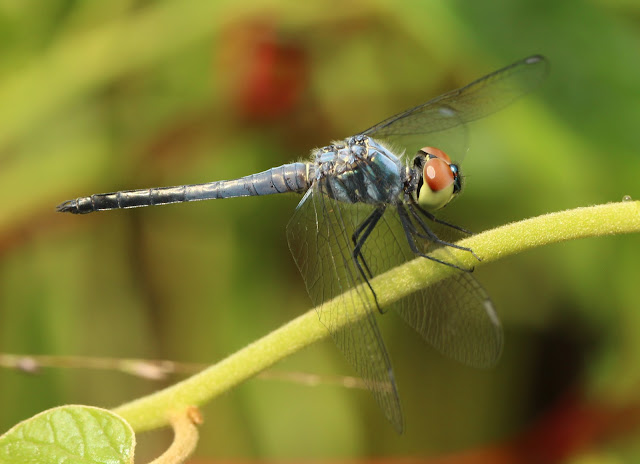
Immature male of Brachydiplax sobrina, August 20 

And nearby an immature female, much harder to find generally

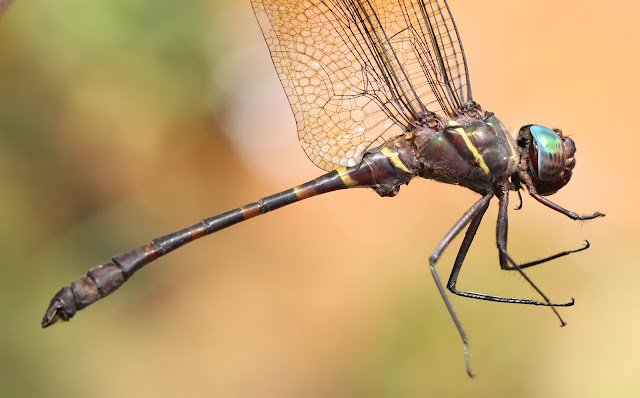
Monstrous Epophthalmia vittigera, a wonderful male, caught on August 21, 2016

A lovely Ceriagrion calamineum, previously recorded from the island, but misidentified as C. aurantiacum in Bui (2008). Finally found on 21 August 2016.

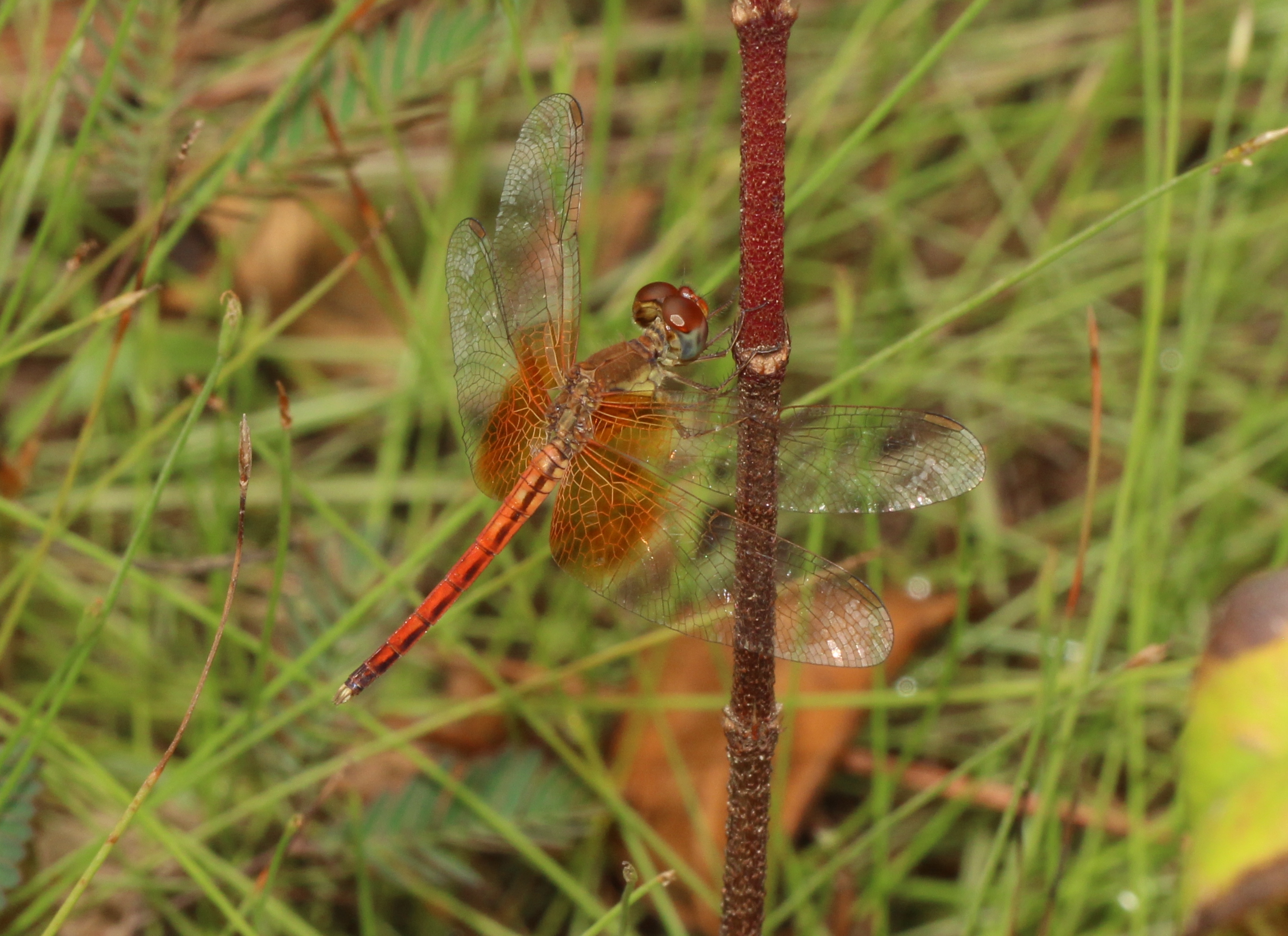
Agrionoptera insignis male over a dark pool, August 19, 2016. The only specimen I saw on my three visits.

The List:

Lestes praemorsus* VIII
Platylestes platystylus* VIII
Vestalis gracilis I, IV, VIII, XII
Libellago hyalina I, IV, VIII, XII
Heliocypha biforata I, IV, VIII, XII
Euphaea cyanopogon**** I, IV, VIII, XII
Rhinagrion viridatum XII, VIII
Podolestes coomansi***** IV
Aciagrion borneense I, XII
Agriocnemis minima* IV, VIII, XII
A. nana* IV, VIII, XII
A. pygmaea I, VIII, XII
Amphicnemis valentini**** VIII
Archibasis viola I, IV, VIII, XII
Ceriagrion calamineum** VIII
C. cerinorubellum IV, VIII, XII
C. malaisei* VIII
C. olivaceum* I, IV, XII
Ischnura senegalensis I, IV, XII
Mortonagrion falcatum*** I
Onychargia atrocyana IV, VIII
Paracercion calamorum* IV, VIII
Pseudagrion australasiae* IV, VIII, XII
P. microcephalum I, IV, XII
P. rubriceps IV, XII
P. pruinosum I
P. williamsoni I, IV, VIII, XII
Coeliccia kazukoae** I, IV
Coeliccia yamasakii IV
Pseudocopera ciliata* IV, VIII, XII
Copera vittata** I, IV, VIII, XII
Prodasineura verticalis** I, IV, VIII, XII
Anax guttatus I, VIII, XII
Gynacantha basiguttata* I, VIII
G. bayadera* I
G. subinterrupta* I
Heliaeschna crassa*** IV
Ictinigomphus decoratus meleanops I, IV, VIII
Paragomphus capricornis* XII
Epophthalmia frontalis* I
E. vittigera* VIII
Acisoma panorpoides IV, VIII, XII
Agrionoptera insignis* VIII
Brachydiplax chalybea* IV, VIII, XII
B. sobrina* IV, VIII
Brachygonia oculata IV, VIII
Brachythemis contaminata I, VIII, XII
Cratilla lineata IV
Crocothemis servilia I
Diplacodes nebulosa I, IV, VIII, XII
D. trivialis I, IV, XII
Hydrobasileus croceus I, VIII
Indothemis limbata*** I, VIII
Lathrecista asiatica I, IV, VIII
Lyriothemis mortoni VIII
Nannophya pygmaea IV, VIII, XII
Neurothemis fluctuans I, IV, VIII, XII
N. tullia IV, XII
N. fulvia IV, VIII, XII
N. intermedia* IV, VIII, XII
Orchithemis pulcherrima IV, VIII
Orthetrum sabina I, IV, VIII, XII
O. pruinosum* XII
O. chrysis I, IV, VIII, XII
Pantala flavescens I, VIII, XII
Potamarcha congener I, IV, VIII, XII
Pseudothemis jorina** I
Rhodothemis rufa* IV, VIII, XII
Rhyothemis aterrima* IV
R. obsolescens IV, VIII
R. phyllis I, IV, VIII, XII
R. variegata I, IV, XII
R. triangularis IV, VIII
Tetrathemis irregularis IV, XII
Tholymis tillarga I, IV, VIII, XII
Tramea transmarina euryale* I, VIII, XII
Trithemis festiva IV, XII
T. aurora I, IV, VIII, XII
T. pallidinervis I, IV, VIII
Urothemis signata I, IV, VIII
Zygonyx iris I, VIII
Zyxomma petiolatum* IV, VIII, XII

*       Refers to species first recorded on the island, although some are very common
**     Coeliccia kazukoae had already been found by Floris Brekelmans, but is not rare. Prodasineura verticalis had been recorded as Prodasineura sp. Copera vittata had been misidentified previously (as C. marginipes), but is a very common species. Pseudothemis jorina had been recorded but misidentified (presumably) as P. zonata. Ceriagrion calamineum had been misidentified as C. aurantiacum.
***   Refers to species recorded for the first time for Vietnam (as far as I know)
****  Refers to a species novum, but misidentified in previous surveys.
*****Recorded by Flores Brekelmans, not by me, but published on this blog

Saturday, 10 October 2015

A few hours in Vientiane, Laos and a new species for the Laotian list.

This Thursday I had a few hours to spare in Vientiane and took a cab to the outskirts of the town. Thank God the surroundings are not close to being as polluted as around Hanoi and I was able to find 38 species in a short time. Vientiane is about as far south as Ha Tinh in Vietnam, which is about the southern edge of my general research area (northern Vietnam). But its species are quite different, much more southern. There was a lot of overlap with the commoner species in Cat Tien National Park, for instance. I was happy to catch a Epophthalmia frontalis male. Yokoi & Souphanthong actually list 31 Macromiidae, 28 of them Macromia. Which is rather astounding. But anyway, I was happy with my frontalis. And I was able to take pictures of male Lestes elatus and female Ceriagrion cerinorubellum. I had seen both these species in Cat Tien, but had not seen these sexes. Below a few pictures. And another very common species in some inundated and apparently deserted rice fields was an Aciagrion. I had to go back to Ris (1911) and Fraser (1933) to find out what may be the differences between Aciagrion occidentale and A. borneese. The appendages look rather similar and the A. borneese I had from Da Nang had been eaten by vermin. But in the end the description of Fraser pointing out that S8 is blue with a black triangle on it in A. occidentale, whereas A. borneese has a broad dorsal black stripe over the whole segment, provided the clue. Photos from India confirm the pattern on A. occidentale, and I therefore conclude that the specimens I saw were A. borneese, on the premise that the pattern is consistent over the complete range of these species. Interestlingly Yokoi & Souphanthong do not list either of these species for Laos. A. borneese is a very common species in Thailand and that country is of course right opposite the river at Vientiane.

Let's start with the addition to the Laotian list, Aciagrion borneese. Note dorsally black S8 and S10, whereas S9 is marked by a thin blackish dorsal line.
Another male with the distinctive pattern

Female Ceriagrion cerinorubellum. Possible to confuse with C. auranticum because of the green eyes and orange-brown cranium. However, S3-7 are blackish above and blue-green laterally, not orange, and S9 misses the clear darker marking.

Lestes elatus female

And the male, which I had failed to find in Cat Tien.

And finally a fine male Epophthalmia frontalis


Sunday, 12 July 2015

Mature Rhinocypha chaoi and a female Macromia septima

July 12 I went to Mau Son in Lang Son Province, another long drive. And at Mau Son followed the grueling walk down to the stream in the valley, followed by the climb back up. It was warm and it was not pleasant. I also received several bee stings (thank you, bees).

But I found what I came for, Rhinocypha chaoi. One of the prettiest damsels I have seen (and I have seen many). In May I had an immature male, but really wanted to see the adult. In the end I saw 5 males and a female.

While searching for them I noticed a smallish Macromia that flew a few round over the stream and then went up into a tree, where it hung from a leaf. I could just catch it and I was thrilled to see it was M. urania. But then I noticed the face was reddish, and thus it was M. septima! Only the second time I see this species and the second female. The males must be out there!

Male Rhinocypha chaoi. This species is so beautiful, it is unreal.

In dorsal view the abdomen is particularly striking. When it flies about you see azure specks dance over the water surface.
The female up in a tree having a snack.
Female Macromia septima. Note the amber wing-patches and the antehumeral surrounded by red (see also below) 
Note the reddish lower half of the dorsal side of the thorax and the reddish face

Monday, 15 June 2015

Macromia number 9, M. katae

This January Natalia von Ellenrieder, Martin Hauser, Stephen Galmairi and Thai Pham published on article in Check List on field research carried out in Vietnam. Of course I carefully perused it and was astonished to read about a new record for Vietnam of Macromia katae not far from Hanoi. Both myself and Sebastien Delonglee set out to find it, but at my visit earlier this year it was probably far too early. But Sebastien was more successful towards the end of May or early June and finally I myself found time today to go to the location. It was mostly very cloudy, but I was lucky enough to almost immediately spot a Macromia cruising up and down and even more lucky to be able to net it for verification. Indeed, it was Macromia katae. Although sharing some characteristics with M. unca, like yellow antehumerals and an obvious spine on the dorsum of S10, it was immediately obvious from its largely blackish face that it was M. katae. Check of the hamule and genital lobe confirmed the ID. In Europe we are happy with one Macromia, in the US with a few, but Southeast Asia has an abundance. This is my ninth species for the north of Vietnam and they are all just simply fantastic.

M. katae is a rather rare species, virtue of the scarcity of its lowland habitat, as explained in the Check List article.

Macromia katae, a beautiful Macromia. Note the darkened wing bases.
The face is very dark, with small yellow markings on labrum, base of mandibles, and postclypeus.

The dorsal spine on S10 is very prominent

The epiproct is quite long, extending well beyond the superiors

Typical hamule and lobe. What I found striking is that the genital lobe is bicolored.


Tuesday, 23 December 2014

Epophthalmia frontalis - this is what makes me tick

On November 13 we were checking the fishponds in Cat Tien. A large Cruiser-type dragonfly was doing the rounds on one of the ponds. I was able to make a few vague inflight shots. Enough at home to see that it was one of the southern Epophthalmia types. But which one? Vittigera, vittata or frontalis? It was only a few days later that I could catch two males and on the 17th I caught also a female. Facial pattern and appendages quickly ruled out vittigera, but the literature on vitiate/frontalis is less straightforward. The yellow spot on cleft in front of the vertex is restricted to the cleft, says Fraser (1936), and separated into two round spots in frontalis. But Asahina (1969) does not make that distinction. His drawing of male frontalis has exactly the same spot as our specimens. It is not altogether clear whether these two species are truly different, rather then geographical variants. If so, E. vittata is the senior synonym. But appendages of male, lamina of female, facial pattern all fit perfectly with E. frontalis, so for the time being I settle on that species. James Holden had reached the same conclusion already before, when he had seen the species in the summer. Although it had been absent in August, it was quite common now, with several males on the same ponds.

First few record shots. Note the reddish-brown abdominal tip.
Another record shot of the same individual
One a two males caught. In E. vittigera the superior appendages have quite a different shape. This is the male of E. frontalis.
Another male of E. frontalis.
The male face with large yellow spot in the cleft, yellow spots on either side of the frons , cream-white undulating line over the postclypeus and cream spots on the bases of the mandibles and on the labrum.
The face of the female is somewhat different, in that all marks are in yellow and there are only two spots on the postclypeus.
The fantastic female, note the dark wing bases.

Distintive brown appendages, superiors shorter than epiproct.

And in dorsal view, appendages slender and relatively straight.


Saturday, 6 December 2014

Two interesting discoveries at Xuan Son


On November 29, while looking for Aeshnids in Xuan Son, I ran into a few additional goodies. Not only was a male Merogomphus paviei still around, I was also very surprised to see several Macromia flying about over a sunny stream. Upon capture these were Macromia malleifera, which was amazing, given the fact that I had visited Xuan Son quite a few times since the last record . That was on July 4. Maybe these were a new generation?

The other record of note was a female Trithemis festiva. Now, T. festiva is a very common species, no doubt about that. But I had only had very few previous glimpses of females, irrespective of males being easily found. And I never had the chance to catch one or take pictures. So it was noteworthy to catch one finally. She was ovipositing and after I took some shots I released her to resume her business.

Magnificent Macromia malleifera, a late season flyer too.
The typical pale-yellow postclypeus of M. malleifera.

And this is her, the elusive female of Trithemis festiva


Thursday, 9 October 2014

Leftovers from Pia Oac

A bit of a misnomer, leftovers, for these wonderful species that I also took pictures of on October 4.

This is Ischnura carpentieri in copula, the male easy to recognize (as member of rufostigma group at least), the female notoriously difficult. A common species in the mountains.

Sympetrum hypomelas does not only occur in Sapa, but also in the lower mountains of northern Vietnam, like here at Pia Oac at approximately 1000m.

This is a male Macromia moorei, still surprisingly common this time of the year at Pia Oac. Note the almost complete band on S2

The same male in dorsal view and under flash

And in hand, showing the obvious lobe that distinguishes it from M. pinrantani vietnamica

Thursday, 10 July 2014

Macromia - a truly wonderful genus

Over the last three weeks I have been roaming around northern Vietnam. It was truly productive, but how to put all that information in postings? For instance, how about the 37 gomphidia species? Or the bundle of Chlorogomphids (even if the season is as good as over for those beautiful fellows).  Or Macromia, for that matter? Karube (2011) mentions 6 species of Macromia (M. pinratani vietnamica, M. moorei, M. septima, M. urania, M. clio and M. cupricincta). As a matter of fact, over these 3 weeks I saw all of these and two more (M. unca and M. malleifera). There are still more species in Vietnam and it is important to have a close look at any that fly past.

Last year I only saw M. pinratani vietnamica and to my shame I have to admit that I came to recognize a reddish face as the telltale sign of that species. Beware! This is not correct. It is absolutely necessary to check a set of characteristics, but most importantly the shape of the hamulus and genital lobe. The presence or absence of facial markings, general coloration and shape of appendages form a set of characters that will in identification.

For the first time I saw a male of Macromia unca. It was hunting several meters high over the edge of a stream in the late afternoon, but well before females normally appear. Although this species was only recently described by Keith Wilson and only found this spring for the first time in Vietnam by Sebastien, it is fair to say this is a very common species in the hills of northern Vietnam. After having found it in Xuan Son NP, I also encountered it low in Tam Dao NP, and at various locations in Bac Kan Province, Ha Giang Province and Cao Bang Province. Invariably it appears in the last moments before dusk, to oviposit in streams while flying hurriedly in erratic flight over the surface.

Female Macromia unca, with generally brownish wings and characteristic markings in yellow on S2-3, long antehumeral stripe, smoked yellow labium and yellow sides to the the antefrons paired with the yellow postclypeus.

This is the male of Macromia unca. It shares the characteristics of the female, but has hyaline wings. In addition is has superior appendages well short of the epiproct and a hamulus that forms an impressive hook.
Of the reddish faced types, after M. pinrantani vietnamica, which has a very small genital lobe and is common, even very common, in Tam Dao for instance, M. moorei is the commonest. It has a much larger genital lobe, a hooked hamulus falling short of the lobe, and generally more yellow on S2, although this is variable. Its patterning is otherwise rather similar to M. pinrantani vietnamica. This was the common species of Pia Oac Nature Reserve.

Female Macromia moorei, showing reddish face and large yellow ring on S2.

Male of M. moorei, showing the large posterior oriented genital lobe. Note also the dorsum of S10, without a clear spike. In this specimen the ring on S2 is interrupted, like in pinratani.

Another male M. moorei, with a complete yellow ring on S2 and similarly the impressive genital lobe.
The second "other" red-faced Macromia we encountered was the much smaller M. septima. I am looking forward to seeing the male. For now we had to content ourselves with the female, which we found on both 24 and 25 June close to the T-junction of QL279 and TL212 in northern Bac Kan Province on a shallow stream.

This reddish faced small species, with amber wing bases, has a reddish dorsum to the thorax with yellow antehumeral stripes just surpassing the middle 
The other smaller species, of which I had already encounted in Tam Dao National Park, but for which until now I had not seen the male, is Macromia urania. This species has a blackish face with a smudgy yellow postclypeus. It has an English name, club-tailed skimmer, because of the expanded posterior segments, but this is in fact not that obvious. We encountered the female also close to the QL279 and TL212 junction in Bac Kan Province. The male was at km 58 of the TL257, south of Bang Lung.

This is a truly magnificent smaller species. The appendages are extraordinary compared to all other males displayed here, rounded and flat, whereas the hamule has a wavy outline, a character shared with a few closely related species (like septima).
Another brightly colored and large species that already featured in these pages is Macromia clio. Here both male and female. This is apparently a species that prefers a variety of habitats, from larger streams to brooks. We found it the male on the same stream that also produced the male M. urania, M. cupricincta and M. unca, along the TL257 in Bac Kan Province. Females were near the aforementioned junction.

Like the female the male of Macromia clio has a bright yellow band across the postclypeus and the blackish center of the labium bordered by a large yellow fringe. 
The female is a fine brightly colored insect, sharing the aforementioned characteristics of the male, but also with a heavily marked abdomen.
We are reaching the end of this parade of Macromia species. M. malleifera already featured in these pages and I still have only seen it in Xuan Son. But the last addition to the Macromia list was another red-faced species: Macromia cupricincta. I expected it to be much brighter reddish-brown, as its name suggests and as its depiction on Karube (2011) shows. Apparently it is not always that bright.

The male of Macromia cupricincta. In fact you can see the brownish color without yellow markings of S8-10, but it is very dark. One could overlook this, also because of the reddish face, as M. pinratani. But note the extreme curve of the wing at the anal triangle, indicative of this species, and the spike on the dorsum of S10.