Showing posts with label Coenagrionidae. Show all posts

Friday, 25 November 2022

An updated list for my three visits to Phu Quoc in 2015 and 2016

During my stay in Vietnam I was able to visit Phu Quoc island, located off the coast of Cambodia to the west of the Vietnamese Mekong delta, several times. It has a very interesting Odonate fauna compared to the rest of Vietnam, with several rare species, not seen elsewhere in Vietnam. I visited the island from 28 December 2015 to 2 January 2016, again from April 12 and April 15, 2016 and finally from August 19 to 21, 2016. Some species are very local and also occur only in the dry or in the rainy season, so not everything can be seen in any one trip. I already published a list after my first trip. This list is updated here to include all records, to which I added the months in which species were recorded by me in Roman capitals. But first a few photos of good species not published here previously.
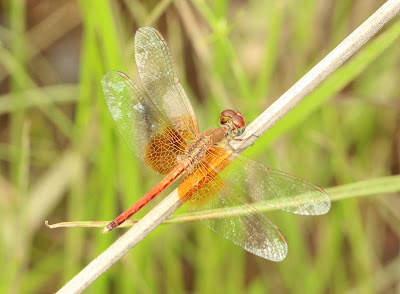
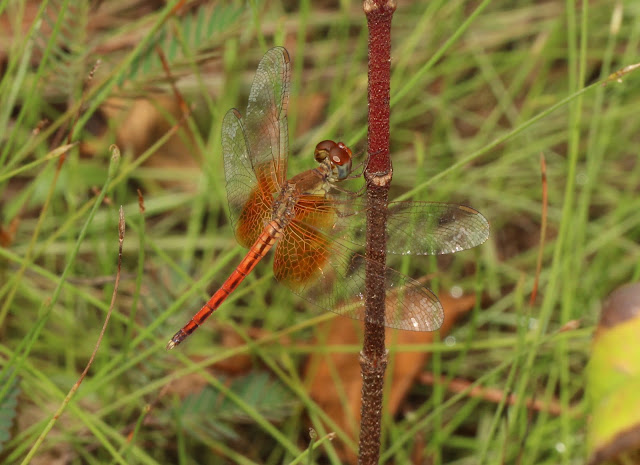
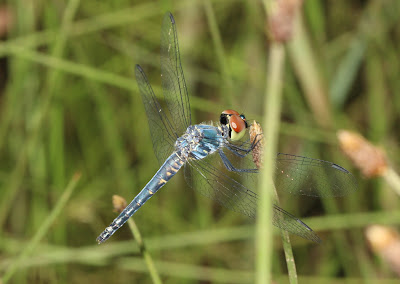
Neurothemis intermedia male, 19 August 2016 

A second Neurothemis intermedia male from August 19, 2016

A target species I had been looking for on all my trips, which had been recorded by Bui (2008). Apparently this rare species is a summer species on the island. I only saw a single female, Lyriothemis mortoni.

The fascinating Platylestes platystylus, also on the island of Phu Quoc., August 20, 2016


Immature male of Brachydiplax sobrina, August 20 

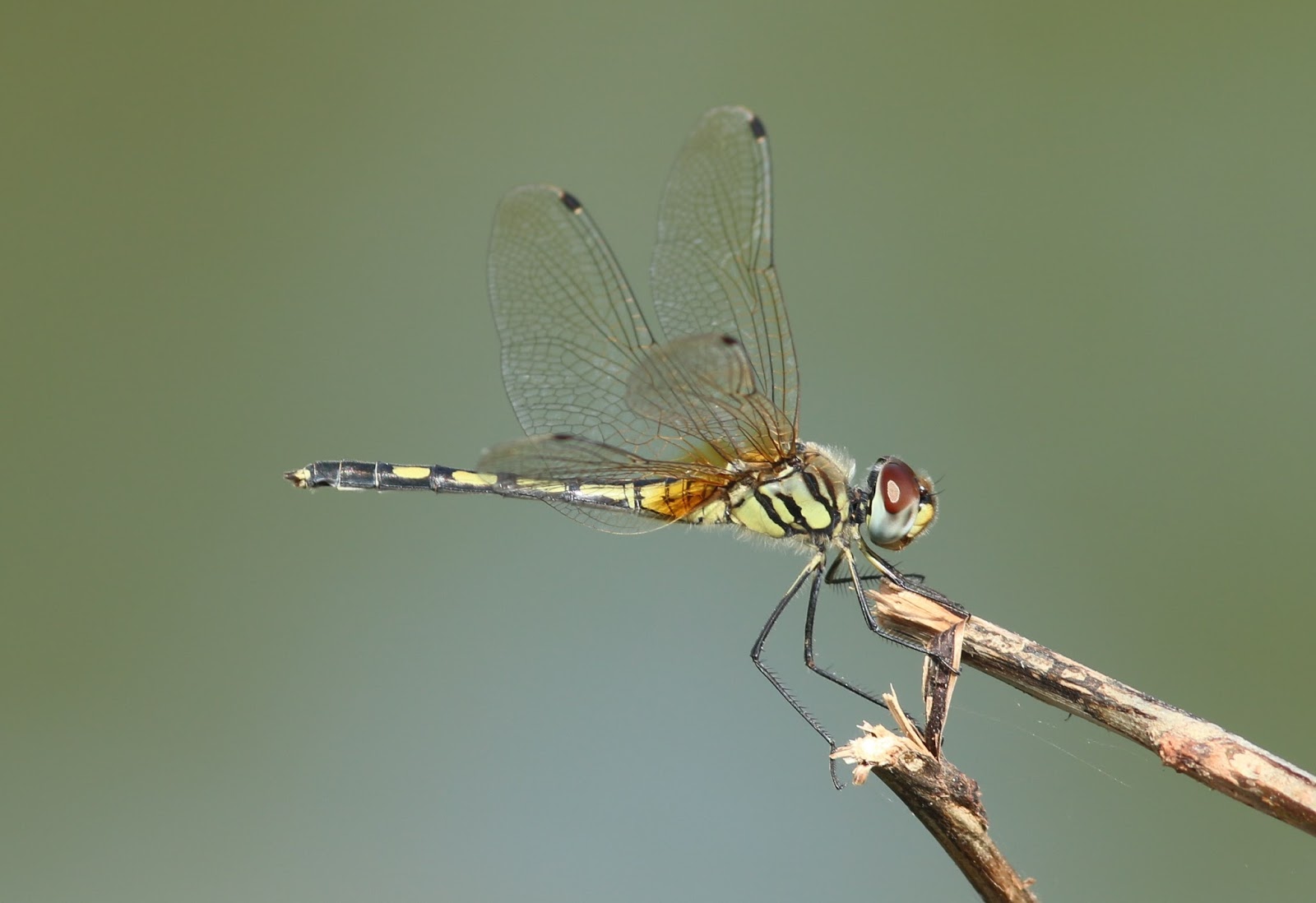
And nearby an immature female, much harder to find generally

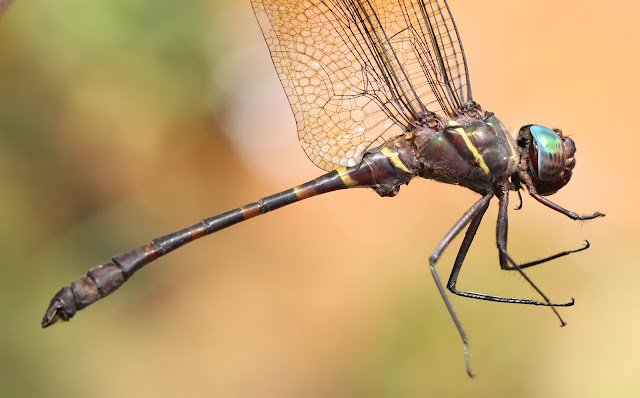
Monstrous Epophthalmia vittigera, a wonderful male, caught on August 21, 2016

A lovely Ceriagrion calamineum, previously recorded from the island, but misidentified as C. aurantiacum in Bui (2008). Finally found on 21 August 2016.

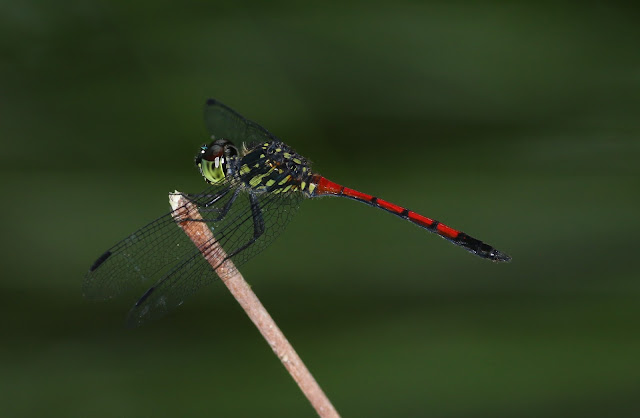
Agrionoptera insignis male over a dark pool, August 19, 2016. The only specimen I saw on my three visits.

The List:

Lestes praemorsus* VIII
Platylestes platystylus* VIII
Vestalis gracilis I, IV, VIII, XII
Libellago hyalina I, IV, VIII, XII
Heliocypha biforata I, IV, VIII, XII
Euphaea cyanopogon**** I, IV, VIII, XII
Rhinagrion viridatum XII, VIII
Podolestes coomansi***** IV
Aciagrion borneense I, XII
Agriocnemis minima* IV, VIII, XII
A. nana* IV, VIII, XII
A. pygmaea I, VIII, XII
Amphicnemis valentini**** VIII
Archibasis viola I, IV, VIII, XII
Ceriagrion calamineum** VIII
C. cerinorubellum IV, VIII, XII
C. malaisei* VIII
C. olivaceum* I, IV, XII
Ischnura senegalensis I, IV, XII
Mortonagrion falcatum*** I
Onychargia atrocyana IV, VIII
Paracercion calamorum* IV, VIII
Pseudagrion australasiae* IV, VIII, XII
P. microcephalum I, IV, XII
P. rubriceps IV, XII
P. pruinosum I
P. williamsoni I, IV, VIII, XII
Coeliccia kazukoae** I, IV
Coeliccia yamasakii IV
Pseudocopera ciliata* IV, VIII, XII
Copera vittata** I, IV, VIII, XII
Prodasineura verticalis** I, IV, VIII, XII
Anax guttatus I, VIII, XII
Gynacantha basiguttata* I, VIII
G. bayadera* I
G. subinterrupta* I
Heliaeschna crassa*** IV
Ictinigomphus decoratus meleanops I, IV, VIII
Paragomphus capricornis* XII
Epophthalmia frontalis* I
E. vittigera* VIII
Acisoma panorpoides IV, VIII, XII
Agrionoptera insignis* VIII
Brachydiplax chalybea* IV, VIII, XII
B. sobrina* IV, VIII
Brachygonia oculata IV, VIII
Brachythemis contaminata I, VIII, XII
Cratilla lineata IV
Crocothemis servilia I
Diplacodes nebulosa I, IV, VIII, XII
D. trivialis I, IV, XII
Hydrobasileus croceus I, VIII
Indothemis limbata*** I, VIII
Lathrecista asiatica I, IV, VIII
Lyriothemis mortoni VIII
Nannophya pygmaea IV, VIII, XII
Neurothemis fluctuans I, IV, VIII, XII
N. tullia IV, XII
N. fulvia IV, VIII, XII
N. intermedia* IV, VIII, XII
Orchithemis pulcherrima IV, VIII
Orthetrum sabina I, IV, VIII, XII
O. pruinosum* XII
O. chrysis I, IV, VIII, XII
Pantala flavescens I, VIII, XII
Potamarcha congener I, IV, VIII, XII
Pseudothemis jorina** I
Rhodothemis rufa* IV, VIII, XII
Rhyothemis aterrima* IV
R. obsolescens IV, VIII
R. phyllis I, IV, VIII, XII
R. variegata I, IV, XII
R. triangularis IV, VIII
Tetrathemis irregularis IV, XII
Tholymis tillarga I, IV, VIII, XII
Tramea transmarina euryale* I, VIII, XII
Trithemis festiva IV, XII
T. aurora I, IV, VIII, XII
T. pallidinervis I, IV, VIII
Urothemis signata I, IV, VIII
Zygonyx iris I, VIII
Zyxomma petiolatum* IV, VIII, XII

*       Refers to species first recorded on the island, although some are very common
**     Coeliccia kazukoae had already been found by Floris Brekelmans, but is not rare. Prodasineura verticalis had been recorded as Prodasineura sp. Copera vittata had been misidentified previously (as C. marginipes), but is a very common species. Pseudothemis jorina had been recorded but misidentified (presumably) as P. zonata. Ceriagrion calamineum had been misidentified as C. aurantiacum.
***   Refers to species recorded for the first time for Vietnam (as far as I know)
****  Refers to a species novum, but misidentified in previous surveys.
*****Recorded by Flores Brekelmans, not by me, but published on this blog

Saturday, 15 April 2017

Amphicnemis valentini - little critters on Phu Quoc*

* Updated January 1, 2020 as a result of the publication of a paper in Zootaxa by Kosterin & Kompier (2018) on Amphicnemis valentini.

Last year August I went to Phu Quoc Island to find a few species I had not yet seen there, but that had been recorded from the island. One of these was Amphicnemis gracilis, which had been recorded by Do et al. (2011). It turned out to be really localized. It frequents swampy forest with lots of ferns. It was not at all easy going, but once I knew how to find them, I saw plenty. They are inconspicuous, sometimes hanging from tips of leaves, but also sitting on twigs and other stuff on the muddy ground. The immature females are pretty, with their red thorax. When maturing they become bluish green. The males are shiny metallic green, with intricate white and very vulnerable appendages. All males had a recurved spike on the prothorax that had not been described for this species, but the caudal appendages are in line with what you would expect of A. gracilis. However, after Oleg Kosterin found the species in nearby Cambodia, displaying the same peculiar spike, it was published in Zootaxa as a new taxon: Amphicnemis valentini. This is the only place in Vietnam where it is known to occur.

A male Amphicnemis valentini. They hang out in the dark, so it is all flash work.

Another male
And yet another
These fleshy things are the caudal appendages
And here you can see the recurved spike from the posterior lobe of the prothorax
The really pretty immature female

And this is what she looks like all grown-up and ready for action. You might think it is a different species, but no.


Sunday, 2 April 2017

April 2 - Huu Lien and first gomphids

April 2 was a nice spring day to look for the first gomphids of the season in Huu Lien Nature Reserve. As always, the first impression was of clearance progressing, but like last year end of March, Trigomphus kompieri was about at various locations. The first I bumped into was a female, but like last year, I could not catch it and did not get a picture! Trigomphus is genus of early gomphids. Paragomphus may actually be year round, although rare in the winter, I think they may be around. Anyway, there was a male about too, interacting with the Trigomphus. I also saw quite a few Paracercion melanotum and fully mature Gynacantha subinterrupta. Below a few photos.

The first male Trigomphus kompieri of the day, a little difficult to get a clear shot.
And the third. Somewhat easier. The second eluded the camera.

Paragomphus capricornis against a muddy stream background.

Paracercion melanotum male

And Gynacantha subinterrupta showing well

Tuesday, 28 February 2017

Just around the corner - Lao PDR

On February 21 I had to go to Luang Prabang in Lao PDR for a meeting. In between reading papers for the meeting I popped into the woods close to the hotel. It was smack in the dry season, but I managed to find two species that I had not seen before, not in Vietnam and not anywhere else. The first was pretty Coeliccia dydima. This species might be confused with the similar C. cyanomelas. C. dydima is a common species in Thailand and Lao PDR, but has not been found yet in Vietnam. And maybe that is because it does not occur there. But I will keep on looking. It was nice to get some experience with it in neighboring Lao. I saw at least 10.
The other species was Aciagrion pallidum. This species  has been reported also from Vietnam, although I have not been able to find it yet, so likely it is localized and/or rare in there. It appears to be a dry season species, when it hides in dry forest and waits for the rains. The rufous abdomen is a good character. I saw only the one male.
Lastly, I also saw few Coeliccia poungyi poungyi, always a nice species to bump into. Here are a few record shots.

Here is the male of Coeliccia dydima. Note the limited extent of the blue on the abdomen tip and the large anterior dorsal markings on the thorax (in comparison to C. cyanomelas)

Here is the female. The pattern on S9 is a good feature.

And an immature male (note the color of the eyes). It is very yellow, not blue, and the dorsal markings on the form a pair of somewhat immature C. onoi like spots, not yet separated into two sets of two (meaning 4 separated spots in total). 

How about this? Beautiful, but inconspicuous, male Aciagrion pallidum.

Finally, Coeliccia poungyi poungyi, a female. Note the solid yellow abdomen tip.

And the exquisite male!

Sunday, 5 February 2017

Okay, one more: Onychargia priydak

Now that I am at it, let's add this one species also to the blog: Onychargia priydak. This is another species that had just been described by Oleg Kosterin in 2015 from Cambodia. It is similar to Onychargia atrocyana, and the females are indistinguishable, but its caudal appendages are somewhat different. A big difference however is that the males develop beautiful whitish pruinosity. That at least makes them easy to recognize! I was able to get a quick photo before the male disappeared. During subsequent searches I found many immatures and females, but none as nice as this specimen.

Again, this species was found close to Bao Loc. A new species for Vietnam, but not unexpected, given the proximity to the Cambodian border.

Beautiful male Onychargia priydak, with pruinose prothorax, synthorax, femora and S1-2.

Saturday, 23 July 2016

Aciagrion - some additional species*

*Adjusted after email conversation with Oleg. A. pallidum changed into A. hisopa.

Aciagrion is quite a speciose and difficult genus, not in the least because many of its members are tiny and thus vulnerable. Thank God that Kosterin et al. (2014) at least sorted the problem of Aciagrion approximans. I had already recorded this species from Cat Tien National Park (a teneral male), but could only ID it properly after the mess surrounding A. tillyardi had been resolved. And I recorded A. borneense and A. migratum already. But there are other species in the area and there were historical records of A. hisopa, A. occidentale, and A. pallidum (Do & Dang).

This spring turned out to be quite productive. Aciagrion approximans turns out to be in fact quite common in Lam Dong Province, where I saw large numbers, but I also recorded it from Quang Tri and Thua Thien - Hue Provinces. It stands out with its typical purplish violet color and in hand has deeply cleft superior appendages in lateral view, but with the dorsal and ventral edges parallel.

On June 11, 12 and 18 I observed Aciagrion hisopa at the same locations as where I recorded Platylestes platystylus (see previous post). All observed specimens were blue and the females did not have reddish abdomens, like A. pallidum would. A. pallidum and A. hisopa have very similar appendages and blue specimens can be confusing. In both species  the lines on the thorax can be diffuse, although they only become truly black in A. hisopa.

On June 18, again at the same site in Dak Lak Province, I noticed another small species with triangular black mark on the dorsum of S8. Otherwise it was similar to A. borneense, which also occurred there, but I thought it might be A. occidentale. The appendages in lateral and dorsal view are virtually identical, but there is one important additional clue and that is that the internal surface of the superior appendages and the complete inferiors are ivory white in A. borneense.

The last species to mention is a blue-and-black species from Thua Thien - Hue Province. I discussed these specimens with Oleg Kosterin and we concluded that it cannot be separated from A. migratum on the basis of its appendages, even if it has a different hue. More research would be necessary to separate it (for instance through DNA analysis), but for now it seems better to treat it as a variant of A. migratum.

Aciagrion occidentale male, note the triangular mark on S8.
Probably the same male in flight
Aciagrion occidentale, female
Male Aciagrion hisopa, June 12, Lam Dong Province. Note the lack of black on the thorax
Female Aciagrion hisopa, June 18, Dak Lak Province

Another male, June 18, Dak Lak Province
A typical Aciagrion approximans, a study in violet, May 2016, Lam Dong Province
And finally Aciagrion migratum, Thua Thien - Hue Province, June 21. If you look carefully you can see the deeply incised superior appendages, but unlike in A. approximans the dorsal and ventral edges diverge.

Thursday, 11 February 2016

Two cool species from Cat Tien

Last weekend I visited Cat Tien National Park to spend a few days with James looking for some of his recent discoveries. One of these was a fine female of Zyxomma obtusum. This is a widespread species, occurring from the Indonesian archipelago to the south of Japan, but it was unclear to me how often it has been recorded in Vietnam. I had never seen it, although I keep an eye open for it at dusk all the time, and I know of no other records. Cuong does not mention it in his overview of Vietnamese records. So it was an exciting find when James ran into it; a find that sadly we could not duplicate. But when checking some of his photos we made another discovery. A Ceriagrion he had taken a picture of last July was C. indochinense! This is a species recorded as widespread from Thailand and also from Vietnam, although I have never seen it, so it is maybe not that common. But last July at a grassy swamp there had been many. We went to check the place, but clearly it is not around in February anymore. I am happy to show both species here and look forward to seeing them myself sometime.

A fine male of Ceriagrion indochinense. This species shares a citrine-yellow abdomen and bright green thorax with yellow face with C. fallax, but it has no black at the abdominal tip. Photo courtesy of James Holden.

The female of Zyxomma obtusum. The males are whitish and ghostlike when patrolling as dusk, but the females are less obvious. However, note the dark wing bases and banded abdomen.

Wednesday, 6 January 2016

Mortonagrion falcatum - an addition to the Vietnamese list

On January 2 I revisited the area around Lake Duong Dong, located centrally on Phu Quoc. The previous day had been quite productive and I was hoping to find a few more additional species for the holiday list. We had found a trail into the forest that after a bit of a hike crossed a stream and it was there that I noticed perched at the tip of a small stick over dead leaves just above the ground by the side of the stream a tiny damsel. Because of its drab basic coloration I thought it was a female and also it did not have obvious appendages in dorsal view. But just as I was getting ready to take better shots my foot slipped a bit and it darted off. Because it was both drab and tiny I immediately lost it. I searched for a long time for additional specimens, but could not find any. Disillusioned, I continued the hike for a while, but on the way back revisited the place and again searched high and low, to no avail. Before leaving even more disillusioned I rechecked the place of the original sighting and there it was! Tiny and inconspicuous, back at its stick. I crawled down next to it and took some photos. But when I wanted to pounce on it, it again darted off into another dimension. The thing was: when I checked the photos (in the middle of shooting) it was a male! I did my best to get as good a close-up of the appendages and this saved the day.

I knew I had seen something like it on some website somewhere and just started leafing through Coenagrionidae. Yes, of course, Mortonagrion! But the first logical suspect, with a sort of similar abdominal pattern, M. arthuri, has rather different appendages. But eventually I found it in Lieftinck (1934): Mortonagrion falcatum. Recognizable by its strange, quite distinctive, appendages. Records are scarce, but it is a widely distributed species, occurring in Indonesia, Singapore, Malaysia, Myanmar, Thailand and with a record from Lao PDR. On the IUCN Red List it is hypothesized that it occurs in Cambodia and Vietnam. Well, it does (in Vietnam, but given the location of Phu Quoc it is highly likely it also occurs in Cambodia. See the pictures below of this interesting midget.

Not a very conspicuous little insect at all, when it perches over brown leaves, but actually rather pretty: Mortonagrion falcatum

The distinctive appendages, the superiors broad and up slanting.


Sunday, 22 November 2015

The male of Gynacantha basiguttata and a male G. japonica thrown in

November 21 I went to Huu Lien to look for the enigma Planaeschna cf. guentherpetersi again, but did not see it. I did catch an Aeshnid that passed overhead in the forest and was very happy to find it was a splendid male Gynacantha basiguttata. I had caught the female a few weeks back too. Apparently it is not that rare inside the forest. The other cool thing I saw was a communal roost of Cratilla lineata. I had seen that in Potamarcha congener, but this was new knowledge to me. At least 15 bundled together on a hanging twig.

On November 22 I went to Xuan Son and looked for the small pale-faced Planaeschna there. I did see one female, but failed to catch it. It was mostly an uneventful day, but I saw a few Gynacantha japonica and was able to take some pictures. Another unexpected species was Trithemis pallidinervis at the river crossing, which I had not seen this far north. And a fine male Ceriagrion chaoi was another nice one. Not at all that common, although regular at Xuan Son.

Very fine male Gynacantha basiguttata, note the dark wingbases.

Scan of the same male. Note the long and slender epiproct and the wingbases.

Pretty male Ceriagrion chaoi

Gynacantha japonica, note the pale epiproct.

And a surprise female Trithemis pallidinervis

Saturday, 10 October 2015

A few hours in Vientiane, Laos and a new species for the Laotian list.

This Thursday I had a few hours to spare in Vientiane and took a cab to the outskirts of the town. Thank God the surroundings are not close to being as polluted as around Hanoi and I was able to find 38 species in a short time. Vientiane is about as far south as Ha Tinh in Vietnam, which is about the southern edge of my general research area (northern Vietnam). But its species are quite different, much more southern. There was a lot of overlap with the commoner species in Cat Tien National Park, for instance. I was happy to catch a Epophthalmia frontalis male. Yokoi & Souphanthong actually list 31 Macromiidae, 28 of them Macromia. Which is rather astounding. But anyway, I was happy with my frontalis. And I was able to take pictures of male Lestes elatus and female Ceriagrion cerinorubellum. I had seen both these species in Cat Tien, but had not seen these sexes. Below a few pictures. And another very common species in some inundated and apparently deserted rice fields was an Aciagrion. I had to go back to Ris (1911) and Fraser (1933) to find out what may be the differences between Aciagrion occidentale and A. borneese. The appendages look rather similar and the A. borneese I had from Da Nang had been eaten by vermin. But in the end the description of Fraser pointing out that S8 is blue with a black triangle on it in A. occidentale, whereas A. borneese has a broad dorsal black stripe over the whole segment, provided the clue. Photos from India confirm the pattern on A. occidentale, and I therefore conclude that the specimens I saw were A. borneese, on the premise that the pattern is consistent over the complete range of these species. Interestlingly Yokoi & Souphanthong do not list either of these species for Laos. A. borneese is a very common species in Thailand and that country is of course right opposite the river at Vientiane.

Let's start with the addition to the Laotian list, Aciagrion borneese. Note dorsally black S8 and S10, whereas S9 is marked by a thin blackish dorsal line.
Another male with the distinctive pattern

Female Ceriagrion cerinorubellum. Possible to confuse with C. auranticum because of the green eyes and orange-brown cranium. However, S3-7 are blackish above and blue-green laterally, not orange, and S9 misses the clear darker marking.

Lestes elatus female

And the male, which I had failed to find in Cat Tien.

And finally a fine male Epophthalmia frontalis