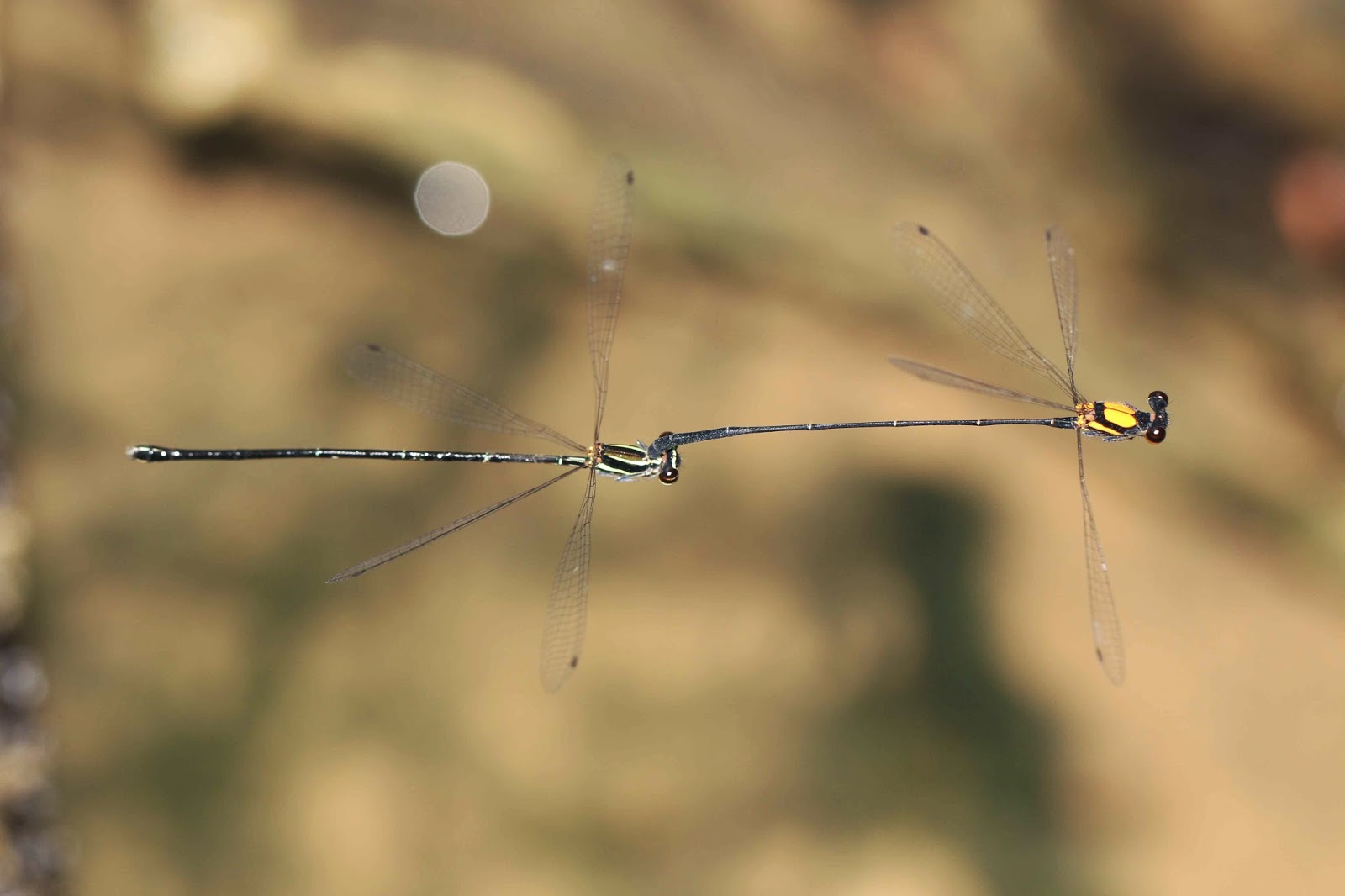
Showing posts with label Paracercion. Show all posts

Sunday, 2 April 2017

April 2 - Huu Lien and first gomphids

April 2 was a nice spring day to look for the first gomphids of the season in Huu Lien Nature Reserve. As always, the first impression was of clearance progressing, but like last year end of March, Trigomphus kompieri was about at various locations. The first I bumped into was a female, but like last year, I could not catch it and did not get a picture! Trigomphus is genus of early gomphids. Paragomphus may actually be year round, although rare in the winter, I think they may be around. Anyway, there was a male about too, interacting with the Trigomphus. I also saw quite a few Paracercion melanotum and fully mature Gynacantha subinterrupta. Below a few photos.

The first male Trigomphus kompieri of the day, a little difficult to get a clear shot.
And the third. Somewhat easier. The second eluded the camera.

Paragomphus capricornis against a muddy stream background.

Paracercion melanotum male

And Gynacantha subinterrupta showing well

Sunday, 22 March 2015

First visit to Huu Lien in 2015 - Trigomphus* **

*This entry was adjusted slightly after publication of the description of Trigomphus kompieri Karube, 2015
**And again after publication of Paracercion ambiguum Kompier & Yu, 2016

Sunday March 22 was supposed to become a sunny day. Sadly, the weather forecast is not very reliable in Vietnam, but after a very cloudy morning I did have some weak sunshine in the afternoon, just enough for things to become a little more active. Last year in April I had found a new species of Trigomphus in Huu Lien, but by then it was already scarce, as Trigomphus is an early genus (season-wise). I wanted to take some better photos of it, so for the first real dragonfly trip in northern Vietnam of the season I headed for Huu Lien. In the morning I saw two males and a female, but they did not linger. When the sun came out in the afternoon they showed better, but sadly no female anymore. This Trigomphus species is the most southerly (apparently) of the genus and with the broad dark line of the flanks quite exceptional. A lovely gomphid. It has recently been described by Haruki Karube as T. kompieri.

I was able to see 31 species over the day, not bad, given that the weather was not good and it is only March. Highlights included 5 freshly emerged Asiagomphus, likely A. auricolor, 3 Epophthalmia elegans, Anax guttatus, and Paracercion ambiguum.

Beautiful Trigomphus kompieri, male
Another male perched by the side of the stream
Same male as in the previous photo, perched this time on a snag 
A common species, but handsome, Trithemis aurora, female
Copula of Pseudagrion microcephalum, one of three Pseudagrion species observed today
Already subject of the blog on many occasions, yet another photo of the pretty Paracercion ambiguum.
One of five freshly emerged Asiagomphus, likely auricolor.


Monday, 27 October 2014

Huu Lien - still a treasure trove*

*Updated after publication of Paracercion ambiguum

On October 19 I was all day at Huu Lien and as we know I ran into beautiful Coeliccia galbina. Thus it was a memorable day. Most other goodies were there too. On the gomphid front Labrogomhus torvus was still flying. Not surprising, as we saw it into December last year. Ceriagrion nipponicum, Vestalaria miao, Atrocalopteryx atrocyana and A. auco (the newly described endemic), Paracercion ambiguum, Prodasineura croconota, Gynacantha japonica and many more. Here are a few additional photos.

Price for rarity is likely deserved by Atrocalopteryx auco. Although its brother A. atrocyana is common all over Huu Lien, I saw only a single male of this species.

But what I did not expect was a great many Prodasineura croconota still flying. Last year I had not seen them and only discovered them in spring this year. But apparently I just overlooked them last autumn. Quite a few tandems were active. This is of course a female.

And this a tandem, with the exquisite male easily identified

Just like last year, Gynacantha japonica was active at dusk, hawking over the paddies. Until now I have not found this species anywhere else. This is a male.
These are the distinctive appendages in ventral view, about 4 times the length of the epiproct

Recognizable by the almost absent lower appendages and the brown crescent along the wing tips: male Vestalaria miao.
And there he is! The Paracercion ambiguum. As usual common along the stream from the reservoir.

Sunday, 5 October 2014

It is great to be back! Pia Oac in October

Work took me to the Netherlands for a few weeks, but back in Hanoi the autumn weather is wonderful, temperatures still high, well above 30 degrees on most days, but humidity lower. This Friday, after the working day was done, we drove to Pia Oac, parked the car after midnight by the roadside near the top and slept a bit till early morning, which took off with Slay-bellied Tesias starting the morning choir. Mist lifted and it was showtime. The next couple of postings will be on the various findings. Exciting stuff, if I may say so, with both a male and a female Sieboldius sp. novum, with at long last evidence of two species of Scalmogomphus, with a classic Paracercion v-nigrum to disperse any lingering doubts, with a new Vestalaria species for us, with two different species of Planaeschnids and so on. Only 41 species for the day, but what quality!

Let me start with a simple photo of Paracercion v-nigrum. Until now the males observed just inside Cao Bang Province along the TL 212 had missed the "V" mark on S8, although everything else pointed to that species. Rice fields had been harvested and were dry, but in the small pool next to fields in which we had observed them before one male, with all blue S8-9, was present. But earlier in the day, inside Pia Oac Nature Reserve, in a small pond with some emergent grasses, I took photos of another and typical male.

Male Paracercion v-nigrum, with typical v-mark on S8

Saturday, 9 August 2014

Paracercion at Van Long


Today, August 9, I went to Van Long with the objective of solving the Paracercion puzzle left from last year. I caught two females and took pictures of the prothorax, to show the posterior edge. It has the same indentation as P. melanotum, but I suspect P. malayanum shares this character, so it is not of much help. The lack of marking along the humeral suture, so obvious in P. melanotum, and the shape of the postocular spots is also remarkable, where it not that between these two specimens the size range is extreme, with one specimen having very large spots, but the other much smaller spots, well within the range of P. melanotum. I am still at a loss as to what these are. The pattern of the thorax and prothorax is very similar to that of P. malayanum from Thailand (see Dennis Farrell's blog), but the males seem not significantly different from P. melanotum. I still consider it possible that this population bridges the two "species".

The first female, with distinctive "melanotum"-like indentation in posterior edge. Markings of prothorax similar to P. malayanum, which may also have similar posterior edge? I do not know.

The second specimen, similar in all respects, but with larger postocular spots

Habitus of two females, one more blueish, the other yellowish and with considerably larger postocular spots. Both lack the double line on the humeral suture you would expect in P. melanotum

Saturday, 19 July 2014

A few other Coenagrionids

In the same general area I encountered Paracercion v-nigrum several other interesting damselflies could be seen. Amongst these Aciagrion migratum, a species I had seen once at Tay Thien in Tam Dao and once in Huu Lien. In the same fields along the TL212 in southern Cao Bang Province this species could be seen in small numbers.

Aciagrion migratum, male, a beautiful slender damsel with forked superior appendage

The female of Aciagrion migratum
 Another species found in the same field was Paracercion melanotum. In fact, the blue line in the black humeral stripe is almost too prominent for this species, suggesting P. sexlienatum. However, shape of postocular spots, color of the eyes and apparent shape of the appendages point towards P. melanotum. After its presence was verified for Huu Lien and it likely also occurs in Van Long Nature Reserve, this is a third location, showing this species occurs over a wide area.

Male Paracercion melanotum
Finally, a species that always truly amazes, because the color of the male is so unbelievable plastic blue. Ceriagrion azureum, a large Ceriagrion, occurs sometimes in rice fields. The place where we had seen them last year in Ba Be National Park had been destroyed, so I was very happy to see this beautiful species in several places, both in northern Bac Kan Province, as at the same site where P. v-nigrum, P. melanotum and A. migratum were present in Cao Bang Province. Here around 10 individuals could be seen.

Copula of Ceriagrion azureum
The same copula
A different male. This is truly a stunning creature.


Paracercion v-nigrum - new for Vietnam

On June 24 I ran into something totally unexpected. In a hamlet along the TL212, just north of the border between Bac Kan and Cao Bang Provinces, I ventured to check some rice fields bordering a small stream. These had been freshly planted and contrary to expectation, produced some interesting species. There were quite a few Aciagrion migratum around, Ischnura aurora and I. carpentieri, Ceriagrion azureum, Paracercion melanotum and something that looked very much like a Coenagrion species. For those who do not know, well, there are no such species in Vietnam as far as we know. I was able to catch the one male I could find. The next day I went back and after a long search located another male and took some pictures. After that I had some online discussions with Oleg Kosterin and as a result went back to the same location on July 7. Although the place had altered, with the rice shooting up, I did find yet another male in the same general area. A further visit on July 11 however did not produce anything, as all field were more or less dry.
Thanks to the close-ups I received from Xin Yu I could verify my initial suspicion that this is Paracercion v-nigrum, although the v-mark on S8 that gave this species its name is missing. Oleg did voice his doubts on the specific identity. The possibility remains that this is an as yet undescribed closely allied species. Nevertheless, the pattern of black and blue on the abdomen and thorax are as one would expect of P. v-nigrum (in view of the apparent variability in the presence or absence of the black v on S8 I consider this of no consequence), and the shape of the appendages is the same. Although the species is very Coenagrion-like in appearance (as is v-nigrum), it does have the greenish lower half of the eyes of many Paracercion species and the tiny speck of blue in the otherwise black humeral stripe also points to this genus. The appearance of this species in Vietnam should raise some eyebrows, as it is known from central China northward (Shaanxi, Hubei, Sichuan).

Paracercion v-nigrum, male

Paracercion v-nigrum, male, in flight

Paracercion v-nigrum in hand. Note th blue in the humeral stripe and the greenish eyes. The shape of the black on the dorsum of S2 is rather variable (see other pictures).

Close-up of appendages (apologies for the rather poor quality)


Old shot of appendages of Paracercion v-nigrum for comparison (courtesy of Xin Yu)

Wednesday, 23 April 2014

A last few photos from Huu Lien* **

*Updated after publication of Paracercion ambiguum
** Updated again after publication of Lyriothemis kameliyae

Here are a last few photos from Huu Lien. It is Wednesday evening, so ready to start thinking of the coming weekend. But for now it is misty, rainy and cloudy, as it has been the last two months. Nevertheless, a few more shots of species seen on April 21. Tetracanthagyna waterhousei is new for the blog.

This is a male Prodasineura autumnalis, a rather common species

And this is a beautiful male Lyriothemis kameliyae

This is the Paracercion ambiguum male, a new species to science. 

And finally a female Tetracantagyna waterhousei. This bulky mama flew up higher into the trees, so I could not get better shots. It is a monster of a dragonfly.

Tuesday, 10 December 2013

Paracercion continued again

Rory Dow was kind enough to provide photos of Paracercion malayanum from Java deposited in the collection at Naturalis in Leiden (Netherlands). Below the posterior view, please compare that to those in the previous message on the subject, and also the lateral view. I include with it the lateral views of specimen from Huu Lien and Van Long published earlier, to avoid that the reader will have to scroll too much. Do you not agree that there is rather great likeness between the three?

"Paracercion malayanum" from Java

Likewise, from Java

P. melanotum from Huu Lien

P. "melanotum" from Van Long

Sunday, 8 December 2013

Paracercion continued


We now have had several posts on (Para)cercion malayanum en P. melanotum. Originally I was under the assumption that the species at Van Long, with females similar to P. malayanum in Thailand, was P. malayanum. This is also how Sebastien published it on his blog. Subsequent comparison of the appendages with males from Huu Lien made it look conveniently different, if closely related. I then found a typical P. melanotum female at Huu Lien. Put this together, then we have a different species at Van Long, similar to P. malayanum. However, the two males I collected the other day in posterior view are rather different from my first specimen from Van Long and in fact are very similar to P. melanotum. What is more, Rory Dow was kind enough to send me photos of posterior view of P. malayanum from Java. It looks suspiciously similar (to both the new specimens from Van Long and to that of Huu Lien.
It makes one wonder whether P. malayanum and P. melanotum are truly different. The photos from Thailand show males with wider blue stripes on the thorax (antehumeral), otherwise look very similar. The side view of specimens from Huu Lien and Van Long again is almost the same and goes well with the Java specimen. The females are rather different, but I have a female from Van Long with in fact a set of antehumeral black lines not unlike P. melanotum. Anyway, until I have close-ups of the prothorax of the females at Van Long (next year), we do not know if they are structurally different or similar to P. melanotum. For the time being I will consider the Van Long species as P. cf melanotum and the Huu Lien one as P. melanotum. P. malayanum may or may not occur in Vietnam, but I have difficulty proving it.

Here is the Huu Lien posterior view once more. With it is the new Van Long posterior view. If Rory will give permission, maybe I can add the Java photos too.

Huu Lien P. melanotum

Van Long new specimen Paracercion sp.

Saturday, 7 December 2013

The female Paracercion ambiguum from Huu Lien*

*This post adjusted after publication of Paracercion ambiguum

This December 7 we went once more to Huu Lien, battling the traffic on "Highway" 1 and once again surviving. The objective was again to find the female of Paracercion ambiguum. The sun was only remotely present; it was rather misty and later on cloudy. We also got the distinct impression that numbers had dropped drastically. But I was in luck. I noticed a female damsel sitting on a stalk of grass emerging from the reservoir right by the grassy edge and was able to catch it. It was rather different from the females of P. microcephalum from last week. In fact, it had the sides of the thorax like the male, same pattern, but different colors. It was slightly larger than the male, with similar postocular spots, but the shoulder stripe was very Paracercion-esk. Close-up of the prothorax showed that it lacks the typical "horns" of Pseudagrion. So, is this not Pseudagrion after all, than what is it, as the male shows characteristics not really in line with Paracercion!

First some pictures of the female:

The female of Paracercion ambiguum, at last!

Close-up of the thorax. Note the same distinctive marking along the interpleural suture as in the male, the large postocular spots, but also the double light line along the humeral suture.

Now let's have a look at some other Pseudagrion prothorax and compare them with our specimen

Prothorax of female P. microcephalum, note the distinctive ridge and horns along the posterior edge.

In female P. rubriceps these are equally distinctive

Whereas in female P. spencei they are clearly visible, if not as large

But this distinctive Pseudagrion feature is missing from our species.

Here is an additional close-up of the ovipositor.