Showing posts with label Libellulidae. Show all posts

Friday, 25 November 2022

An updated list for my three visits to Phu Quoc in 2015 and 2016

During my stay in Vietnam I was able to visit Phu Quoc island, located off the coast of Cambodia to the west of the Vietnamese Mekong delta, several times. It has a very interesting Odonate fauna compared to the rest of Vietnam, with several rare species, not seen elsewhere in Vietnam. I visited the island from 28 December 2015 to 2 January 2016, again from April 12 and April 15, 2016 and finally from August 19 to 21, 2016. Some species are very local and also occur only in the dry or in the rainy season, so not everything can be seen in any one trip. I already published a list after my first trip. This list is updated here to include all records, to which I added the months in which species were recorded by me in Roman capitals. But first a few photos of good species not published here previously.
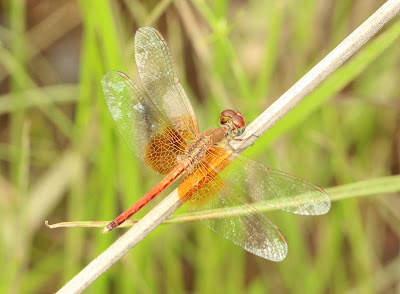
Neurothemis intermedia male, 19 August 2016 

A second Neurothemis intermedia male from August 19, 2016

A target species I had been looking for on all my trips, which had been recorded by Bui (2008). Apparently this rare species is a summer species on the island. I only saw a single female, Lyriothemis mortoni.

The fascinating Platylestes platystylus, also on the island of Phu Quoc., August 20, 2016


Immature male of Brachydiplax sobrina, August 20 

And nearby an immature female, much harder to find generally

Monstrous Epophthalmia vittigera, a wonderful male, caught on August 21, 2016

A lovely Ceriagrion calamineum, previously recorded from the island, but misidentified as C. aurantiacum in Bui (2008). Finally found on 21 August 2016.

Agrionoptera insignis male over a dark pool, August 19, 2016. The only specimen I saw on my three visits.

The List:

Lestes praemorsus* VIII
Platylestes platystylus* VIII
Vestalis gracilis I, IV, VIII, XII
Libellago hyalina I, IV, VIII, XII
Heliocypha biforata I, IV, VIII, XII
Euphaea cyanopogon**** I, IV, VIII, XII
Rhinagrion viridatum XII, VIII
Podolestes coomansi***** IV
Aciagrion borneense I, XII
Agriocnemis minima* IV, VIII, XII
A. nana* IV, VIII, XII
A. pygmaea I, VIII, XII
Amphicnemis valentini**** VIII
Archibasis viola I, IV, VIII, XII
Ceriagrion calamineum** VIII
C. cerinorubellum IV, VIII, XII
C. malaisei* VIII
C. olivaceum* I, IV, XII
Ischnura senegalensis I, IV, XII
Mortonagrion falcatum*** I
Onychargia atrocyana IV, VIII
Paracercion calamorum* IV, VIII
Pseudagrion australasiae* IV, VIII, XII
P. microcephalum I, IV, XII
P. rubriceps IV, XII
P. pruinosum I
P. williamsoni I, IV, VIII, XII
Coeliccia kazukoae** I, IV
Coeliccia yamasakii IV
Pseudocopera ciliata* IV, VIII, XII
Copera vittata** I, IV, VIII, XII
Prodasineura verticalis** I, IV, VIII, XII
Anax guttatus I, VIII, XII
Gynacantha basiguttata* I, VIII
G. bayadera* I
G. subinterrupta* I
Heliaeschna crassa*** IV
Ictinigomphus decoratus meleanops I, IV, VIII
Paragomphus capricornis* XII
Epophthalmia frontalis* I
E. vittigera* VIII
Acisoma panorpoides IV, VIII, XII
Agrionoptera insignis* VIII
Brachydiplax chalybea* IV, VIII, XII
B. sobrina* IV, VIII
Brachygonia oculata IV, VIII
Brachythemis contaminata I, VIII, XII
Cratilla lineata IV
Crocothemis servilia I
Diplacodes nebulosa I, IV, VIII, XII
D. trivialis I, IV, XII
Hydrobasileus croceus I, VIII
Indothemis limbata*** I, VIII
Lathrecista asiatica I, IV, VIII
Lyriothemis mortoni VIII
Nannophya pygmaea IV, VIII, XII
Neurothemis fluctuans I, IV, VIII, XII
N. tullia IV, XII
N. fulvia IV, VIII, XII
N. intermedia* IV, VIII, XII
Orchithemis pulcherrima IV, VIII
Orthetrum sabina I, IV, VIII, XII
O. pruinosum* XII
O. chrysis I, IV, VIII, XII
Pantala flavescens I, VIII, XII
Potamarcha congener I, IV, VIII, XII
Pseudothemis jorina** I
Rhodothemis rufa* IV, VIII, XII
Rhyothemis aterrima* IV
R. obsolescens IV, VIII
R. phyllis I, IV, VIII, XII
R. variegata I, IV, XII
R. triangularis IV, VIII
Tetrathemis irregularis IV, XII
Tholymis tillarga I, IV, VIII, XII
Tramea transmarina euryale* I, VIII, XII
Trithemis festiva IV, XII
T. aurora I, IV, VIII, XII
T. pallidinervis I, IV, VIII
Urothemis signata I, IV, VIII
Zygonyx iris I, VIII
Zyxomma petiolatum* IV, VIII, XII

*       Refers to species first recorded on the island, although some are very common
**     Coeliccia kazukoae had already been found by Floris Brekelmans, but is not rare. Prodasineura verticalis had been recorded as Prodasineura sp. Copera vittata had been misidentified previously (as C. marginipes), but is a very common species. Pseudothemis jorina had been recorded but misidentified (presumably) as P. zonata. Ceriagrion calamineum had been misidentified as C. aurantiacum.
***   Refers to species recorded for the first time for Vietnam (as far as I know)
****  Refers to a species novum, but misidentified in previous surveys.
*****Recorded by Flores Brekelmans, not by me, but published on this blog

Sunday, 5 January 2020

Overlooked and forgotten - Tholymis tillarga

I realized that a whole genus was missing from my blog. Of course it has only one species, but nonetheless, how is this possible. After all, Tholymis tillarga is a common species that tolerates pretty grim water quality, so it is around even in central Hanoi. It is a typical pond species often found during the day hanging in the underbrush, with females hunting at head height close to dusk, and males starting to patrol the edges of ponds in the hour or so before dark, so from well before sunset. It shares that space with Zyxomma petiolatum. The latter is quite inconspicuous, but Tholymis, or Twister, as it is commonly called, is a bright red insect with white clouds in its wings. Not the female, which is yellowish brown and has yellow patches in the wing. Because it is so common, I rarely took photos of it and when I realized that it was missing from the blog I had a hard time finding some shots of it. I also did not want to search long, so I guess these photos may be somewhat disappointing. So be it, at least it now is on the blog.
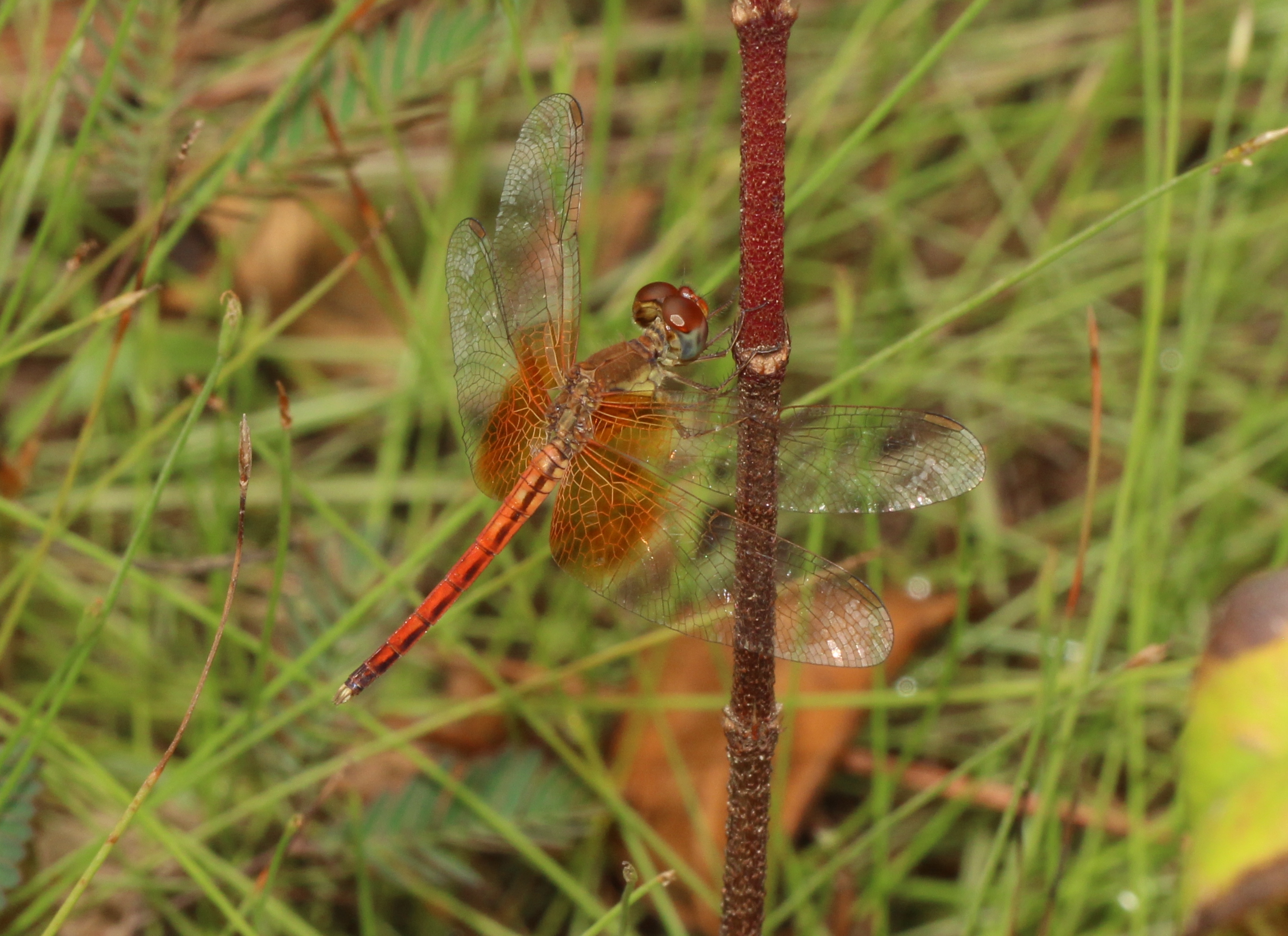
Male Tholymis tillage, 1 May 2014 in Huu Lien. I will replace it if I find a better shot. But it is nice and red.
Immature male, but the color in its wing is already starting to show. 4 August 2013, Hanoi City.

Female Tholymis tillage, 13 July 2013, Ba Vi.

Tuesday, 25 July 2017

Saying good-bye, a last visit to Xuan Son National Park

After 4 years of oding in Vietnam, I will be leaving. This blog will continue, because there is still a lot to publish. I have just been too busy trying to clean up some remaining issues. There simply was not enough time to write entries. Articles are the priority and even there I am behind. Not sure how many species the tally is, after 4 years. Probably around 440 species, but many first need a formal description. And then there is so much out there still to discover.

This spring and summer has been awful for dragonflies. It has just been cloudy and rainy. Some of the puzzles I wanted to solve therefore remain unsolved for now. But at least Sunday 23 July was a good and sunny day, even if I got soaked in the morning. The upside: only one leech lodged on my stomach.

Xuan Son has been wonderful, although the forest is being opened up by road building. I hope that will not lead to further incursions. The trees still stand and the stream remain good. Not sure how many species I actually saw there, somewhere in the range of 125-135 species. With several new species described and several more on the way. So, with the promise of some sun, this is where I went for my very last outing.

And to my huge surprise I ran not into 1, not 2, but 3 species I had not recorded there before. The first was a male Orthetrum melania superbum, a subspecies of O. melania described, and also only recorded, from Yen Bai. A large and conspicuous dragonfly that apparently tolerates abysmal conditions (puddles with muddy, water buffalo dung infested, water), but is nevertheless hardly ever seen. A single male attended a small pond. Fantastic.


This remains one of the most beautiful Orthetrum species I have seen 


By the early afternoon I wanted a change of scenery and drove to a nearby hill in the forest and noticed a dragonfly seemingly ovipositing on the wet concrete road. I got out and caught it and was very surprised to see it was a male, so why was it dipping its body in the wetness of the concrete? And it was a Chlorogomphus, in fact it was C. auratus, which I had never recorded in the park before. I guess I focus too much on the one fantastic stream, but ignore trickles on other mountains.

What is splendid discovery, Chlorogomphus auratus

Further afield still I wanted t check the area on the other side of the central hamlet and stopped by a small stream. A tiny trail ran next to it and I went in to see what it had to offer. And bumped into a small, Coeliccia pyriformis-sized, Coeliccia with large pale blue dorsal markings, a little like larger C. uenoi, but more rounded, and much like the even larger species we are currently describing from Ba Be. Indeed, under the microscope it is clearly closely related to that species, with similar genital ligula, similar appendages (although details differ), but obviously different thorax pattern and abdomen pattern (apart from the total insect being smaller than the abdomen of the Ba Be species alone, which is very robust).

To make sure it was not just aberrant I searched high and low and eventually, in a rather different location, was able to locate a second male, which was exactly like the first. How wonderful, to wrap up Vietnam with a new species of Coeliccia (coincidentally the 9th species of the genus occurring in Xuan Son, amazing).

Wonderful Coeliccia spec. nov. 
Close up of the thorax


So, back to the Netherlands and time to write up in earnest!


Monday, 10 April 2017

Orthetrum internum headaches

Last Thursday I was in Sa Pa and as usual this time of the year Orthetrum internum was already out in good numbers. Wen-Chi Yeh had responded to my posting of the species in 2014, but I had overlooked the significance of his comment. Basically he said that my photos looked different from what he was used to for O. internum. I had noticed that lack of pruinosity on the  dorsal side of the thorax, but in my posting mentioned this as one of the characteristics of O. internum. How wrong can you be?

Yesterday I visited Pia Oac in Cao Bang and ran into O. internum is several places. This in itself is strange, because I had never seen it there before. But even more strange was the fact that they were clearly pruinose and much more black-and-yellow. These were true O. internum! But if so, then what is the species in Sa Pa?

Structurally the two are identical. I am not sure if there are structural differences visible to us between O. internum and O. japonicum. These two were considered subspecies of O. japonicum in the past, until DNA sequencing made it clear they were in fact separate species. So, the lack of structural differences does not necessarily mean that the Sa Pa species is O. internum, nor does it support the other option, of course. But in coloration it is very different. The labium and labrum are pale orange, not black. The frons lacks black edges dorsally. The venter is not nearly as black, with the hamulus pale brown with only the tooth darker brown, but it is black-and-white in O. internum. And the thorax ground colour is black or dark brown in O. internum, with clear yellow on the prothorax (especially posterior lobe). In the Sa Pa species the ground colour if brown with pale markings, and there is no yellow on the prothorax, just pale areas. And most interestingly, there never is any pruinosity on the dorsum of the thorax!

From Sa Pa, note orange labium and labrum, brown color of thorax, no pruinosity, pale thoracic markings. Photo taken in 2014
Last Thursday. Note some characteristics. 
But this is a very black O. internum. Note also black labium and labrum, black on top of frons, pruinosity on the thorax, from Pia Oac
In dorsal view
A slightly less black male from Pia Oac. Note also the clarity and extent of the yellow markings on the thorax.
Note the yellow posterior lobe of the prothorax.


Friday, 7 April 2017

Lyriothemis kameliyae published in Zootaxa

Yesterday Lyriothemis kameliyae was published in Zootaxa. This is not at all a difficult species to recognize once you realize that it is actually different from L. bivittata. Problem is that all Lyriothemis species flying around in southeast Asia with a double yellow lateral marking on the otherwise brown thorax and with a red abdomen, plus dark streaks at the wing bases, had been lumped together under L. bivittata. In fact, there are at least several species involved. L. kameliyae occurs together with L. bivittata in northern Vietnam. Xin Yu already wrote to me he had collected L. kameliyae in China. Undoubtedly it is quite widespread. As beautiful as it is, it remained anonymous, until now!
Male L. bivittata (top) and male L. kameliyae (bottom). Spot the differences!

Sunday, 5 February 2017

A third Aethriamantha species - A. gracilis

Last year I encountered Aethriamantha gracilis in three different provinces in central Vietnam. The first encounter was with several males in a large pool in fields adjacent to a river in Quang Nam Province in early May. The initial enthusiasm, because I considered this a new finding for Vietnam, was dampened a little when already a few weeks later I found it near Bao Loc in some peaty ditches, where it was still present in June. And in September I found it at yet another very different location, at a pond in the forest near K'bang in Gia Lai Province. Clearly this is not a rare species, maybe overlooked because of its similarity to several of the Brachydiplax species? But let's face it, it is a little gem and worth paying attention to.

Male Aethriamantha gracilis, Bao Loc, Lam Dong, June 2016

Another male

Well, they all pretty much look the same, another male.

Tuesday, 26 April 2016

Two little forest friends from Phu Quoc

There are two species of smallish dragonflies that occur in the forests of Phu Quoc towards the end of the dry season. And I really wanted to see both of them, because they are stunning. Neither of these two are rare, but they reach the eastern limit of their distribution in the very south of Vietnam. I was happy to see quite a few. Brachygonia oculata is the commoner of the two, but I also saw plenty of Orchithemis pulcherrima. The latter is small, the former is in fact tiny.

The male of Orchithemis pulcherrima stands out in the darkness of the forest with is bright red abdomen 

This is the same specimen in dorsal view

The immature female is not nearly as bright

And neither is the female. Her thorax pattern is somewhat reminiscent of the smaller Brachygonia, but apart from the general shape of the abdomen and her size another obvious difference is the pattern on S8-10, with black restricted to the area adjacent to the dorsal carina
This little stunner is Brachygonia oculata. The different colour bands on the abdomen are really something.

Another male in all its splendor

And the female, showing all blackish S8-10.

Monday, 25 April 2016

Two new Rhyothemis species from Phu Quoc

On April 12 to 15 we visited Phu Quoc Island to see a few of the dry season specialties. This year is exceptionally dry and the island suffers from break-neck speed development and ground water abuse, but I was able to locate many of the goodies that I hoped for, although not all. Amongst these were two Rhyothemis species that I had not recorded before. One of these is known to occur in the island and although numbers are low, I bumped into it at a handful of widely separated locations. This is the smallish and wonderful Rhyothemis obsolescens.

The other I did not recognize. At a pond in the forest on several days I observed a male Rhyothemis perched that looked a lot like R. plutonia, but the greenish iridescence on the wings seemed more extensive and the remarkable purple of that species was missing. The wings seemed to have a reddish ground colour and towards the tip the greenish colour was visible as dots too. I tried to catch it, but I could not. In the end it dawned on me that this is Rhyothemis aterrima. This species has been recorded in Vietnam before. Cuong & Hoa list a record by Asahina from Binh Duong Province from 1962. But I know of no other records. Supposedly it is not uncommon in for instance Malaysia, but it is difficult to find photos on the web, so maybe it is actually not that common. I am very happy with it.
This is the wonderful male of Rhyothemis obsolescens. The pale borders to the wings give them a sort of out of focus aspect.
From below the golden shine is missing, but the brown and paler areas form a beautiful pattern. It excels at holding its wings at different angles.
Although this specimen takes a more conservative pose.

This is the difficult Rhyothemis aterrima male. This photo is a little too dark and therefore it looks quite a bit like R. plutonia. But note the relative slender hinds wings, extensive green and lack of purple.

Much more apparent in this photo is the reddish ground colour of the wings and it can be clearly seen that the green on the outer wings forms distinct dots.

Thursday, 21 April 2016

Tramea basilaris - a true vagrant

Today I was hoping to quickly sneak off to the little pool where the last few days the Anax indicus had been hanging around, but it was cloudy all day. Just after lunch the sun seemed to start peeking through the clouds, so I made a dash for it. The pool is only 15 minutes from my place of work. But when I got there the sun was gone again and clouds ruled the sky. But at the side of the pool there was a large branch lying in the water and on one of the tips was a Tramea. It would be out of season for Trames virginia, but it did have rather large saddlebags. However, when I gave it a closer look the lack of an obviously protruding hamule and a hole in the saddlebag soon made it clear this was something else. Indeed, Tramea basilaris. This is an extraordinary species, originating in Africa individuals roam as far as Japan and South America. In Vietnam it is known as a vagrant. At least, that is what the IUCN website says. I had never seen it. So there you have it. At the small pool where a few days ago Anax indicus was discovered as a new species for Vietnam, today yet another rare long distance migrant. The winds have definitely shifted to summer patterns, blowing from the southwest.

Tramea basilaris, showing the genital lobe without a longer hamule.
From behind, showing the irregular saddlebags with paler "hole"

And another side view, showing the saddlebag pattern again.

Thursday, 11 February 2016

Two cool species from Cat Tien

Last weekend I visited Cat Tien National Park to spend a few days with James looking for some of his recent discoveries. One of these was a fine female of Zyxomma obtusum. This is a widespread species, occurring from the Indonesian archipelago to the south of Japan, but it was unclear to me how often it has been recorded in Vietnam. I had never seen it, although I keep an eye open for it at dusk all the time, and I know of no other records. Cuong does not mention it in his overview of Vietnamese records. So it was an exciting find when James ran into it; a find that sadly we could not duplicate. But when checking some of his photos we made another discovery. A Ceriagrion he had taken a picture of last July was C. indochinense! This is a species recorded as widespread from Thailand and also from Vietnam, although I have never seen it, so it is maybe not that common. But last July at a grassy swamp there had been many. We went to check the place, but clearly it is not around in February anymore. I am happy to show both species here and look forward to seeing them myself sometime.

A fine male of Ceriagrion indochinense. This species shares a citrine-yellow abdomen and bright green thorax with yellow face with C. fallax, but it has no black at the abdominal tip. Photo courtesy of James Holden.

The female of Zyxomma obtusum. The males are whitish and ghostlike when patrolling as dusk, but the females are less obvious. However, note the dark wing bases and banded abdomen.

Tuesday, 12 January 2016

Indothemis limbata - new to Vietnam

On January 1 on Phu Quoc we checked a man-made pond close to the dam that closes off the Duong Dong Reservoir. A heavily vegetated pond, it had many dragonflies of a wonderful diversity of species.  My attention was drawn to a blue-and-black horizontally perching dragonfly that reminded me of a pond hawk Erythemis. This being south-east Asia, that of course was impossibly. Excited I got closer to it and recognized Indothemis limbata, a little recorded species known from India and Sri Lanka in the west to Thailand in the east (where Dennis Farrell has recorded it commonly in some places). It had not been recorded from Vietnam until now. Only recently (Ellenrieder et al., 2014) had its congener I. carnicata been recorded from Vietnam. This species has been found at little used swimming pools, indicating a preference for still, but deep, water with rocky surroundings. I. limbata appears to prefer heavily vegetated ponds. It is easily recognized by its blackish body, blackish-brown basal patches to the hind wings (with some limited marking of the forewings) and bluish pruinose abdomen. Although I saw at least 5-6 different males, I did not see any females.

A male in strong sunlight

Another male. Note the darkened wingtip crescents.

In dorsal view the dark brown basal patches to the hind wings are obvious

Sunday, 22 November 2015

The male of Gynacantha basiguttata and a male G. japonica thrown in

November 21 I went to Huu Lien to look for the enigma Planaeschna cf. guentherpetersi again, but did not see it. I did catch an Aeshnid that passed overhead in the forest and was very happy to find it was a splendid male Gynacantha basiguttata. I had caught the female a few weeks back too. Apparently it is not that rare inside the forest. The other cool thing I saw was a communal roost of Cratilla lineata. I had seen that in Potamarcha congener, but this was new knowledge to me. At least 15 bundled together on a hanging twig.

On November 22 I went to Xuan Son and looked for the small pale-faced Planaeschna there. I did see one female, but failed to catch it. It was mostly an uneventful day, but I saw a few Gynacantha japonica and was able to take some pictures. Another unexpected species was Trithemis pallidinervis at the river crossing, which I had not seen this far north. And a fine male Ceriagrion chaoi was another nice one. Not at all that common, although regular at Xuan Son.

Very fine male Gynacantha basiguttata, note the dark wingbases.

Scan of the same male. Note the long and slender epiproct and the wingbases.

Pretty male Ceriagrion chaoi

Gynacantha japonica, note the pale epiproct.

And a surprise female Trithemis pallidinervis