Showing posts with label Lestidae. Show all posts

Friday, 25 November 2022

An updated list for my three visits to Phu Quoc in 2015 and 2016

During my stay in Vietnam I was able to visit Phu Quoc island, located off the coast of Cambodia to the west of the Vietnamese Mekong delta, several times. It has a very interesting Odonate fauna compared to the rest of Vietnam, with several rare species, not seen elsewhere in Vietnam. I visited the island from 28 December 2015 to 2 January 2016, again from April 12 and April 15, 2016 and finally from August 19 to 21, 2016. Some species are very local and also occur only in the dry or in the rainy season, so not everything can be seen in any one trip. I already published a list after my first trip. This list is updated here to include all records, to which I added the months in which species were recorded by me in Roman capitals. But first a few photos of good species not published here previously.
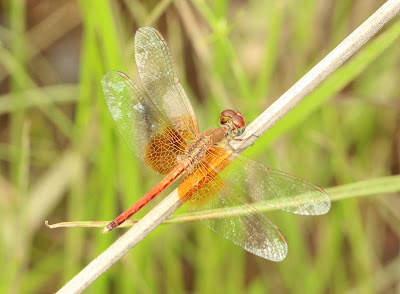
Neurothemis intermedia male, 19 August 2016 

A second Neurothemis intermedia male from August 19, 2016

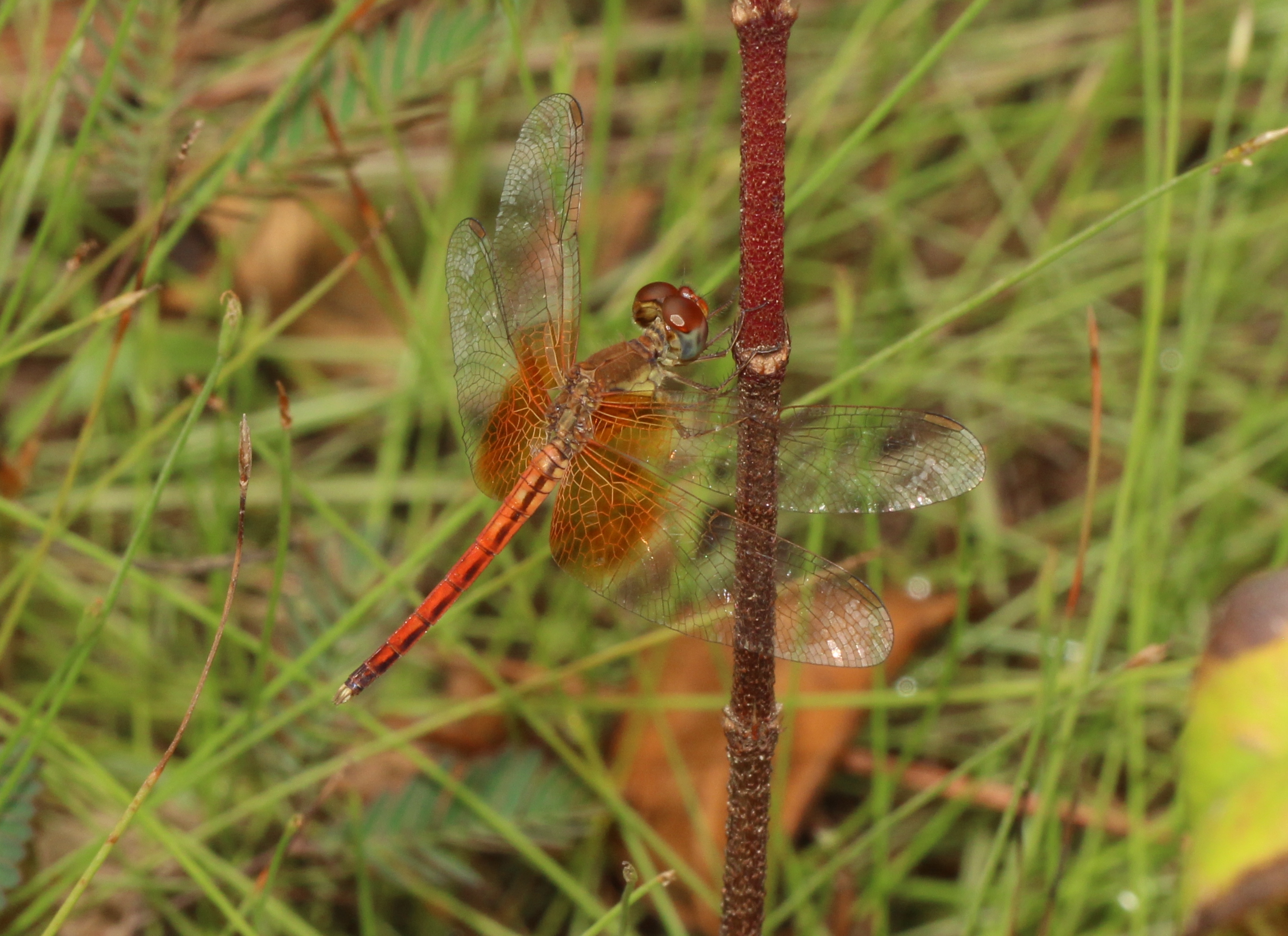
A target species I had been looking for on all my trips, which had been recorded by Bui (2008). Apparently this rare species is a summer species on the island. I only saw a single female, Lyriothemis mortoni.

The fascinating Platylestes platystylus, also on the island of Phu Quoc., August 20, 2016


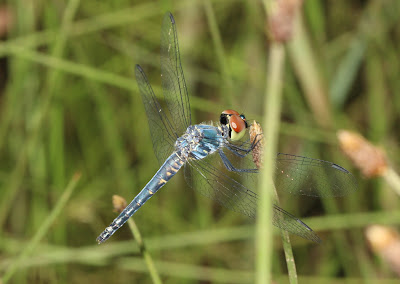
Immature male of Brachydiplax sobrina, August 20 

And nearby an immature female, much harder to find generally

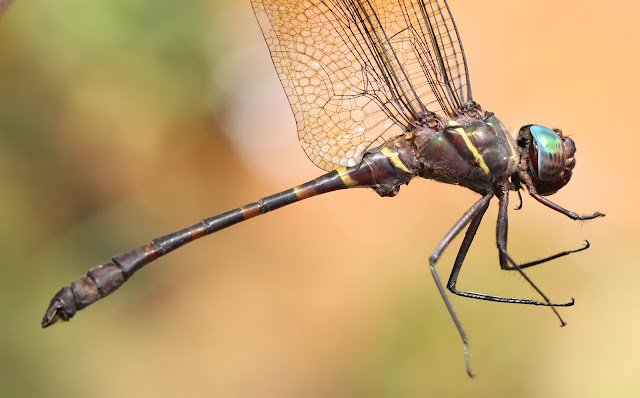
Monstrous Epophthalmia vittigera, a wonderful male, caught on August 21, 2016

A lovely Ceriagrion calamineum, previously recorded from the island, but misidentified as C. aurantiacum in Bui (2008). Finally found on 21 August 2016.

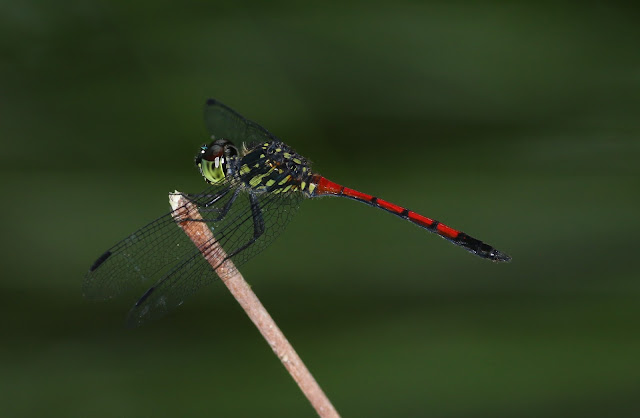
Agrionoptera insignis male over a dark pool, August 19, 2016. The only specimen I saw on my three visits.

The List:

Lestes praemorsus* VIII
Platylestes platystylus* VIII
Vestalis gracilis I, IV, VIII, XII
Libellago hyalina I, IV, VIII, XII
Heliocypha biforata I, IV, VIII, XII
Euphaea cyanopogon**** I, IV, VIII, XII
Rhinagrion viridatum XII, VIII
Podolestes coomansi***** IV
Aciagrion borneense I, XII
Agriocnemis minima* IV, VIII, XII
A. nana* IV, VIII, XII
A. pygmaea I, VIII, XII
Amphicnemis valentini**** VIII
Archibasis viola I, IV, VIII, XII
Ceriagrion calamineum** VIII
C. cerinorubellum IV, VIII, XII
C. malaisei* VIII
C. olivaceum* I, IV, XII
Ischnura senegalensis I, IV, XII
Mortonagrion falcatum*** I
Onychargia atrocyana IV, VIII
Paracercion calamorum* IV, VIII
Pseudagrion australasiae* IV, VIII, XII
P. microcephalum I, IV, XII
P. rubriceps IV, XII
P. pruinosum I
P. williamsoni I, IV, VIII, XII
Coeliccia kazukoae** I, IV
Coeliccia yamasakii IV
Pseudocopera ciliata* IV, VIII, XII
Copera vittata** I, IV, VIII, XII
Prodasineura verticalis** I, IV, VIII, XII
Anax guttatus I, VIII, XII
Gynacantha basiguttata* I, VIII
G. bayadera* I
G. subinterrupta* I
Heliaeschna crassa*** IV
Ictinigomphus decoratus meleanops I, IV, VIII
Paragomphus capricornis* XII
Epophthalmia frontalis* I
E. vittigera* VIII
Acisoma panorpoides IV, VIII, XII
Agrionoptera insignis* VIII
Brachydiplax chalybea* IV, VIII, XII
B. sobrina* IV, VIII
Brachygonia oculata IV, VIII
Brachythemis contaminata I, VIII, XII
Cratilla lineata IV
Crocothemis servilia I
Diplacodes nebulosa I, IV, VIII, XII
D. trivialis I, IV, XII
Hydrobasileus croceus I, VIII
Indothemis limbata*** I, VIII
Lathrecista asiatica I, IV, VIII
Lyriothemis mortoni VIII
Nannophya pygmaea IV, VIII, XII
Neurothemis fluctuans I, IV, VIII, XII
N. tullia IV, XII
N. fulvia IV, VIII, XII
N. intermedia* IV, VIII, XII
Orchithemis pulcherrima IV, VIII
Orthetrum sabina I, IV, VIII, XII
O. pruinosum* XII
O. chrysis I, IV, VIII, XII
Pantala flavescens I, VIII, XII
Potamarcha congener I, IV, VIII, XII
Pseudothemis jorina** I
Rhodothemis rufa* IV, VIII, XII
Rhyothemis aterrima* IV
R. obsolescens IV, VIII
R. phyllis I, IV, VIII, XII
R. variegata I, IV, XII
R. triangularis IV, VIII
Tetrathemis irregularis IV, XII
Tholymis tillarga I, IV, VIII, XII
Tramea transmarina euryale* I, VIII, XII
Trithemis festiva IV, XII
T. aurora I, IV, VIII, XII
T. pallidinervis I, IV, VIII
Urothemis signata I, IV, VIII
Zygonyx iris I, VIII
Zyxomma petiolatum* IV, VIII, XII

*       Refers to species first recorded on the island, although some are very common
**     Coeliccia kazukoae had already been found by Floris Brekelmans, but is not rare. Prodasineura verticalis had been recorded as Prodasineura sp. Copera vittata had been misidentified previously (as C. marginipes), but is a very common species. Pseudothemis jorina had been recorded but misidentified (presumably) as P. zonata. Ceriagrion calamineum had been misidentified as C. aurantiacum.
***   Refers to species recorded for the first time for Vietnam (as far as I know)
****  Refers to a species novum, but misidentified in previous surveys.
*****Recorded by Flores Brekelmans, not by me, but published on this blog

Thursday, 15 June 2017

At long last another Lestes

Considering my world Odonata list, Lestes is one of the genera with the most recorded species and that is not surprising, giving the number of described species and the fact they occur around the globe. But irrespective of that, there are not that many species around in Vietnam, apparently. Only three I had been able to find. Lestes praemorsus is the common species, found from the very north to the very south, and Lestes elatus from the southern half of Vietnam. Lastly, I recorded pretty Lestes nodalis from Huu Lien Nature Reserve, to the north of Hanoi. And that was it. Until on May 12 this year I stopped by the road in Lam Dong province, to the northwest of Bao Loc, to check a grassy inundated area in the afternoon. I noticed many Lestes praemorsus, but it dawned on me that some appeared to be larger than others and these all had a reduced pale abdomen tip. This could not be a coincidence. I took photos and collected a few. In the evening I became disappointed. It seemed the appendages were the same, so maybe just variants? But when I returned home several days later and was able to check them under the microscope, it became clear there were in fact differences. Most striking were the differences between the inferior appendages of the species, in addition to the aforementioned differences in coloration. Two species appeared to have this combination of characters, Lestes dorothea Fraser, 1924 and Lestes praecellens Lieftinck, 1937. The former is quite large, a little larger according to the description than mine, which fit better the species described by Lieftinck from Java in size. However, the female I photographed has much more extensive thoracic markings than that species, in line with what is to be expected of L. dorothea. That species is recorded from India, Thailand and Malaysia. Based on the structural characteristics and patterning of the male and patterning of the female I think it is safe to conclude this is L. dorothea as well.
By the way, based on the likeness of the appendages of L. praecellens and L. dorothea one may ask whether these are truly different species. There thoracic markings are also rather similar, if it weren't for the female.

Lester dorothea male. Note the lack of pruinosity on S9.

Male and female of L. dorothea

The female, showing the extensive dark markings on the thorax, unlike L. praemorsus

Another male showing the limited pruinosity on the abdomen tip

A Lestes praemorsus male for comparison. Smaller and with pruinosity on S9.

Friday, 22 July 2016

Platylestes platystylus - also in Vietnam

May 28 I received an email from James Holden. Platylestes platystylus had been found at the fish ponds in Cat Tien National Park. Thrilling, because this is a little known and elusive species, according to the IUCN website. Dennis Farrell has reported it from Thailand, where it was known to occur, and it has also been recorded from Lao DPR. It ranges all the way west to India, although there is some doubt whether this really all concerns the same species.

Anyway, it was great to hear it occurred in Vietnam, because Lestidae are quite uncommon here, with just a few species compared to for instance Thailand. I was also rather envious, because it is a beautiful species and because I want to see every species known in Vietnam. Frustrating, because it is of course impossible to see everything.

On June 11 I was crossing the provincial border from Gia Lai Province into Dak Lak Province when I noticed an inundated depression in the open landscape. Until recently the area had been parched, but now the rains had started and water had accumulated there. It turned out it was probably the remnant of what once was a swamp. It was late in the afternoon, but I did see a few interesting damsels and decided to have a closer look. And there it was: a male Platylestes platystylus! It moved away quickly, but I had no doubt, but also no picture. While dusk settled I had to leave, but decided to return on my way back from my destination (Bao Loc).

The next morning I drove further south and into Lam Dong Province when I noticed a small shallow and grassy pond that looked promising. And there I found my second male Platylestes platystylus. Maybe not that uncommon after all, just occurring in not often researched temporary habitat?

On the way back north a week later (June 18) I revisited the depression in Dak Lak, but now in the morning. It was really crowded will all sorts of exiting species. Amongst the 35 species or so I found on the 1.5 hectare several species of Aciagrion, several Lestidae, several Ceriagrion, but also Indothemis limbata and I. carnicata side by side, and lots of other goodies. And at least 10 Platylestes platystylus. Now I had my photos sorted.

The first Platylestes platystylus male on photo, June 12 in Lam Dong Province
The same male in dorsal view

This is the female, June 18 in Dak Lak Province

Another male on June 18

Male appendages in lateral view

And male appendages in dorsal view


Saturday, 13 February 2016

A new genus and a new species - Indolestes anomalus new for Vietnam

February 6 I had arrived in Cat Tien National Park for a 3 day field trip to work a bit with James Holden, who has been holed up there for half a year or so. We decided to work our way through the forest to visit two bits of streams that are running all year round, south of the grasslands. Hard work, as going off-trail means using GPS on working your way through bamboo. And those in the know are aware what that means. Our clothes were torn to shreds during the day, but we did see the two target Prodasineura species I really wanted to see. The first was P. doisuthepensis, a species that had been on my wish list for 2015, but I only saw it now. The other was the splendid P. hoffmanni, I already published on recently, with photos by James.

Anyway, while working our way through the forest I spotted a female Lestes with closed wings and took a quick swipe at it with my net. It looked different from anything we had seen before, although we considered it a possible Lestes elatus, a species we hardly ever, if at all, encounter. So forgive us if we failed to see immediately it certainly was not that.

What was striking in the specimen was not just the three separated markings on the mesepimeron, but also the very large ovipositor. The markings on the final segments were also not as expected of L. elatus. Later, at home, I took a closer look and noted the rather squarish pterostigmata. That set me onto the right course. The few photos of Indolestes anomalus (on Dennis Farrell's site for instance) were a good match and led me to the description by Fraser 1946 and reproduced in Asahina (1985). Wings match the original description (20mm), but abdomen was slightly larger (28.5 against 27mm). The original description is of a female. I am not sure whether the male is now known.

Indolestes anomalus is a rarely observed species, known from very few records of single specimens from Thailand only. It is good to see the species is more widespread, although the pattern of yet another single specimen from a relatively well researched area indicates it is indeed rare.

Female Indolestes anomalus. Note large bulging ovipositor, with brown S9. Top of head blackish green, three markings on the mesepimeron, the middle square, pattern of S1-2 and squarish pterostigma.
Close-up of the thorax, showing the pattern on the mesepimeron.


Saturday, 10 October 2015

A few hours in Vientiane, Laos and a new species for the Laotian list.

This Thursday I had a few hours to spare in Vientiane and took a cab to the outskirts of the town. Thank God the surroundings are not close to being as polluted as around Hanoi and I was able to find 38 species in a short time. Vientiane is about as far south as Ha Tinh in Vietnam, which is about the southern edge of my general research area (northern Vietnam). But its species are quite different, much more southern. There was a lot of overlap with the commoner species in Cat Tien National Park, for instance. I was happy to catch a Epophthalmia frontalis male. Yokoi & Souphanthong actually list 31 Macromiidae, 28 of them Macromia. Which is rather astounding. But anyway, I was happy with my frontalis. And I was able to take pictures of male Lestes elatus and female Ceriagrion cerinorubellum. I had seen both these species in Cat Tien, but had not seen these sexes. Below a few pictures. And another very common species in some inundated and apparently deserted rice fields was an Aciagrion. I had to go back to Ris (1911) and Fraser (1933) to find out what may be the differences between Aciagrion occidentale and A. borneese. The appendages look rather similar and the A. borneese I had from Da Nang had been eaten by vermin. But in the end the description of Fraser pointing out that S8 is blue with a black triangle on it in A. occidentale, whereas A. borneese has a broad dorsal black stripe over the whole segment, provided the clue. Photos from India confirm the pattern on A. occidentale, and I therefore conclude that the specimens I saw were A. borneese, on the premise that the pattern is consistent over the complete range of these species. Interestlingly Yokoi & Souphanthong do not list either of these species for Laos. A. borneese is a very common species in Thailand and that country is of course right opposite the river at Vientiane.

Let's start with the addition to the Laotian list, Aciagrion borneese. Note dorsally black S8 and S10, whereas S9 is marked by a thin blackish dorsal line.
Another male with the distinctive pattern

Female Ceriagrion cerinorubellum. Possible to confuse with C. auranticum because of the green eyes and orange-brown cranium. However, S3-7 are blackish above and blue-green laterally, not orange, and S9 misses the clear darker marking.

Lestes elatus female

And the male, which I had failed to find in Cat Tien.

And finally a fine male Epophthalmia frontalis


Sunday, 28 December 2014

Two more Lestidae from Cat Tien

During my little excursion to Cat Tien, I was able to finally find Orolestes octomaculatus. That was very welcome. James had found one in the lodge, but I had not been able to replicate that record and felt hopelessly left out. This time round I was more lucky. First we found a freshly emerged female in the flooded excavations on the way to the fishponds. Then I found a female smack in the middle of the forest, and finally several males at ponds close to the bird lake trail. It is an easy species to recognize. The female in hand by the 5-6 large teeth on the ovipositor and the male by the 8 spots on the wing.
The other Lestidae I ran into, was a female Lestes elatus, which I found at the fishponds. Luckily an easy species to recognize on account of its patterning. Also apparently common in all sorts of disturbed habitats. I found only one, but at least we know it is there. Hopefully also males next time.

Lestes elatus, a female photographed from some distance

The same female in hand. I am sorry about the prominent finger, but if you check the print, you can see it is me. The pattern on S8-9 is very typical.

Orolestes octomaculatus, not a good photo and with flash, but you can see the typical double-dot pattern on all wings.

Another male, again a little hasty when taking the picture

Female of Orolestes octomaculatus, note the rather different, plain, coloration of S8-9 when compared to female O. selysi (see that post)
Note the large teeth on the ovipositor (same female as in previous picture)


Monday, 28 April 2014

Ovipositing female of Orolestes selysi

This weekend when in Huu Lien I observed several females of Orolestes selysi. I previously only saw males, so for the readers interest, here are some pictures. The female started ovipositing in life wood about 2 meters above a shallow and slow moving stream in a bush. Interestingly, she twisted her abdomen so that sometimes the ovipositor faced left, sometimes right.

The female of Orolestes selysi

Ovipositing with twisted abdomen

Wednesday, 23 April 2014

Some additional species at Huu Lien from April 21

The two Copera species of Huu Lien and the one Pseudocopera were already common and easily found. Here are the males of P. ciliata and C. marginipes in their full glory.

Pseudocopera ciliata is the easy one, large, and white when mature

Here a male Copera marginipes with its simple, but large superior appendages

A somewhat messier C. marginipes. C. vittata normally has much less white on the last segments.
A remarkable and large species was Orolestes selysi. The dark-winged form and the hyaline form occurred side by side.

A fantastic dark-winged specimen of Orolestes selysi

The somewhat less striking, sorry to say, hyaline version.
I also had the opportunity to take a better look at some immature Orthetrum glaucum.

First, a female Orthetrum glaucum.

A fresh, still less pronounced, female

The interesting immature male. The striking pattern is later completely obscured by pruinosity.

Monday, 21 April 2014

Lestes nodalis - a weird Lestes!

April 21 was Easter Monday and thus a holiday for me. After two days in cloudy Hanoi I just had to go somewhere, but the weather was not appealing at all. I decided to go for it anyway and drove to Huu Lien Nature Reserve. Huu Lien is a brilliant place for dragonflies, still, but there is always the sound of chainsaws in the background and I dread seeing cut down trees left and right in the last decent patches of the forest. Also, the water quality is deteriorating. All in all I hope that we will be able to enjoy the bounty of the place also in years to come. Anyway, I had nearly 50 species on a mostly cloudy day in April, not bad at all. I saw two Gomphids I had not seen before, one of which I could catch. More on that later.

When checking a field laid bare with some weeds near a shallow stream that dries out in winter, bordering agricultural lands, I noticed a weirdly colored Lestes. I was able to take some pictures and catch it, but afterwards I saw nearly 10 more, both males and females. Checking the literature at home it turned out to be Lestes nodalis (Selys, 1891). A species known from Thailand, Myanmar, India, and bordering China (Guangxi, Yunnan), so it is maybe not surprising it also occurs here in Vietnam, but it had not been recorded before, so another addition to the Vietnamese list!

The coloration of both the male and the female is rather peculiar, lacking the metallic shine so often seen in the genus. The appendages are very typical and the pterostigma is dark with a light border all around.

Lestes nodalis, male

Another male, showing off its fabulous colors

Close-up of head and thorax

The female is not less weird in color, maybe more so

Another female, note also the darker trailing edge of the slightly amber wings


Appendages of the male in dorsal view. Superior appendages with distally pointed projection, mostly pale yellowish with black tips.