Wednesday, 13 November 2013

Brachythemis contaminata

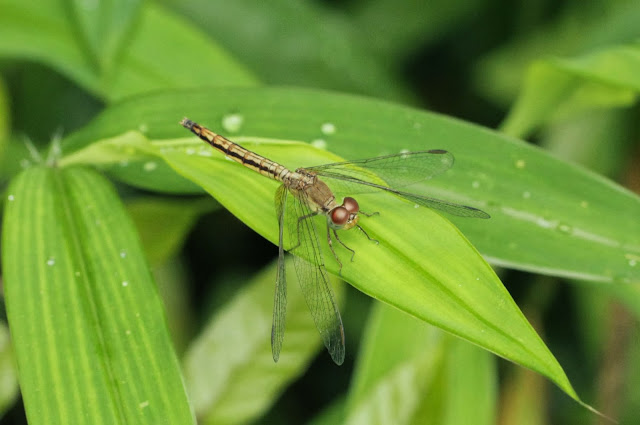
As for tying up loose ends, what about this most common of highly tolerant species? Brachythemis contaminata certainly is not a good indicator of water quality, or to the contrary, it is almost an indicator of low water quality, occurring in places where even rats cannot survive, making you wonder what they actually live off. Then again, mosquitoes thrive anywhere too. Its name goes well with its general surroundings. Interestingly, the study by Do Manh Cuong of the distribution of dragonflies in Vietnam, shows it as only known from 4 provinces. This is a clear indicator of the lack of data from Vietnam, not, sadly, of the fantastic state in most waterbodies are in. It is an easy to recognize species, at least the male, and can be found abundantly along low quality water bodies, where they sit on rubbish, twigs, concrete blocks, anything, along the water's edge or on anything protruding from the surface, like floating dead animals. It is certainly not that I do not like this species, I do, I just hate the sight of its surroundings most of the times.

Brachythemis contaminata, male, in surprisingly nice green habitat!

Brachythemis contaminata, female, also in green surroundings


Calicnemia haksik*

*Post adjusted after identity of C. mortoni was re-established as C. haksik

The genus Calicnemia has quite a few representatives, at least 6 of which have been found in Vietnam and two even quite near to Hanoi, C. haksik and C. erythromelas. Many are exquisite, in colors of blue, red, black and yellow. I have only had the pleasure of encountering one species so far, at a few localities in Tam Dao National Park, where they were found on rocks dripping with water in relative shade. This is C. haksik, a species with relatively little red on the abdomen. I saw it on three different dates in August, but undoubtedly it also occurs in some other months.

Copula of Calicnemia haksik

Calicnemia haksik, male

Calicnemia haksik, female

Tuesday, 12 November 2013

Hooray, 110 species on the blog

I think I should celebrate that. And there are still more loose ends to tie up too, the tally for this year will top 120. And then we can start seriously next year!

Burmagomphus vermicularis - I presume

When in July checking some of the streams in Ba Be National Park that were both not very fast flowing, and with muddy substrate, in open terrain bordered by forested hills, I regularly flushed freshly emerged smallish gomphids with quite interesting markings, like the oblique lines on the dorsum of the synthorax. Although I did not see any mature individuals, clearly this was a Burmagomphus species. Only two Burmagomphus species have been recorded from Vietnam, of which one and is the widespread Burmagomphus vermicularis, known from Southern China, Hainan, Taiwan, Laos and Vietnam. This species inhabits muddy streams in agricultural areas bordered by forested hills. (The other is recently described B. schneideri from southern Vietnam.) Now, it is of course possible that other species of this genus share the preference for this habitat and it is not impossible that more of the at least 24 known species occur in Vietnam, so until I catch a male the identification remains tentative, but it is likely that what I encountered is in fact this rather common species.

Freshly emerged female Burmagomphus vermicularis, presumably

The same individual, at a slightly different angle

Monday, 11 November 2013

Macromidia rapida

In Cuong's checklist on the dragonflies of Vietnam one Macromidia species is mentioned, M. rapida. It is not the only species occurring in Vietnam, as proven by Sebastien Delonglee, who also recorded M. genialis shanensis (see his blog for more information). It maybe is not uncommon, just hard to find. I saw it in the foothills at Tam Dao National Park, where three males were battling it out for some reason known to them in a dark corner of a rocky stream, near a tiny sandy beach, mid August. The next day I also saw two females ovipositing in small feeder streams of the rocky stream. I am sorry that the photos did not turn out like I hoped, but for the time being, this is what we have to make do with. The appendages of the male or whitish apart from the tips and bases, different from M. genialis, which has them all black.
Macromidia rapida, male

Macromidia rapida, female

Tip of abdomen of female

Dorsal view of appendages of male

A few more Rhinagrion hainanense

October 26 we paid another visit to Xuan Son NP, with amongst others the objective to see more Rhinagrion hainanense and try to take pictures of it displaying. After all, that is one of the more fascinating sights in nature I have observed in a long time. But it proved to difficult, with only one male and one female about and the male nimbly buzzing around. So, I could only take picture of it tail-lifting in display when perched. Also, the female, ovipositing in wet mud. From the large and robust ovipositor one might think that it serves to penetrate wood, but no. With thanks to Sebastien for pointing it out by the water's edge.

Rhinagrion hainanense, male, exquisite!

Raising its abdomen in display

Female Rhinagrion hainanense, pretty!

Sunday, 10 November 2013

Neurothemis tullia, N. fulvia, and N. intermedia

It is autumn in Hanoi, typhoon Haiyan is bringing lots of rain and wind. I just returned from a 10 day trip to the Netherlands, hence the silence on the blog and even if I still saw Brachythemis contaminata outside our window today, there is not a lot going on in Odonate country close to home. But there are still some loose ends to tie up and one is the Neurothemis genus. And it is a good thing I started doing that today, because checking the genus I remembered an odd unidentified female libellulid I saw at Cuc Phuong late July and now finally clinched the ID, Neurothemis intermedia!

There are 4 Neurothemis species that have been recorded in Vietnam according to the synopsis by Do Manh Cuong. There is N. fluctuans, recorded in southern Vietnam, and N. fulvia, N. tullia and N. intermedia, all three recorded both in the north and in the south. I have only seen intermedia once, in Cuc Phuong, Ninh Binh Province, and N. fulvia was very very common around Ba Be, in rice paddies, but otherwise I have seen it only once at Tam Dao National Park and once at Cuc Phuong, all in July and August, although that may be more due to the fact that I visited Ba Be in July than that it is restricted to those months. And N. tullia, which apparently is a very common species in for instance Thailand, I saw only in Van Long Nature Reserve, although there is was common where it occurred, which was in grassy shallow pools. These are attractive libellulids, with colorful wings.

I admit, the photos are not the best. I promise to do better next time I run into them.

Neurothemis fulvia, male, basking in the summer sun
Another male N. fulvia at Ba Be

Neurothemis tullia, female, with a striking wing pattern, not easy to overlook

Neurothemis tullia, male, likewise, at Van Long Nature Reserve 

Female Neurothemis intermedia, with striking abdominal lines, but no obvious wing markings. Hope to see a male soon!