Sunday, 24 November 2013

A few more common dragonflies not yet on the blog - Trithemis

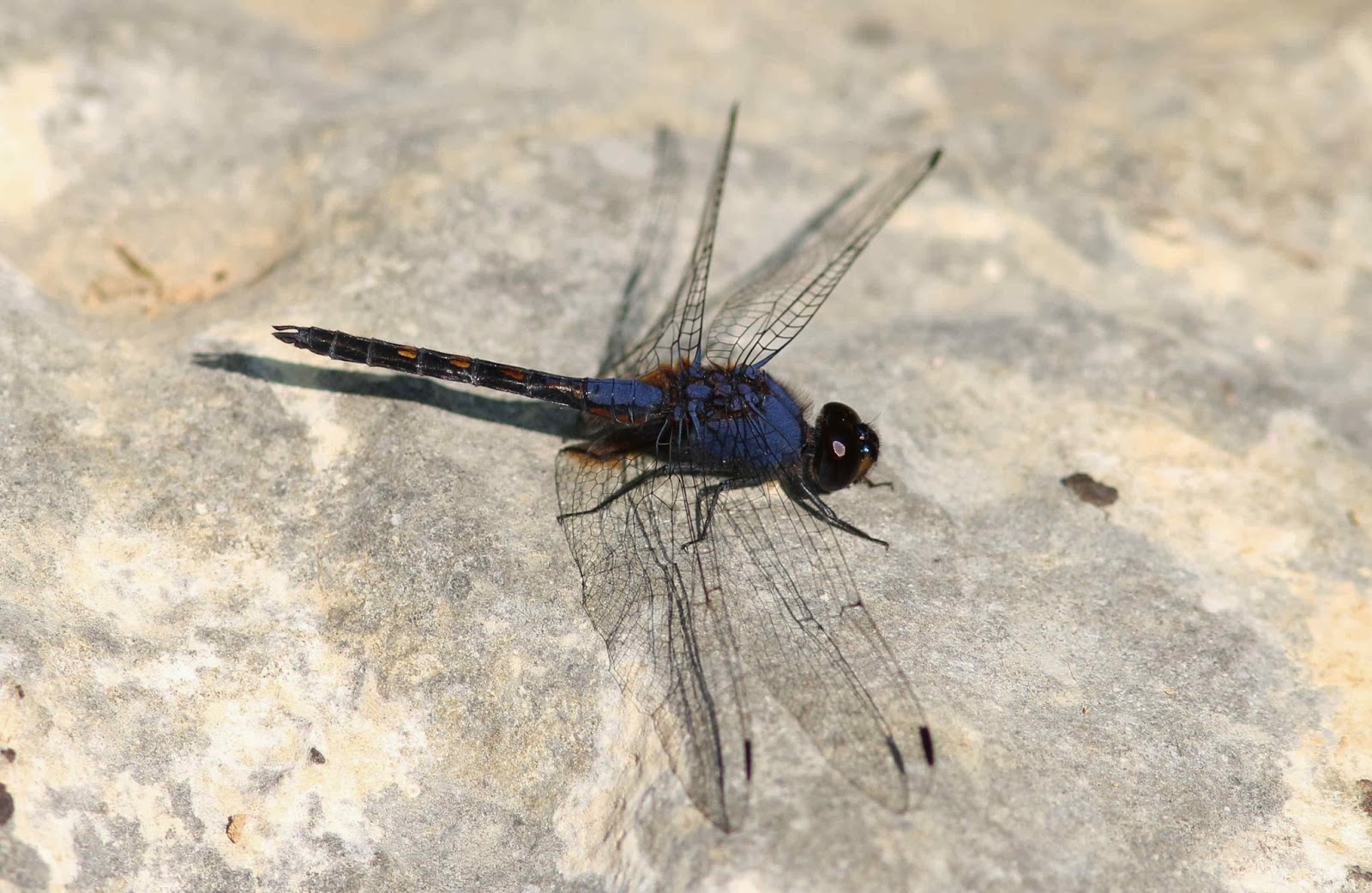
There are two (very common) and one less common, but certainly not uncommon, Trithemis species easily encountered in northern Vietnam. One is the very purple Trithemis aurora, a common, but excitingly beautiful dragonfly. There are after all many reddish, but few purple dragonflies about. The second is the dark blue (but with abdomen checkered with yellow) Trithemis festiva, a species occurring as far west as Turkey. And lastly, the somewhat different Trithemis pallidinervis, which sits with wings raised very much like the Idiataphe dragonflies of the New World. There is some difference in the way these different species from the same genus behave. T. aurora males sit often on exposed branches and twigs sticking out of, or overhanging the water. T. festiva likes to sit on rocks or concrete along or in streams and T. pallidinervis is a species not of streaming, but of standing water, and sits on emergents in heavily vegetated shallow waters. It is for instance common in Van Long, but I also saw it in Huu Lien recently. T. aurora females are easily found perched on the tips of branches, often quite high, from where they hunt, T. pallidinervis females can be found perched in the same way as males along lakes and pools, but females of T. festiva are rarely seen, at least by me. T. pallidinervis was introduced before, but for completeness sake, here an old specimen (in fact from Huu Lien)

As purple as it gets, Trithemis aurora, male

A different male

Trithemis aurora female, not a good photo, I know, just did not get round to taking proper pictures of it

Trithemis festiva, male, on a rocky surface

Trithemis pallidinervis, male, and a nice oldish one too

Saturday, 23 November 2013

The Cuc Phuong Coeliccia sp. n. also at Huu Lien*

When checking a little stream by the side of a field in Huu Lien, we bumped into 3 males of the pretty little Coeliccia still to be described from Cuc Phuong. It is good to know this species is more widespread. Here is a record shot.

* Sebastien pointed out that although I call it the Coeliccia from Cuc Phuong, because we saw so many there, it was in fact first found at Huu Lien and only later at Cuc Phuong. So I did a little bit of reverse engineering here.

Undescribed Coeliccia male

Additional Ceriagrion and Paracercion photos*

*Adjusted after publication of Paracercion ambiguum

With another visit to Huu Lien, I had to try to get additional pictures of both Ceriagrion nipponicum and the possible new Paracercion species. Both were around at the reservoir. I could collect two more males Paracercion and C. nipponicum posed well enough. It was fun watching them battle with C. auranticum, showing the striking color difference.

Ceriagrion nipponicum, male

Another male, equally vivid
Let's throw in Ceriagrion auranticum for comparison, a male
And Ceriagrion nipponicum female, note the relative short abdomen (wings reaching 3/4 of S6)

The enigma Paracercion, all characteristics proved consistent


Gynacantha subinterrupta and G. japonica

Saturday 23 November was a misty and cloudy cool day, but evens, we headed to Huu Lien for another eventful day. Saw some good birds too, but this is about dragons. In the late afternoon we saw several light brownish colored Gynacanthas flying about in very erratic fashion. Because of the checkered appearance of the abdomen G. subinterrupta? And yes, eventually I was able to net both an immature male and immature female. Compare them to the fully mature male from Ba Be in July and the difference in coloration is very obvious. The checkered appearance of the abdomen remains striking. There were also a few Gynacanthas with more direct and straight flight paths towards dusk. I could catch one, indeed, female G. japonica. Here are the photos.

Gynacantha japonica, female

Gynacantha subinterrupta, immature male

Gynacantha subinterrupta, immature female

Friday, 22 November 2013

A few cool jewels from Huu Lien

We encountered 4 species of Jewel at Huu Lien, Heliocypha perforata, Rhinocypha biforata, aforementioned Rhinocypha cf. drusilla group and Libellago lineata. These are lovely damsels, brilliantly colored, and especially Libellago, tiny. All were very common in places, apart from the drusilla type, of which we saw only one. Here are a few impressions.

Beautiful Rhinocypha biforata, male
Rhinocypha biforata, female

Stunning Libellago lineata, male

An immature male Libellago lineata

And the female Libellago lineata

Heliocypha perforata, male

Paracercion malayanum, more widespread?*


On Sunday 17 november we spotted a single male Paracercion malayanum* at a stream in Huu Lien National Park. This is interesting, as so far as I know this species is in Vietnam only known from Van Long Nature Reserve, several hundred kilometers away. It is very common there, but here as said we only observed one male. There were many Paracercion calamorum about, a species it also occurs side by side with at Van Long. Anyway, likely it has a wider range in Vietnam than thought until now. That in itself is not strange, clearly there is still much to discover. In fact, every weekend we run into new records, range extensions and new species.

* See also the later post on Paracercion, especially "Paracercion continued", as this post is outdated and the species at Huu Lien is not Paracercion malayanum, but P. melanotum

Paracercion malayanum, male*

The same male, in hand.

Wednesday, 20 November 2013

At last, Copera vittata! Overlooked?

Yellow-legged Copera are everywhere in Vietnam. We call them geelvoetje, little yellow foot in Dutch. It is always Copera marginipes. The other common Copera is C. ciliata, with white legs and we call that one therefore witvoetje, little white foot. And of course there ought to be another Copera around, with orangy legs, but I never saw it. I did notice that the amount of white on the abdominal tip is rather variable in C. marginipes, but studied enough closely to conclude that it was always this species. In Huu Lien however I once more closely looked at all geelvoetjes and noticed that the appendages looked different on some, even if the legs were yellowish, not orangy. And I also remembered that the dorsum of the thorax was supposed to be blodgy, not sharply demarcated from the humerals. Well, study up close revealed that this was nevertheless C. vittata. Clearly the geographical differences, or individual differences, are great. The appendages however leave no room for doubt, they are very differently shaped from C. marginipes, with longer superiors and upwards slanting and tapering inferiors. It is definitely possible that I had overlooked it in the previous months. From now on I will pay better attention and surely will find out whether or not it is in fact commoner.

Copera vittata, male, note the bushy looking appendages

Another male, with very yellow legs

Yet another male, note the appendages. Yellow legs and dark, clearly demarcated dorsum of thorax


Another male, showing tapering and upward slanting inferior appendages

For comparison, Copera marginipes, note straight and thick inferior and short superior appendages, and interestingly, longer wings, reaching unto S6.