Sunday, 9 August 2015

Planaeschna cucphuongensis - luckily more widespread?

*Post updated November 15, 2025. The genus Planaeschna has been synonymized with Aeschnophlebia. Also, Kompier et al. (2021) treated the Planaeschna [Aeschnophlebia] species of Vietnam in detail. Names are adjusted blow between square brackets [].

In 1998 Haruki Karube collected a male Planaeschna [Aeschnophlebia] on June 2 from Cuc Phuong National Park, which he described in 1999 as Planaeschna cucphuongensis. The species appears rare at Cuc Phuong, but was also found by Ellenrieder et al. Yokoii has also recorded it in Lao, so it may be more widespread. Nevertheless, I was surprised to find it on May 11 in Pu Luong Nature Reserve, which is quite a bit higher in altitude than Cuc Phuong, although belonging to the same mountain range. Pu Luong lies west of Cuc Phuong. The location I found the species was about 60km west of central Cuc Phuong. First I caught a female and subsequently a teneral male. This male fit the description by Karube very well, albeit that it was very fresh. The female was mature, but a proper description of the female is lacking. I therefore wanted to verify the identity of these two specimens against specimens from Cuc Phuong. I had not been successful in locating the species in Cuc Phuong before, but on June 16 I went to the general location where it had been recorded by Ellenrieder et al. and I was lucky enough to find a female. This female is identical to the female from Pu Luong, supporting the identification of the teneral male. In view of the scarcity of the species at Cuc Phuong, this is a great to know. In stead of being a rare species restricted to the National Park, it ranges possibly wide both over an altitudinal range, as geographically all the way into Lao DPR.
The species is one of several (like P. [ishigakianaguentherpetersi, P. tomokunii, and P. species novum from Xuan Son) that have a generally brown-orange face. It has limited dorsal markings on the abdomen. The female has the ventral half of S2 all yellow, and has extensive brown basal patches to both fore and hindwing.
Female Planaeschna cucphuongensis. Note extensive dark basal patches, large yellow ventral areas to S1-2 and base of S3. Also S4-7 with only mid-dorsal spots on the dorsum and none on S8-10, mirroring the pattern of the male.

Scan of dorsal view. Note lack of cross-veins in median space, indicating Planaeschna.

Face of the female from Cuc Phuong. Sort of uniform orange, although frons darker, especially towards dorsal side and labrum more yellow

The face of the Pu Luong female, too dark a photo, but even so it is obvious the pattern and colour are similar

The Pu Luong female, showing same characteristics as the female from Cuc Phuong, just somewhat fresher, as she is younger
Teneral male Planaeschna cucphuongensis. Photos taken in local hotel in the evening after allowing the specimen to dry. Sadly it could not take shape properly. Nevertheless patterning of abdomen, even if vague, can be seen. Mid-dorsal marks are the only markings on the dorsum of S4-7

Typical appendages in dorsal view, nicely rounded on inner edge in apical half. Identical to holotype description.

The face of the teneral male, indicating it will likely be darker on the frons (and postclypeus) when mature.

Ventral view against hotel bedding. Median space without cross-veins indicating Planaeschna. Anal loop 6-celled and triangle 3-4 celled in fore and hindwing (description of holotype 4-5 celled)

Tuesday, 4 August 2015

Another Devadatta - and easy to boot

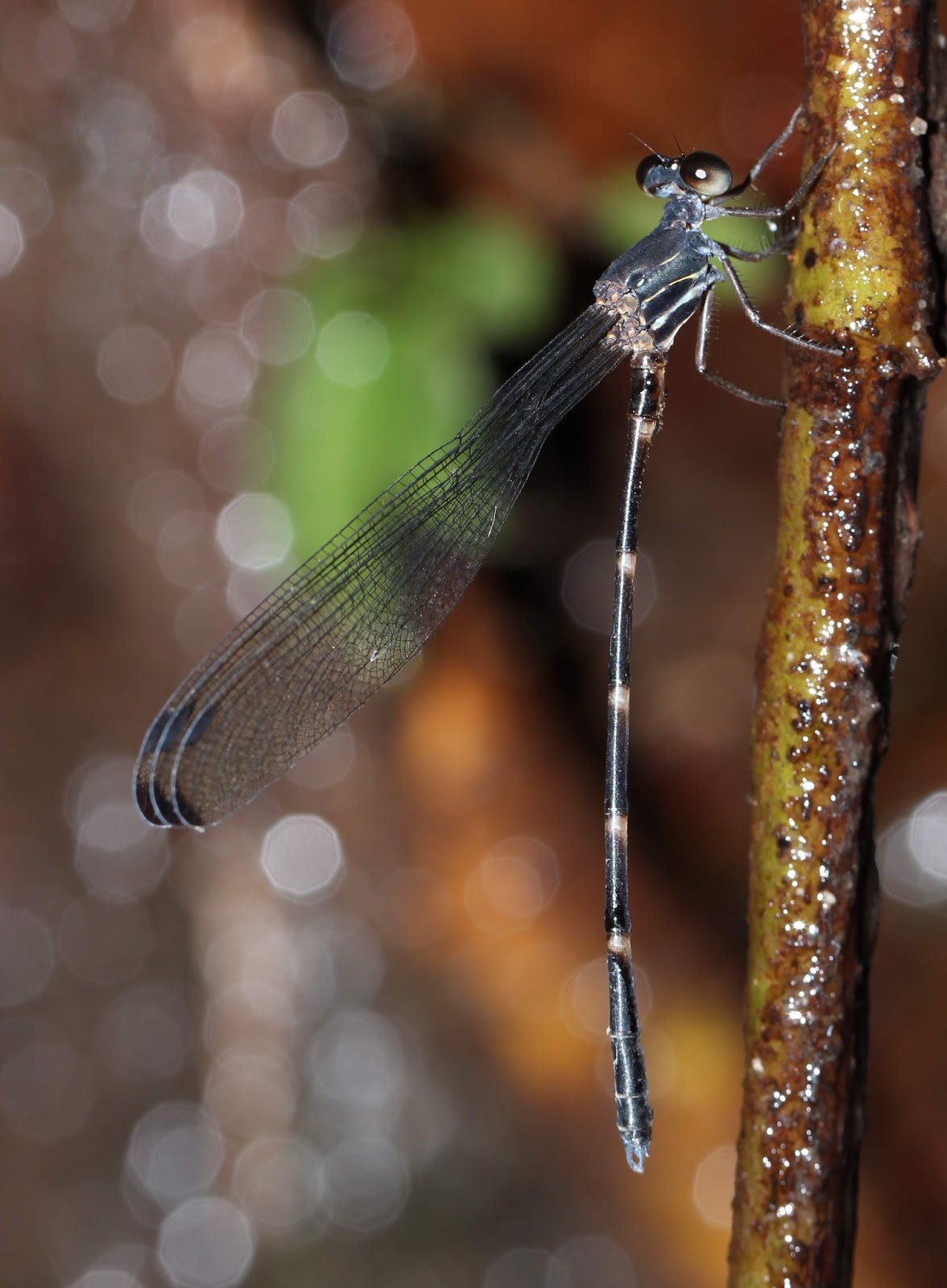
9 and 10 May, it seems ages ago, I visited Ha Tinh Province with Toan, close to the border with Lao PDR. On both days I saw at a small trickle under dense forest cover a species I had hoped to find for a while now: Devadatta cyanocephala. Unlike the Devadatta ducatrix / kompieri doublet of the previous posting, this is a distinctive species. Not only has the male markings on the thorax, both male and female have the bluest faces imaginable.

Devadatta cyanocephala is known from Lao and several provinces in Vietnam, including Ha Tinh. As far as I know this is the furthest north is has been recorded until now. When I revisited the place in June I could not find any, so possibly  it is a spring species.

Male Devadatta cyanocephala. Like congeners darkened wingtips. But it has pale lines on the thorax over the sutures.

Under this angle the distinctive blue face becomes apparent

And right from the front it can no longer be ignored: this is a blue face. It makes it easy to separate this species from its cousins. Imaging being a small bug and being devoured by something so blue! What a way to go.
Here is a not so good shot in hand of the female. Note the broad stripe over the flank.

Her face is still blue, but not as blue blue as that of the male


Saturday, 1 August 2015

Devadatta ducatrix and D. kompieri - an appraisal

Until this year, the identification of Devadatta specimens in Vietnam seemed straightforward. There was one rather dull looking species called D. ducatrix and there was a slightly less dull species with a blue face called aptly D. cyanocephala. And because the situation was simple, I did not collect specimens of the dull species, which is a regular occurrence in hill and mountain forest in the north of Vietnam, where it inhabits shaded trickles.

This situation changed drastically after I last year explained the productive Yen Bai site to Toan and he visited it in the middle of May. He collected several Devadatta specimens and concluded that some represented an as yet undescribed taxon. This spring the new species was published in Zootaxa by Phan, Sasamoto and Hayashi. They did me the honor of naming the new species after me.

The differences between D. ducatrix and D. kompieri are slight and based on a comparison of very few specimens. But at the same time the complete set of differences should enable identification, although the authors stress that it is important to collaborate their findings with DNA analysis in the future, when the extent of the populations is more clear and more specimens are available.

Obviously I was keen to see this species carrying my name for myself and in the middle of May headed to Yen Bai Province. This year, I had decided, I would collect Devadatta specimens to compare. The first time I ran into the species was on May 14 still east of Nghia Lo on a mountain pass and almost 80km from Tu Le, where the species had been found by Toan. Later that day I also had them in that area. What is more, over the spring and early summer I noted the species regularly in Yen Bai, but also caught a male of what I concluded was D. kompieri near Lao Cai along the lower part of the road up to Sa Pa. In fact, I found few specimens of D. ducatrix this year, for instance in Thanh Hoa, Lang Son and Cao Bang Provinces.

I used a combination of characters from Phan et al. to identify the specimens, but also noted that some were not consistent. I caught for instance a specimen in which the number of cells between the first anal vein and the trailing edge of the hindwing (should be 2 in D. kompieri and 3 or more in D. ducatrix) was 2 in one wing and 4 in the other. Sadly it afterwards escaped when I tried to administer some moisture to it to keep it alive.

Today is a very rainy day in Vietnam and anyway, the season for Devadatta is over, so today I had a closer look at all specimens collected this season. I have 9 usable D. kompieri males, 1 D. ducatrix male and one female of both species (presumably), plus a scan of two presumed D. ducatrix males from Cao Bang.

Let's first summarize the differences described by Phan et al. for the two species. I paraphrase from the article, but slightly adjusted to exclude the references to D. yokoii.


(1) D. kompieri is smaller (Hw 31–34; abdomen including appendages 32–37) than the more robust D. ducatrix (Hw 33; abdomen including appendages 39 mm in our specimen, and each 40 and 43.3 mm in holotype (Lieftinck 1969)). (2) Wings of D. kompieri, compared with those of D. ducatrix, are proportionally shorter and have a less rounded apex and a narrower dark marking at tip. (3) The pterostigma is proportionally longer and narrower in D. kompieri than in D. ducatrix. (4) The venation of D. kompieri is less dense, especially in the space between first anal vein and posterior wing margin in the Hw, which consists of two cell rows at most, whereas there are two to three rows in D. ducatrix. (5) Superior appendages of D. kompieri are slimmer, while those of D. ducatrix are broader). 


The authors compared 4 specimens of the new D. kompieri with a single male D. devadatta also caught at Tu Le. Based on the extent of the dark marking at the tip of the wings and the shape of the pterostigma all my specimens from Yen Bai and the specimen from Lao Cai seem to be D. kompieri, whereas the one male from Thanh Hoa should on the basis of these characters be D. ducatrix, as should the two males I scanned from Cao Bang. If we look closer at the 9 D. kompieri specimens, length of abdomen (incl appendages) ranges from 36 to 41.5 mm (this is the specimen from Lao Cai, largest for Yen Bai is 41mm (2 specimens). This overlaps with both the one specimen identified by Phan as D. ducatrix and the size of one of the types from Lieftinck. My own D. ducatrix specimen has 38mm. Therefore it is questionable whether the size criterion is useful.


Hindwing length in my specimens ranged 32-38mm, again including the measurements of Phan's D. ducatrix specimen and also that of my own (34mm). This is logical, larger specimens will have larger wings generally. It illustrates that these measurements are of limited value to separate the species.


Relative hindwing length compared to abdomen length ranges 0.86 - 0.93 in D. kompieri (N=9) and 0.89 - 0.96 in D. devadatta (N=3). Although sample size is very limited, this may indicate that on average D. devadatta has slightly longer wings relatively. Nevertheless, given the overlap and small sample size, it remains to be seen whether in certain cases this may be of value.


In the pterostigma of the D. kompieri specimens (in 8 out of 9) the length of the pterostigma that is confluent with the costa is less than half that of the total length. In the D. ducatrix specimens it is slightly more than half. And the number of cells completely covered by the pterostigma is 4 in D. kompieri (one specimen 5), whereas in D. ducatrix it is 5 (one specimen 4). Therefore the shape and size of the pterostigmata in combination with the denser venation of D. ducatrix may be an indicator of specific identity.


However, the number of cell town between the first anal vein and the trailing edge of the hindwing appears to be of limited value and even varies within specimens between left and right. Sample size is limited, but number of cell rows (the maximum in the field) ranges 2-3 in D. kompieri (with only 2 specimens with maximum of 2 in both wings) and 3-4 in D. ducatrix (but one specimen with only 2 in one wing).


Last, I postulate that there is no consistent difference in the width of the apical part of the the superior appendages, whereas the inferiors are rather variable in outline in dorsal view. I consider the appendages of no value to support identification, but it must be stressed this is based on a single male D. ducatrix being no different from 9 males of D. kompieri.


In addition, although not given as an ID characteristic, the slightly amber colour of the wings in D. kompieri when mature also occurs in D. ducatrix when mature.


To summarize for the male specimens, apart from the size and shape of the apical spot on the wings, there is little to consistently support that this is a valid indicator of specific identity. Size is of no value, and shape and relative length of the wings either extremely limited or also of no value. It does seem that the density of wing venation may have some very limited usefulness, although D. ducatrix with only 2 cells between anal vein and trailing edge are to be expected, given that one of the 3 specimens examined has only 2 cells in one wing. The sample of D. kompieri does not contain any specimen with an abundance of 3 row cells or with 4 rows (although escaped presumed D. kompieri specimen had one wing with 4). In addition, the shape of the pterostigma also appears almost consistently to be different. Shape of the appendages appears not to be of value for identification.


When comparing the single females of both species (identified on the basis of extent of apical spot and association with males, although not in tandem) reveals that abdomen length of D. kompieri is 35.5mm compared to 32 for D. ducatrix. Hindwing is 34 in D. kompieri and 32.5 in D. ducatrix, thus supporting the conclusion that D. ducatrix is not consistently more robust than D. kompieri. Both specimens have 2 cells maximum between the first anal vein and the trailing edge, but D. kompieri has only 3 cells covered by the pterostigma against 4 in D. ducatrix, which is in line with the males. Whether this is consistent remains to be seen, given that the comparison is based on single females.


However, the cerci of the female D. kompieri are much shorter and more like an equilateral triangle than that of D. ducatrix. In D. kompieri to ovipositor extends beyond the tip of the cerci, in D. ducatrix this is reversed.


So, not all hope is lost. It is possible that D. kompieri and D. ducatrix are different, but clearly they are very similar species or subspecies. Differences in wing venation especially are of limited value when so slight as is the case here. Most differences appear clinal. Whether the differences are the product of peculiarities in geographical populations or truly represent separate species may require more research and, as the authors rightfully suggest, collaboration by DNA analysis. If it can be shown that the structural differences between the females hold up in larger samples this will support the case for two different species. 


Devadatta kompieri male from Lao Cai. The largest specimen and somewhat in between the two species as far as the shape of the apical spot in the fore wing goes. Number of cell rows and shape of pterostigma consistent with D. kompieri.
Same specimen from Lao Cai in lateral view
Male Devadatta kompieri from Yen Bai. Long pterostigma with few covered cells, two rows of cells in hindwing between first anal vein and trailing edge, limited apical spots.

Same male in lateral view

Rather typical Devadatta ducatrix male from Thanh Hoa. Note extensive apical spots, particularly in hindwing, more square pterostigma with 5 covered cells and 3-4 cell rows in hind wing between anal vein and trailing edge
Same male in lateral view

Two female Devadatta. Presumed D. ducatrix top and presumed D. kompieri bottom. Pointed face of latter due to opened mouth.
S8-10 of presumed female D. ducatrix. Note slender and long cerci
S8-10 of presumed female D. kompieri. Note shorter and stubby cerci.


Finally, two males of D. ducatrix from Cao Bang. Bottom male with limited extent of apical spots possibly result of very immature state, but specific identity not entirely sure (if we assume there are indeed two valid species). What is of interest here is that this specimen has 2 cell rows between first anal vein and trailing edge in right hindwing, but 3 in the left. In escaped presumed D. kompieri even more extreme difference observed of 2 in one wing and 4 in other.

Thursday, 23 July 2015

Nesoxenia lineata - new for Vietnam

July 23 I received a message from James Holden. He is currently surveying Odonata in Cat Tien National Park. He alerted me to a small Lathrecista asiatica-like dragonfly that was not just smaller, but had very different venation. Could I help?

When I checked my earlier post on Lathrecista, I noticed to my excitement and shame that I had included there a photo of exactly the same species James had now found, caught by me on August 5 last year.

Superficially the two species are very similar, but the venation is very different. The smaller species (James measured 27mm total length) has two rows of cells between the cubital space and the wing margin in the hind wing. It has a free triangle in the hind wing, but in the fore wing the triangle is 2-celled and the sub triangle 3-celled. There are two bridge cross veins in both wings. And amazingly, there is no anal loop in the hind wing. These characters fit very well Nesoxenia lineata, but that species has distinctive thoracic markings. I have found no pictures with the extensive pruinosity of both mine and James' specimen. And N. lineata is apparently somewhat larger.

Rory Dow commented that the venation indeed points to N. lineata. He also mentioned that he would not be surprised if the heavy pruinosity is either the result of age or of geographical variation. And that the size is close enough, given the likely small sample on which the size of the species is probably based in the literature.

Yesterday I received another photo from James, this time of a female. This female too seems lightly pruinose, but the underlying pattern of the thorax is clearly visible and fits N. lineata like a glove.

N. lineata has been recorded in Thailand, but has never been recorded from Vietnam. But judging from both my own and James' observations, it is regular at Cat Tien. Because both our males and the female display heavier pruinosity than usual, this may be a peculiarity of the Cat Tien population.

The possible Nesoxenia caught by James. Note the venation characters. Red extends onto S9. 

This is Lahtrecista asiatica. Much larger, distinct anal loop, 4 rows of cells between cubital space and wing margin in hind wing, only 1 bridge cross vein
My specimen of last year August, showing obscured thoracic pattern.

Blow-up of hamule, strongly hooked
Photo by James, including his hand, of female N. lineata, showing the typical thoracic pattern of the species


Tuesday, 21 July 2015

Anisogomphus maacki - new for Vietnam

June 18 I noticed a rocky stream next to the road that runs just north of Pia Oac and connects Cao Bang to Ha Giang. I decided to climb down to it and give it a go. After a short while surveying I noticed a gomphid perched on the rocks in the stream that first reminded me of Stylurus, because of the wide expansion of S8-9 and the markings on it. But in hand I noticed the typical Anisogomphus spines on the femora. A bit at a loss I checked Chao and found out that it was just that. Anisogomphus maacki, a species that years ago I had also seen in Japan.

This is noteworthy, its occurrence in Vietnam, because its occurrence in the south of China, although reported, has been questioned. The species has a wide distribution, ranging from Nepal to Japan, but generally is believed to be a more northern type of gomphid.

That is why it was an even larger surprise that I ran into it again on June 23 just below Sa Pa in Lao Cai. Which means that it cannot be that rare and must be rather widespread. Here too I found it at a rocky stream in relatively open terrain. At least 7 males were present.

There are several Anisogomphus species in Vietnam. Besides the relatively uncommon Anisogomphus koxingai that also includes Anisogomphus tamdaoensis, which was placed in the wrong, but closely related genus Merogomphus originally, but now placed in Anisogomphus. In fact, it would not surprise me if it would turn out to be a junior synonym of Anisogomphus pinratani from Thailand. The two species are very similar, to say the least. Anisogomphus tamdaoensis is a widespread and common species. And then there is the Anisogomphus sp. novum that I first saw at Pia Oac. As a matter of fact I saw a female at the same place as where I first saw Anisogomphus maacki. That location is actually not that far from where I saw this unknown species first (about 40-50km).

Male Anisogomphus maacki, with widely expanded S7-9 and big yellow markings, although quite reduced on S9.

Another shot of the same individual from Cao Bang
Close-up of the thorax and head of a different specimen

S7-10 and appendages in dorsal view. This specimen even less yellow on S9

Face of the same second specimen from Cao Bang

One of the males from Lao Cai. Note the large spines on the distal part of the femur of the last pair of legs.

S7-10 and appendages in dorsal view, this specimen clearly with more yellow on S9

Scan of the Lao Cai specimen

Saturday, 18 July 2015

Philoganga revisited - the case for several species

*Text slightly adjusted on August 19, 2019. The reference to P. robusta being sometimes pruinose may be mistaken, it could just as well be P. vetusta. The species incertae in fact is P. montana and has been recorded also in 2018 in Cao Bang (male and female).

I already posted in the past on Philoganga. At the time I discussed the occurrence of whiter specimens presumably P. robusta, if we consider that the colour pattern of the specimens is a reliable indicator of specific identity.

This spring I noticed in early May that Philoganga were quite common on Mau Son mountain in Lang Son Province. The thing was that they were consistently pale bluish-green on the abdomen and none where orange. This triggered me in collecting more Philoganga this year for comparison. Although sample size is still small, it supports the impression in the field from larger numbers of specimens that Mau Son specimens were larger and more robust on average than P. vetusta.

The issue is complicated, because older males seem to sometimes develop pruinosity that makes them appear whitish. This has not been established amongst the population of P. robusta of Mau Son. There is also some variability in size of specimens, especially, it would seem, in P. vestusta.

Wilson & Reels (2001) reviewed the literature on Chinese records of Philoganga. There is no need to repeat here their excellent overview of mistakes and inconsistencies in the records of these very similar species. What they did conclude was that some characteristics mentioned in the literature to separate the species were clearly erroneous. The number of cells in between the wing margin and 1A is such a character. Indeed, I could find no consistent difference between what I consider P. vetusta and P. robusta in this character.

Wilson & Reels do suggest that the presence or absence of an antehumeral stripe could be of help. I found that the antehumeral may be somewhat more prominent in P. robusta, but that it can also be prominent in P. vetusta. Prominence seems to be related to age, with older specimens becoming darker on the dorsum of the synthorax with reduced or faded antehumeral.

The number of antenodal cross veins has also been mentioned as possible identification character. This was already pointed out by Wilson & Reels as invalid. Indeed, I counted 12-14 antenodals in definite P. vetusta (N=4) and 13-15 in P. robusta (N=3). Likewise postnodals range from 30-31 in P. vetusta to 29-34 in P. robusta. I have found no differences either for the few females I collected, but it is hard to draw conclusions, as the specific identity is difficult to prove, although one was caught in tandem with P. vetusta male and thus presumably that species
.

Wilson & Reels mentions that abdomen size of specimens from Hainan for P. robusta was 61.0 mm. My specimens are slightly smaller, 56-58.5 mm. They are however clearly larger than the bright orange typical P. vetusta that I was able to collect, which ranged from 51-54mm. I plotted the sizes in a graph replicated below.

Chart 1. Four definite P. vetusta from Xuan Son and two definite P. robusta from Mau Son are plotted by size (abdomen incl appendages versus hind wing length). Red crosses refer to two pruinose specimens, both from Xuan Son. The largest appears by colour to be P. robusta, the other could be either. Green squares refer to one teneral specimen from Tam Dao, possibly P. robusta, and one to Philoganga species incertae, see main text. Thus although non-pruinose whitish specimens appear to be constantly larger than orange specimens (but beware of sample size) there is a small area of overlap.

It thus seems that the hypothesis that P. robusta can be identified by colour alone from P. vetusta is supported by the measurements of the specimens involved. Nevertheless more specimens are needed and from different areas to substantiate this. After all, local populations may be genetically homogeneous, which may influence the size distribution.

In the graph a single Philoganga species incertae is represented by one of the green squares. This specimen was caught in Cao Bang Province close to Cao Bang city on May 20. From its size it seemed to fit P. vetusta. However, the dorsum of S1-4 is black, not even whitish. It has a cream bar over the cranium of the head, which is absent in either P. vetusta and P. robusta when mature, although this may be an indication that the present specimen is still immature. In fact at first I dismissed it as just that, an immature P. vetusta. However, as can be seen from the pictures below, it has two strange characteristics in its wing I have not seen in any other Philoganga. The most striking is that vein 1A seems to run on further than in other species, where it curves back to the wing margin. Therefore even at the wing margin there is only one row of cells between 1A and CuP, whereas in P. robusta and P. vetusta there is a whole field of easily 10 cells. Furthermore the quadrangle is much more square than the elongated quadrangles of either P. robusta and P. vetusta. These aspects indicate the possibility of this being in fact an unknown species of Philoganga.

Two males Philoganga robusta from Mau Son and what is presumably a female of the same species. Note the blueish-green colour of S1-4, although the smallest specimen also has a hint of orange.
The same three specimens in lateral view. They are not pruinose, but the males lack orange on the thorax or first abdominal segments.
Three typical P. vetusta males from Xuan Son, displaying bright orange abdomen and varying degrees of clarity of the antehumeral stripe. The top right specimen is similar in size, but has pruinosity covering the first few abdominal segments and sides of thorax. It is difficult to say whether this is vetusta or a small robusta.
Typical P. vetusta male caught in tandem with female. Pattern of dorsum of S9 of female is different from possible female P. robusta. However, this female is the larger of the two, 72mm total body length against 67mm for the Mau Son female.
The same specimens in lateral view, the male displaying bright orange both on the thorax and on the first abdominal segments.
Aged specimens from Xuan Son. Top male P. vetusta showing that aged individuals at least not always covered in pruinosity. Below very large aged specimen with pruinosity on the thorax, but very dull abdomen, tentatively identified as P. robusta on combination of size and lack of bright orange.

Philoganga species incertae. Note the wing pattern with absence of a field between 1A and CuP,  which is very different from the wing pattern of specimens illustrated above. Note also bar over cranium.

Hind wing detail of Philoganga vetusta, showing 10 cells between location where 1A reaches the wing margin and location where CuP reaches wing margin and field at widest location 3 cells wide. 
Hind wing detail of Philoganga species incertae, displaying three cells only between 1A and CuP, and field, if you can call it that, 1 cell wide. Apologies for the legend (A1 versus 1A)

Tuesday, 14 July 2015

Two additional Leptogomphus species


On May 16 I caught a female Leptogomphus in the Tu Le area in Yen Bai Province. On close inspection of the occipital ridge it revealed to smaller lateral horns, protruding backwards, and two central horns bend forward. I was a little baffled and consulted Haruki Karube, who was quick to point out that this was indeed Leptogomphus uenoi, described by Asahina in 1996 and of which the IUCN website says there is doubt it is a valid species, as it was based on a single female. Karube has put that straight, by describing both the male and female this year. The male looks surprisingly like L. perforatus, so it is easy to overlook it, even in the hand. But the female is, at least in hand, distinctive enough. I was happy to find it, of course. It may be widespread, as is indicated by the original specimen being from Sa Pa, the specimens of Karube being from Bach Ma National Park, and my own being from Yen Bai.

On June 17 I caught another female for close inspection on Pia Oac Mountain in Cao Bang Province. This female has two very prominent central horns on the occipital ridge that are both pointing forward and have very thick bases, that touch one another. It misses the backward pointing lateral spikes. I have not been able to match this female with any known species. It may well belong to an as yet undescribed species. Anybody any ideas?

Leptogomphus uenoi, female. Yes, it is a Leptogomphus and yes, other than that it is difficult to tell what species unless you check the occipital ridge.
But if we do so, we see this. 4 horns, to pointing towards the back and to pointed forward in true bull fashion, typical of L. uenoi.
Here at another angle, showing the bull horns
So what it this? It looks exactly the same as the L. uenoi female, although in fact the larger horns are already visible here in lateral view. It is Leptogomphus species incertae.
This is what they look like in frontal view: two thick-set adjoining horns
And here at a different angle you can again see their thick shape, not spike-like, as in many other species, but a water-drop shape. Leptogomphus species incertae.