I just returned from a field trip to REGUA in Rio de Janeiro State in Brazil (which is why the blog has been silent), where I am working on a photo field guide. An amazing 191 species during this visit makes it a place worth visiting. Now it is time to start writing up. And, of course, the season will be starting soon in the north of Vietnam too. Cannot wait for the gomphids to start flying again!
I wish all of you a great and Odonate rich 2014 and ever increasing water quality.
Saturday, 8 February 2014

Wednesday, 18 December 2013
Onychargia atrocyana
This weekend I was on a mission in the Mekong Delta. And I know that I said I would be back next year, but when visiting the a Fish Breeding Center (with Pantala flavescens and plenty of Brachythemis contaminata), I plucked a small blackish damsel from a bush near the entrance. A few quick and dirty shots with the iPad, and I released it again. It is a species that undoubtedly is common on spring and early summer, even in the north, but that I had as yet failed to see: Onychargia atrocyana. So, even if the photos are terrible, I would like to share this with you! (Until next year I can replace these with better pics).
 |
| Onychargia atrocyana, male |
 |
| And the same male ventrally |
Wednesday, 11 December 2013
Prodasineura autumnalis
Out of three Prodasineura species mentioned in Do & Dang, there is one that even based on the scarce available material for Vietnam is widespread and this is the rather drab Prodasineura autumnalis. I have seen it all over the place, along better quality and lesser quality small streams in or near hills, at least when there is some wood along them. You see a lot of females too and often tandems. They hover readily above the water or hang from the tips of snags and leaves. The males are blackish all over, but the females have a nice stripy pajama. This may well be the last entry for this year. Coming weekend I have to work and thereafter I will be elsewhere for a while. But mind you, in February this blog will be filled with new entries with a vengeance.
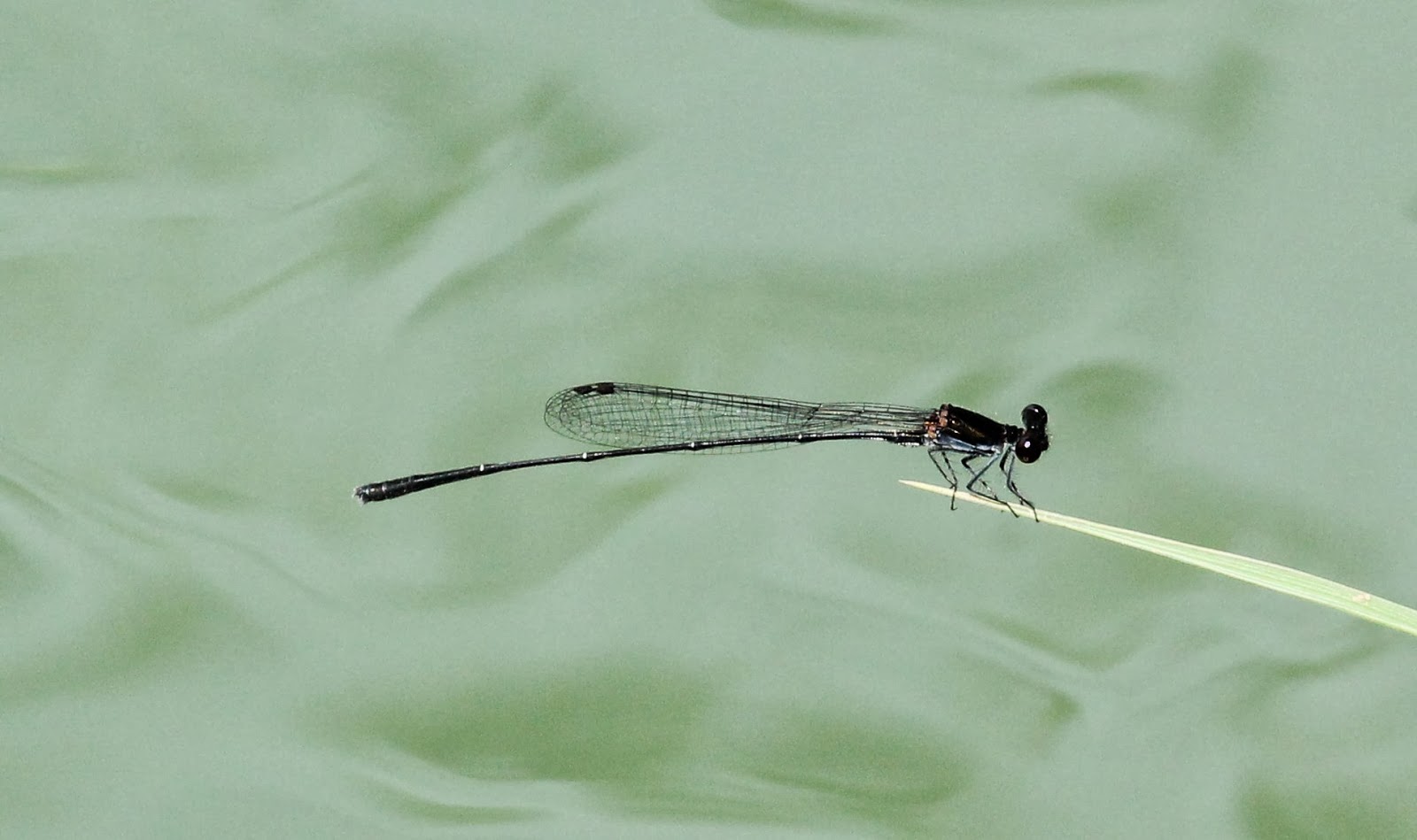 |
| Prodasineura autumnalis, male |
 |
| Prodasineura autumnalis, female, far away shot. As is so often the case, no good photos of the more common species. |
 |
| Prodasineura autumnalis, immature male |
Tuesday, 10 December 2013
Paracercion continued again
Rory Dow was kind enough to provide photos of Paracercion malayanum from Java deposited in the collection at Naturalis in Leiden (Netherlands). Below the posterior view, please compare that to those in the previous message on the subject, and also the lateral view. I include with it the lateral views of specimen from Huu Lien and Van Long published earlier, to avoid that the reader will have to scroll too much. Do you not agree that there is rather great likeness between the three?
 |
| "Paracercion malayanum" from Java |
 |
| Likewise, from Java |
 |
| P. melanotum from Huu Lien |
 |
| P. "melanotum" from Van Long |
Sunday, 8 December 2013
December 8, Xuan Son in the winter sun
This Sunday, I drove to Xuan Son, to see what has changed since I last visited. Like in Huu Lien, water level had dropped, but the good streams were still good. Here too about 30 species for the day, but numbers for most were down. Coeliccia sasamotoi was the exception, being very much in evidence all over the place. What is interesting is that several species recorded for Huu Lien in summer, but completely absent during all our visits this November / December were still commonly flying at Xuan Son. Aristocypha fenestrella and Matrona basilaris were easily found. Also Euphaea masoni, only seen during our first visit to Huu Lien a month ago and not since, was still about in small numbers. What makes them stay on here?
I bumped into the following species: Matrona basilaris, M. taoi, Vestalis gracilis, Neurobasis chinensis, Atrocalopteryx coomani, Vestalaria miao, Noguchiphaea yoshikoae, Heliocypha perforata, Aristocypha fenestrella, R. "arguta" (I took pictures of several in hand, with hardly any orange on S9-10 to quite a bit), Euphaea masoni, Agriocnemis femina, Ceriagrion auranticum, C. fallax, Pseudagrion pruinosum, Coeliccia onoi, C. scutellum, C. sasamotoi, Indocnemis orang, Copera marginipes, C. vittata (I must have overlooked it before), Boyeria karubei, Orthetrum sabina, O. pruinosum, O. glaucum, Diplacodes trivialis, Neurothemis fulvia, Palpopleura sexmaculata, Crocothemis servilia, Trithemis festiva, T. aurora.
I bumped into the following species: Matrona basilaris, M. taoi, Vestalis gracilis, Neurobasis chinensis, Atrocalopteryx coomani, Vestalaria miao, Noguchiphaea yoshikoae, Heliocypha perforata, Aristocypha fenestrella, R. "arguta" (I took pictures of several in hand, with hardly any orange on S9-10 to quite a bit), Euphaea masoni, Agriocnemis femina, Ceriagrion auranticum, C. fallax, Pseudagrion pruinosum, Coeliccia onoi, C. scutellum, C. sasamotoi, Indocnemis orang, Copera marginipes, C. vittata (I must have overlooked it before), Boyeria karubei, Orthetrum sabina, O. pruinosum, O. glaucum, Diplacodes trivialis, Neurothemis fulvia, Palpopleura sexmaculata, Crocothemis servilia, Trithemis festiva, T. aurora.
 |
| Old male Euphaea masoni |
 |
| Another male with hole in wing |
 |
| Matrona basilaris, male, was still common |
 |
| Matrona basilaris, female |
 |
| Atrocalopteryx coomani, male |
 |
| Matrona taoi, male, only one and damaged male around |
 |
| Pretty Coeliccia sasamotoi, male |
 |
| Ceriagrion fallax, male |
 |
| One of several captured Rhinocypha cf. arguta, with at least some orange on S9-10. |
 |
| Very nice male Copera vittata, overlooked previously? |
7 december at Huu Lien
We visited Huu Lien on the 7th to find the female of the "Pseudagrion". It was not too warm and not too sunny, but it was a good day. Clearly numbers were dropping and we only saw about 30 species, but hey, it is December. No Atrocalopteryx species, but supercool Labrogomphus torvus was still around. Water levels had dropped and some places had dried up already.
 |
| Much nicer sitting like this, than in hand: Labrogomphus torvus, male |
 |
| The same male, after it chased a butterfly and came back |
Paracercion continued
We now have had several posts on (Para)cercion malayanum en P. melanotum. Originally I was under the assumption that the species at Van Long, with females similar to P. malayanum in Thailand, was P. malayanum. This is also how Sebastien published it on his blog. Subsequent comparison of the appendages with males from Huu Lien made it look conveniently different, if closely related. I then found a typical P. melanotum female at Huu Lien. Put this together, then we have a different species at Van Long, similar to P. malayanum. However, the two males I collected the other day in posterior view are rather different from my first specimen from Van Long and in fact are very similar to P. melanotum. What is more, Rory Dow was kind enough to send me photos of posterior view of P. malayanum from Java. It looks suspiciously similar (to both the new specimens from Van Long and to that of Huu Lien.
It makes one wonder whether P. malayanum and P. melanotum are truly different. The photos from Thailand show males with wider blue stripes on the thorax (antehumeral), otherwise look very similar. The side view of specimens from Huu Lien and Van Long again is almost the same and goes well with the Java specimen. The females are rather different, but I have a female from Van Long with in fact a set of antehumeral black lines not unlike P. melanotum. Anyway, until I have close-ups of the prothorax of the females at Van Long (next year), we do not know if they are structurally different or similar to P. melanotum. For the time being I will consider the Van Long species as P. cf melanotum and the Huu Lien one as P. melanotum. P. malayanum may or may not occur in Vietnam, but I have difficulty proving it.
Here is the Huu Lien posterior view once more. With it is the new Van Long posterior view. If Rory will give permission, maybe I can add the Java photos too.
 |
| Huu Lien P. melanotum |
 |
| Van Long new specimen Paracercion sp. |
Subscribe to:
Posts (Atom)