Thursday, 4 June 2015

Priscagrion kiautai - a new genus and species for Vietnam*

*This entry was adjusted when the identity of the mystery species was established through the kind help of Wen-Chi Yeh and Keith Wilson.

The middle of May I was alerted by Toan that he had seen an unknown species of Megapodagrionidae at Pia Oac, a place I regularly visit myself. Excitedly I went to check, after I had met with Toan in Cao Bang and seen his specimens, which showed indeed something very unusual. On May 20 I visited Pia Oac and saw 2 males of his species. On May 31 I visited again and this time saw at least 6 males. The female still needs to be located.

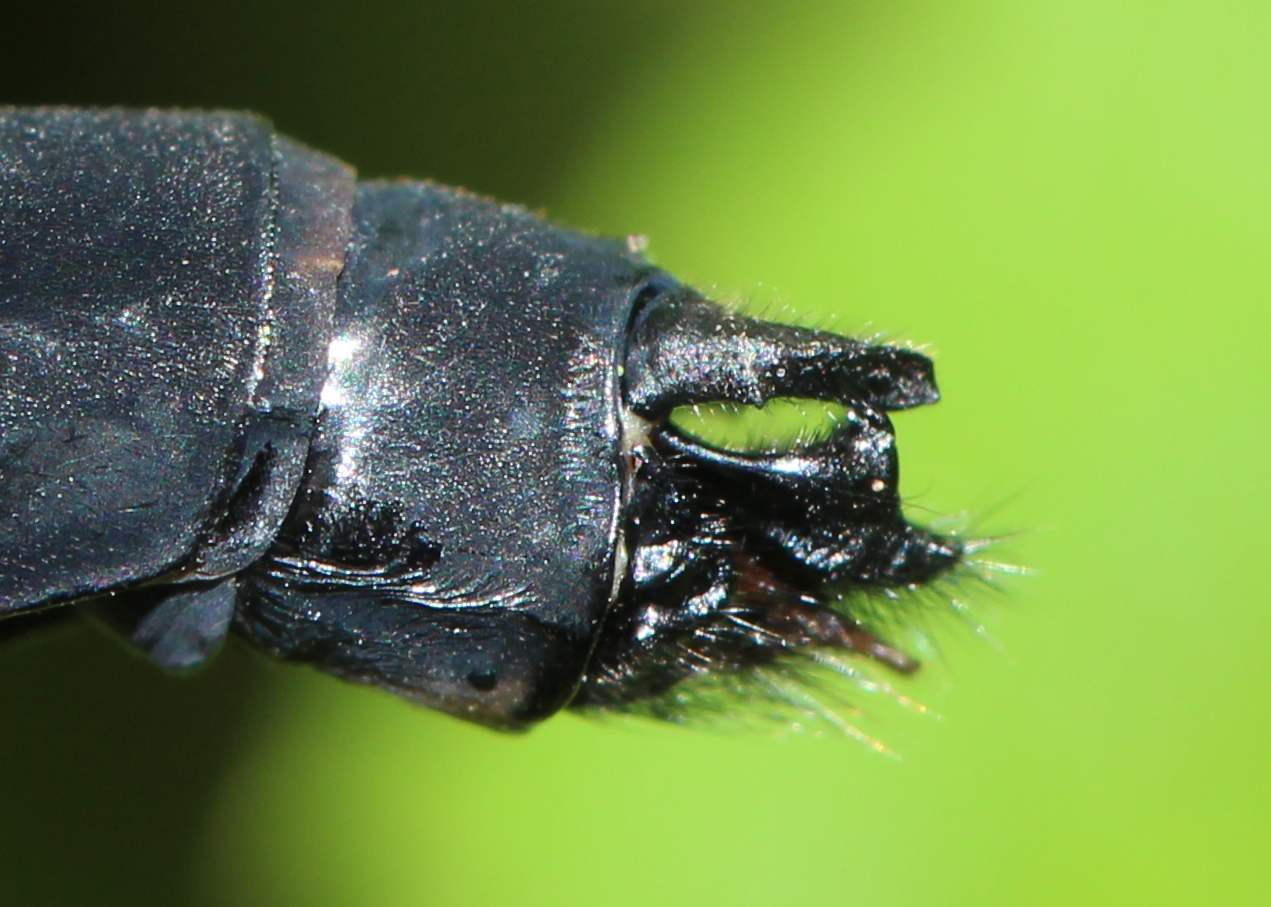
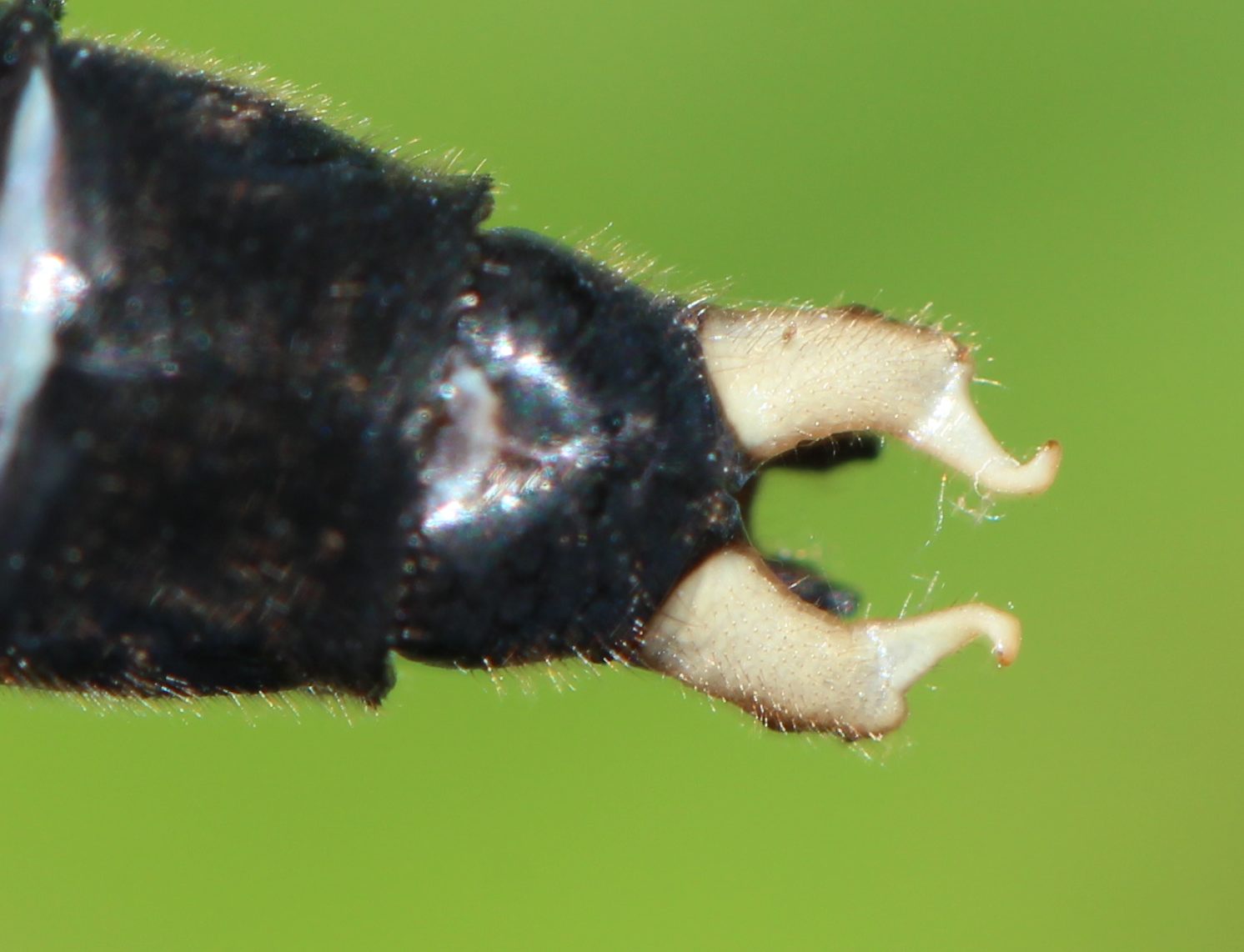
This is a robust damselfly, that sits on exposed branches, twigs, vines and sometimes leaves in shady places along a stony stream under forest cover. As it sits quietly with wings spread out it is easy to overlook, where it not for the bright blue abdominal tip. Otherwise it is quite dark in appearance. Apart from the curved superior appendages the forked inferior is also striking. After initial bewilderment Wen-Chi Yeh helped me out by pointing to Priscagrion. Subsequent communication with Keith Wilson confirmed his suspicion that this is a Priscagrion species. Priscagrion was described by Zhou & Wilson in 2000 and contains two species, Priscagrion kiautai and P. pinheyi. Although P. kiautai has darkened wingtips in the description, based on specimens from Guizhou Province in China, the other characteristics seem to fit very well, notably the exact shape of the appendages. Although subsequent research may point out this it in fact a closely related, but different, (sub)species, for the moment it seems safe to identify the mystery damsels as P. kiautai, a great addition to the Vietnamese fauna.

Priscagrion kiautai in its dark surroundings
A different male enticed to sit on a leaf on May 31

Facial pattern of the male
The same species in hand on May 20

Appendages in dorsal view
And in lateral view. The shape of the inferiors is intriguing.


Wednesday, 3 June 2015

Watanabeopetalia - cool Chlorogomphids

On May 18 I was lucky enough to catch two different Watanabeopetalia species in the Sa Pa area. This genus was established in 2002 by Karube, based largely on the shape of the penile organ, and contains 4 species, 3 of which occur in Vietnam, I think. These are Watanabeopetalia uenoi, W. usignata and W. ojisan. But at the moment I do not have all the literature, so I may have to update this later. Anyway, I caught a male W. usignata and a male W. uenoi. They can easily be separated on the basis of their very different facial patterns.

W. uenoi is known only from the Pia Oac and Sa Pa areas. W. usignata was known from Sichuan and Shaanxi in China and recently found also at Sa Pa. It is thus no surprise that I found both species at Sa Pa, but they may be regarded as specialties.

For those interested, this is genus 133 for the blog. There are still several that I have not posted yet. Boy oh boy, what diversity!

Male Watanabeopetalia uenoi, a pretty and slender species
Its face is orange brown
Appendages in dorsal view
And in lateral view

Superficially similar male Watanabeopetalia usignata
But a very different facial pattern
Different appendages in dorsal view (note inferiors)
And also quite different in lateral view
Both species in dorsal view. Left W. uenoi and right W. usignata. The latter is slightly larger. Note the different pattern on S2.


Cephalaeschna aritai - a peculiar Aeshnid

May 17 I was posting by a little pond near Sa Pa, waiting for a medium-sized dragonfly I had seen earlier that day (that subsequently turned out to be Procordulia asahinai), when at the end of the afternoon an Aeshnid appeared that started hunting erratically over the pond and nearby bushes. It seemed to have a very striped abdomen and I was lucky enough to be able to net it. In hand it did not look like anything I knew. Especially the thorax pattern was very peculiar. It was a female, but I was hopeful I might be able to find out what it was, exactly because of its weird patterning. I decided to write to Haruki Karube, who was quick to respond and pointed to Cephalaeschna aritai, a species he described from Sa Pa in 2003. Because the types where bought from local collectors there was some doubt about their exact origin, but this record proves that it indeed occurs in the Sa Pa region. The female and the male share the peculiar pattern on the thorax, making this species easy to recognize.

Female Cephalaeschna aritai, with interesting pattern of spots and lines both laterally and dorsally on the thorax, plus a very distinctly banded abdomen.
The interesting broken dorsal line and rectangular antehumeral spot.

Facial pattern in brown and pale yellow

Cephalaeschnid abdominal tip


Tuesday, 2 June 2015

Procordulia asahinai - Cordulids rule!


May 17 I was checking a small pond in the Sa Pa area when I noticed a medium-sized dragonfly hovering over the water. Before I could find out what it was, it had disappeared, leaving me puzzled. But the next day when I returned around noon it was there again and it turned out it was a smallish Cordulid, something I did not expect at all. I thought it might be a Hemicordulia species, but checking the literature I came across a species that looked quite similar and had been described from Tam Dao by Haruki Karube in 1997: Procordulia asahinai. At the time he also first thought he had collected a Hemicordulia species, but small auricles and a cross-vein in the anal triangle showed it was a Procordulia. I immediately checked my specimen for these characteristics and…BINGO! After that it was easy. This was Procordulia asahinai, a species occurring in the higher mountains of northern Vietnam. I love Cordulids, so a happy day!

Male Procordulia asahinai, a pretty species
The face in frontal view
Hamule in lateral view
Appendages in dorsal view
And the same in dorsolateral view


Two new and two old Anotogaster species

The last few weeks have been pretty productive where Anotogaster species are concerned. And these giants are a always a treat. They are big, bold and beautiful. They are also pretty confusing, with at least 5 different species occurring in northern Vietnam, all of which for instance occur around Sa Pa and often several species are present at the same streams (see also the very useful introduction on Vietnamese Anotogaster species by Haruki Karube).

Until now I had observed A. sakaii, the largest species, A. klossi and A. gigantica (the smallest, intriguingly). This year I again saw A. sakaii. On May 3 we observed a male on mount Mau Son in Lang Son Province, on May 20 I saw it in Pia Oac in Cao Bang Province and on May 25 I saw one at the Love Waterfall area in Sa Pa.

But on May 17 I also caught a smaller species in the Sa Pa area. This turned out to be A. chaoi. This somewhat smaller species resembles A. sakaii in that it has orange bases to its mandibles. But it is, as said, significantly smaller, with a deeper excavated frons and different appendages. On May 25 I saw at least 3 males at Sa Pa, and also a female. (There is some confusion about A. gregoryi, a species recorded from Thailand, that may have been confused with A. chaoi).

The male Anotogaster chaoi. Note the orange mandible base.
The face of the male in frontal view, showing the deeply excavated frons (relative to A. sakaii)
The female of A. chaoi, sharing the same pattern of the face and the small yellow lines along the posterior edge of S2.
The face of the female
Appendages of the male in dorsal view
And in lateral view

On May 25 I also found a freshly emerged male at exactly the same spot where a week earlier I had caught my first A. chaoi. But it was immediately clear that this fresh specimen was a different species, the magnificent A. sapaensis. Magnificent, because it has an all orange face, very different from the other 4 species known from Vietnam. This feature makes it easy to recognize. Other characteristics, like the shape of the appendages help verify the ID. After all it cannot be ruled out that there may still be undiscovered species about, so this check is necessary.

Against the unattractive background of discarded plastic the very attractive fresh A. sapaensis, right next to its exuvia.
The face in close-up, all unmarked orange brown 

On May 31 I caught my fourth species of this year at Pia Oac. This was A. klossi, which I had found there before. Like A. gigantica it has yellow bases to the mandibles, helping to separate it from A. sakaii and A. chaoi. A. klossi is a large species, close to A. sakaii, with the male being about 10 cm. It differs from A. gigantica not just in size, but also in the abdominal pattern, which is much reduced and more orange red ventrally.

Scan of the male A. klossi, with the much reduced banding on the abdomen, turning orange red ventrally.
The face of the same male, with the bright yellow mandible bases


Monday, 1 June 2015

Heliogomphus retroflexus - about time

On May 10 I was checking a stream in central Ha Tinh Province when I noticed a freshly emerged gomphid landing by the side of the stream. I quickly made a few shots and checking them in preview it dawned on me that this must be Heliogomphus retroflexus. This is a species with a wide range, across Mainland China, Taiwan, Hainan, and south to at least Lao PDR and northern Vietnam. In fact the type was collected in Tonkin. But I had not seen it and was keen to do so, after it recently had been recorded from the Tam Dao mountain range by Natalia von Ellenrieder and colleagues. To find it relatively far south possibly extended its range. The stream I found it at ran through heavily disturbed woodland and plantations.

To my big surprise I ran into it again in Xuan Son on May 30, and not just one or two, but at least 10-15 individuals, all taking refuge from the heavy sun along the karst cliffs in the forest along the main stream. Not only several males and females, but also several copula were chilling there. It is not a difficult to recognize species, with the characteristic appendages of the male and the ringed abdomen. Strange to find it in such numbers in a place extensively surveyed last year.

Male Heliogomphus retroflexus. Apologies for the bad angle. They all tended to sit higher  up.
This female was more obliging
Not to speak of this very kind copula. 
This is the male in hand. Note the bulging lamina.
The appendages in dorsal view
The female, similarly ringed and with a golden wash to the wing bases. Note also the curvy hind femora.
The original teneral male from Ha Tinh. The ringed abdomen is already apparent.

Onychothemis culminicola - addition to the Vietnamese list

May 9 I visited an area in Ha Tinh Province, close to the Laotian border, together with Toan. Along an open stream surrounded by forest I noticed a dragonfly perched on a twig that reminded me of South American Elasmothemis cannacrioides. Upon closer look it became clear what it was: Onychothemis culminicola. This is a widespread species in Southeast Asia, for instance from Indonesia and Malaysia, but also from Thailand and Lao PDR. Based on this it has been suspected it may also occur in Vietnam. Indeed, it does! It is quite an easy species to recognize.

Male Onychothemis culminicola, Ha Tinh Province