Friday, 25 November 2022

An updated list for my three visits to Phu Quoc in 2015 and 2016

During my stay in Vietnam I was able to visit Phu Quoc island, located off the coast of Cambodia to the west of the Vietnamese Mekong delta, several times. It has a very interesting Odonate fauna compared to the rest of Vietnam, with several rare species, not seen elsewhere in Vietnam. I visited the island from 28 December 2015 to 2 January 2016, again from April 12 and April 15, 2016 and finally from August 19 to 21, 2016. Some species are very local and also occur only in the dry or in the rainy season, so not everything can be seen in any one trip. I already published a list after my first trip. This list is updated here to include all records, to which I added the months in which species were recorded by me in Roman capitals. But first a few photos of good species not published here previously.
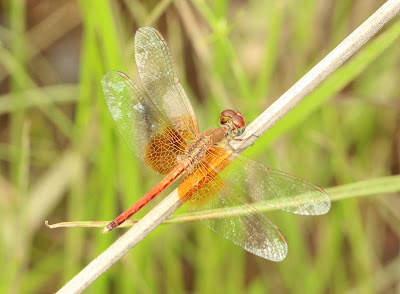
Neurothemis intermedia male, 19 August 2016 

A second Neurothemis intermedia male from August 19, 2016

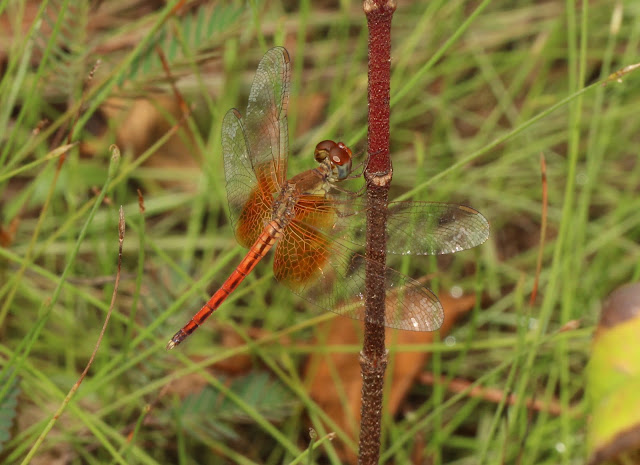
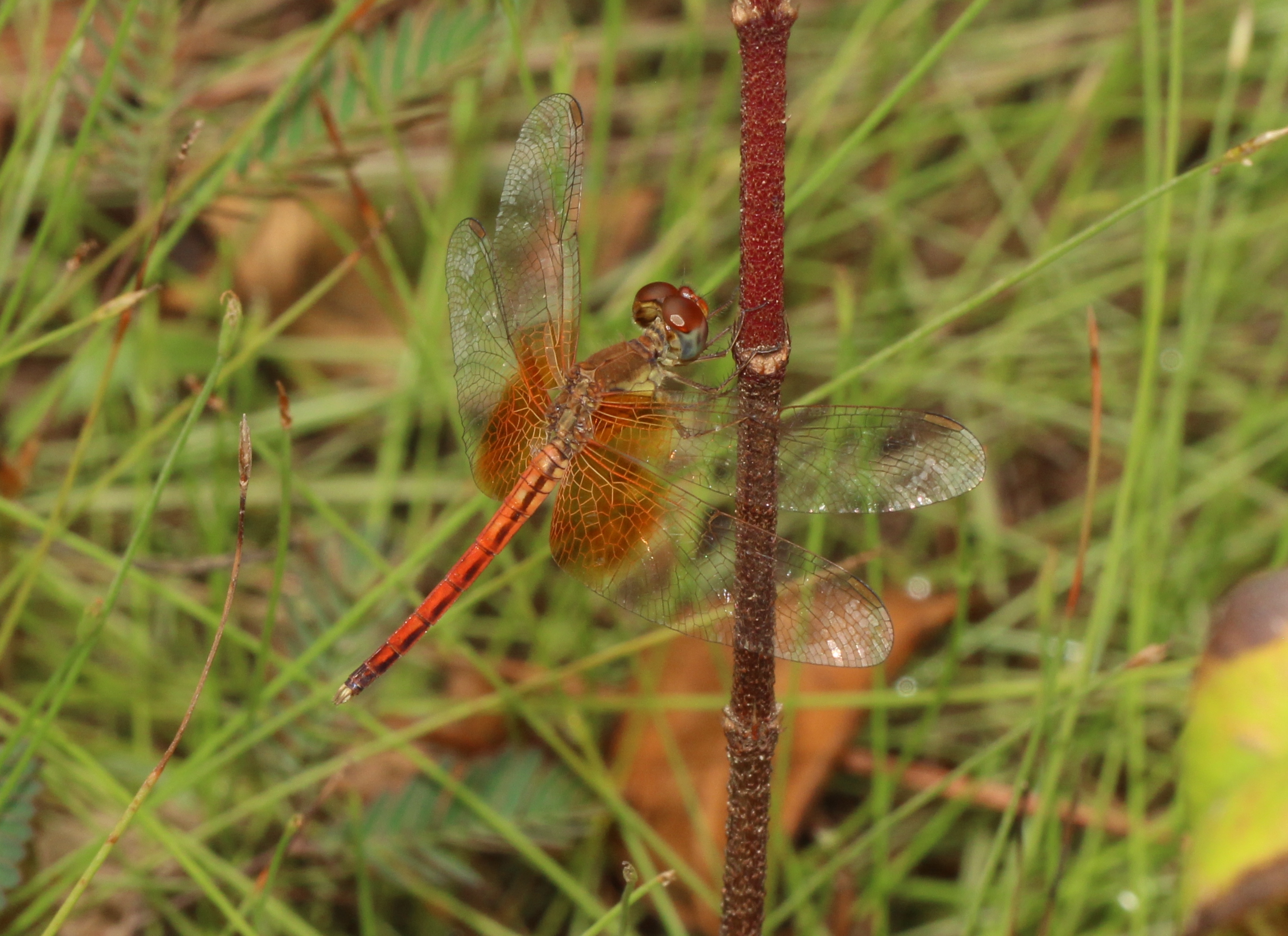
A target species I had been looking for on all my trips, which had been recorded by Bui (2008). Apparently this rare species is a summer species on the island. I only saw a single female, Lyriothemis mortoni.

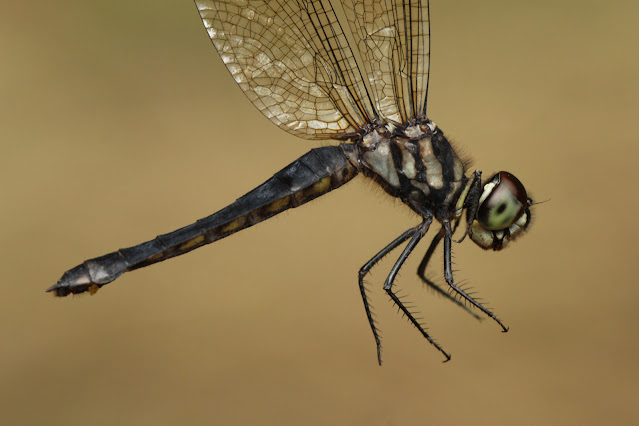
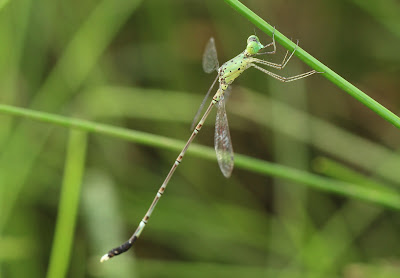
The fascinating Platylestes platystylus, also on the island of Phu Quoc., August 20, 2016


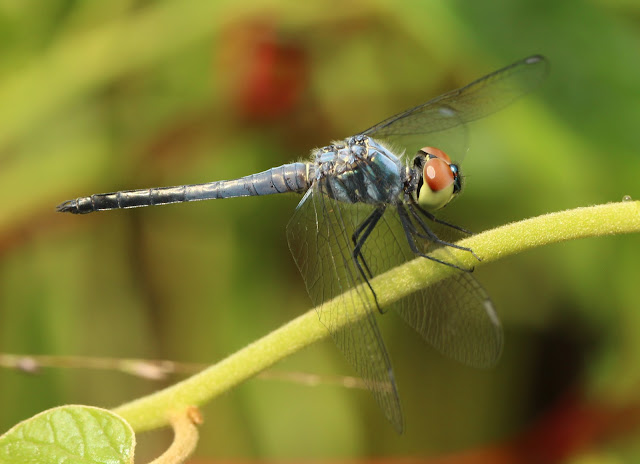
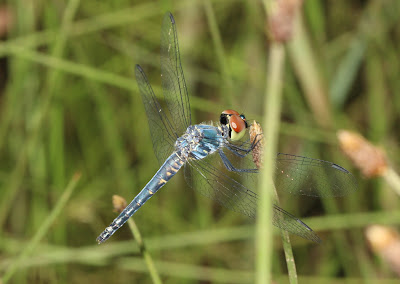
Immature male of Brachydiplax sobrina, August 20 

And nearby an immature female, much harder to find generally

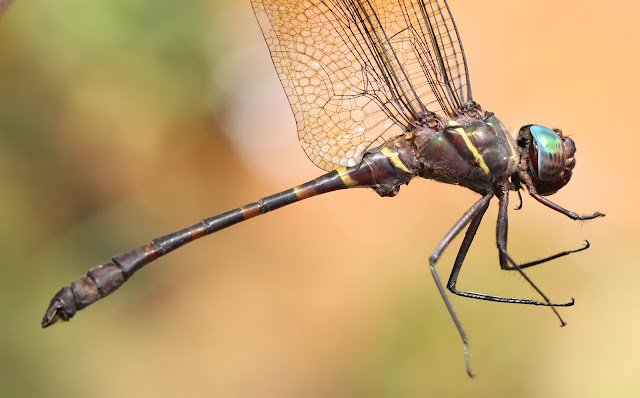
Monstrous Epophthalmia vittigera, a wonderful male, caught on August 21, 2016

A lovely Ceriagrion calamineum, previously recorded from the island, but misidentified as C. aurantiacum in Bui (2008). Finally found on 21 August 2016.

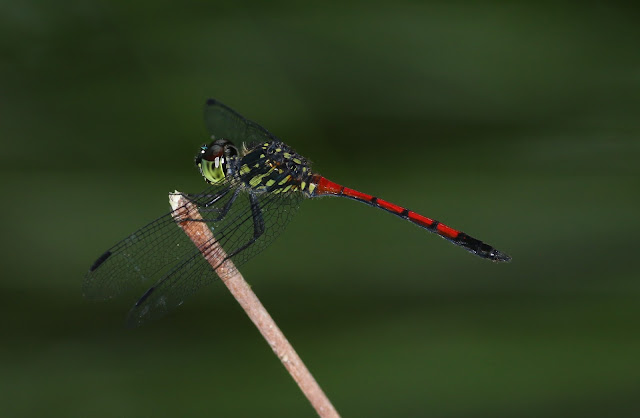
Agrionoptera insignis male over a dark pool, August 19, 2016. The only specimen I saw on my three visits.

The List:

Lestes praemorsus* VIII
Platylestes platystylus* VIII
Vestalis gracilis I, IV, VIII, XII
Libellago hyalina I, IV, VIII, XII
Heliocypha biforata I, IV, VIII, XII
Euphaea cyanopogon**** I, IV, VIII, XII
Rhinagrion viridatum XII, VIII
Podolestes coomansi***** IV
Aciagrion borneense I, XII
Agriocnemis minima* IV, VIII, XII
A. nana* IV, VIII, XII
A. pygmaea I, VIII, XII
Amphicnemis valentini**** VIII
Archibasis viola I, IV, VIII, XII
Ceriagrion calamineum** VIII
C. cerinorubellum IV, VIII, XII
C. malaisei* VIII
C. olivaceum* I, IV, XII
Ischnura senegalensis I, IV, XII
Mortonagrion falcatum*** I
Onychargia atrocyana IV, VIII
Paracercion calamorum* IV, VIII
Pseudagrion australasiae* IV, VIII, XII
P. microcephalum I, IV, XII
P. rubriceps IV, XII
P. pruinosum I
P. williamsoni I, IV, VIII, XII
Coeliccia kazukoae** I, IV
Coeliccia yamasakii IV
Pseudocopera ciliata* IV, VIII, XII
Copera vittata** I, IV, VIII, XII
Prodasineura verticalis** I, IV, VIII, XII
Anax guttatus I, VIII, XII
Gynacantha basiguttata* I, VIII
G. bayadera* I
G. subinterrupta* I
Heliaeschna crassa*** IV
Ictinigomphus decoratus meleanops I, IV, VIII
Paragomphus capricornis* XII
Epophthalmia frontalis* I
E. vittigera* VIII
Acisoma panorpoides IV, VIII, XII
Agrionoptera insignis* VIII
Brachydiplax chalybea* IV, VIII, XII
B. sobrina* IV, VIII
Brachygonia oculata IV, VIII
Brachythemis contaminata I, VIII, XII
Cratilla lineata IV
Crocothemis servilia I
Diplacodes nebulosa I, IV, VIII, XII
D. trivialis I, IV, XII
Hydrobasileus croceus I, VIII
Indothemis limbata*** I, VIII
Lathrecista asiatica I, IV, VIII
Lyriothemis mortoni VIII
Nannophya pygmaea IV, VIII, XII
Neurothemis fluctuans I, IV, VIII, XII
N. tullia IV, XII
N. fulvia IV, VIII, XII
N. intermedia* IV, VIII, XII
Orchithemis pulcherrima IV, VIII
Orthetrum sabina I, IV, VIII, XII
O. pruinosum* XII
O. chrysis I, IV, VIII, XII
Pantala flavescens I, VIII, XII
Potamarcha congener I, IV, VIII, XII
Pseudothemis jorina** I
Rhodothemis rufa* IV, VIII, XII
Rhyothemis aterrima* IV
R. obsolescens IV, VIII
R. phyllis I, IV, VIII, XII
R. variegata I, IV, XII
R. triangularis IV, VIII
Tetrathemis irregularis IV, XII
Tholymis tillarga I, IV, VIII, XII
Tramea transmarina euryale* I, VIII, XII
Trithemis festiva IV, XII
T. aurora I, IV, VIII, XII
T. pallidinervis I, IV, VIII
Urothemis signata I, IV, VIII
Zygonyx iris I, VIII
Zyxomma petiolatum* IV, VIII, XII

*       Refers to species first recorded on the island, although some are very common
**     Coeliccia kazukoae had already been found by Floris Brekelmans, but is not rare. Prodasineura verticalis had been recorded as Prodasineura sp. Copera vittata had been misidentified previously (as C. marginipes), but is a very common species. Pseudothemis jorina had been recorded but misidentified (presumably) as P. zonata. Ceriagrion calamineum had been misidentified as C. aurantiacum.
***   Refers to species recorded for the first time for Vietnam (as far as I know)
****  Refers to a species novum, but misidentified in previous surveys.
*****Recorded by Flores Brekelmans, not by me, but published on this blog

Tuesday, 9 February 2021

A new Chlorogomphus for Vietnam

 Preparing to leave Vietnam in the spring and early summer of 2017 was difficult. So much to do still, so many riddles to solve. Late May I had the opportunity to go say goodbye to the Sa Pa area. I had now found a few good spots that were both rather pristine and just outside the National Park, so I could try without the guards looking over my shoulder to look for gomphids and chlorogomphids. On May 29 I worked my way down a slope and heavy brush to the small stream I knew was there inside the forest and stood there by the side of the stream for hours, amusing myself with many Anotogaster chaoi, but little else, until a large dragon fly by. I was able to catch it and stunned to see a large puzzling Chlorogomphid. Sadly it was a female and although it had some striking features, like colored wing bases and thin stripes between the larger ones on the side of the thorax, I could not connect it to a species. That is, until I saw photos of Chlorogomphus miyashitai Karube, 1995 in the bible of Haomiao Zhang on Chinese dragonflies. This properly set me on the path to identification. Chlorogomphus miyashitai was described in 1995 from 'Xien Khang' in northeastern Laos (Karube 1995). I think this refers to Xiang Khouang, a province in northeastern Laos, a region of high mountains, although the description has no other information on the habitat or the altitude of the type location. Haomiao Zhang reports it from the Pu'er region in Yunnan, where it occurs to 1500 m alt. The Laos Province is south of the Sa Pa region, but the Pu'er region borders the Vietnamese Lai Chau province and is thus not that far from Sa Pa. I caught my insect at approximately 1700 m alt. The dorsal pattern of S2, the pattern of the thorax and face, the wing coloration all point to Chlorogomphus miyashitai. Although not recorded from Vietnam previously, it fits well the known distribution, so its occurrence comes as no real surprise.


Female Chlorogomphus miyashitai in hand


Face in frontal view


Sunday, 5 January 2020

Overlooked and forgotten - Tholymis tillarga

I realized that a whole genus was missing from my blog. Of course it has only one species, but nonetheless, how is this possible. After all, Tholymis tillarga is a common species that tolerates pretty grim water quality, so it is around even in central Hanoi. It is a typical pond species often found during the day hanging in the underbrush, with females hunting at head height close to dusk, and males starting to patrol the edges of ponds in the hour or so before dark, so from well before sunset. It shares that space with Zyxomma petiolatum. The latter is quite inconspicuous, but Tholymis, or Twister, as it is commonly called, is a bright red insect with white clouds in its wings. Not the female, which is yellowish brown and has yellow patches in the wing. Because it is so common, I rarely took photos of it and when I realized that it was missing from the blog I had a hard time finding some shots of it. I also did not want to search long, so I guess these photos may be somewhat disappointing. So be it, at least it now is on the blog.
Male Tholymis tillage, 1 May 2014 in Huu Lien. I will replace it if I find a better shot. But it is nice and red.
Immature male, but the color in its wing is already starting to show. 4 August 2013, Hanoi City.

Female Tholymis tillage, 13 July 2013, Ba Vi.

Friday, 3 January 2020

Anisopleura bipugio - also in central Vietnam

Hämäläinen & Karube described a new Anisopleura species from Lam Dong Prov. in southern Vietnam (technically at the very southern border of the Central Highlands) in 2013. I was never to verify it myself that far south, but in 2016 I ran into it several times. This is my third of fourth species of Anisopleura in Vietnam. In previous entries I introduced A. qingyuanensis and A. yunnanensis and a possible species novum from Pia Oac. The latter has different thorax pattern than A. yunnanensis, but its genital ligula and caudal appendages are seemingly the same and we could find no clear differences in DNA, so eventually decided not to describe it (Phan et al. 2018). Anisopleura is a tricky genus with a lot of look-alike species, so finding one that is remarkably different is pretty thrilling. This is certainly the case for A. bipugio, which has magnificent horns on its prothorax. I observed the species in Bach Ma National Park and nearby Quang Tri and Thua Thien - Hue Provinces. In Bach Ma it occurs together with A. qingyuanensis, which is common further north.

Male Anisopleura bipugio near the top of Bach Ma National Park, August 5, 2016

Close-up of male head, Thua Thien - Hue Prov., June 21, 2016. Females also have these remarkable horns.


Coeliccia cyanomelas and its synonyms

Recently a paper was published by Yu et al. in IJO (2019) on Coeliccia cyanomelas. Before that, Steinhoff & Uhl (2015) had already shown that C. onoi was a junior synonym of C. cyanomelas. Now, Yu et al. showed that C. wilsoni, C. sexmaculata and C. mingxiensis were also junior synonyms of C. cyanomelas. And, if you have been following these pages, you will be aware that I had reported C. mingxiensis too. It had first been recorded by Do in 2009 from Tam Dao. Because it looks strikingly different from all other species in the region, I never stopped to properly think when I saw similar specimens and assumed they were C. mingxiensis. I should have known better, because the color of the eyes and the weakness of their bodies indicated that these are immature specimens. Coeliccia cyanomelas is just an extreme example of changes in coloration during various stages of maturity as often observed in the genus. Here are a few photos showing different stages.

Here a fresh C. cyanomelas with the typical reddish shoulders, white-pink appendages and comma shaped antehumerals. This is what we used to call C. mingxiensis
This is the same specimen with the thorax in close-up. The color of the eyes is clearly immature.

This is a somewhat more mature male. The thorax is much darker above, with the antehumerals reduced to short lines, but the shoulder is still reddish. The abdomen tip is now white, not pink, and the eyes coloring properly too.

Here the reddish shoulders are gone and blue tones are evident.

This is just a variant, with additional small spots close to the wing base.

And thrown in: an adult female. Females similarly go through pale yellow stages first, but eventually turn blue like the mature males.


Thursday, 2 January 2020

Asiagomphus mayhem - Vietnam is the place to be


August 2018 I finally was able to publish the results of 4 years of chasing Asiagomphus species in Vietnam. The paper that appeared in Zootaxa that year provided information on 8 species from this diverse genus. Asiagomphus acco is one of the easy species to recognize and had been recorded from Vietnam before. It is widespread and I published it on the blog long ago. Another species that is, at least in hand, easy to recognize is Asiagomphus reinhardti, which had only recently been described from neighboring Cambodia. The male has highly distinctive appendages, quite different from all other species in SE Asia. I found it both in Lam Dong Province and in Gia Lai Province. Here is an example in hand.

Male Asiagomphus reinhardti, caught May 17, 2016, near Bao Loc
As pointed out elsewhere in the blog, the most widespread species of Asiagomphus in northern Vietnam is probably A. auricolor. The original description by Fraser was based on a female and it had been hard to match it with its female. In my paper I give a first description of the male and provide further information on the female. Photos of this species are included already on this blog in past entries.

In neighboring Thailand Asiagomphus xanthenatus occurs and I was able to verify the occurrence of this species in central Vietnam, where I one lucky day ran into three males. Here is a photo of one of these.

Asiagomphus xanthenatus male, May 15, 2016 from Quang Nam Province.
Near Da Lat in Lam Dong Province, not that far actually from where I collected A. reinhardti (Bao Loc), I found a new species to science, Asiagomphus kosterini, which I reported already in this blog. 

That leaves us with 3 more species. One of these is a species with longitudinal stripes on the abdomen, different from all other species in Vietnam, although this pattern occurs on many of the northern species. This is Asiagomphus pacificus, which I found in Cao Bang Province and Bac Kan Province in the north. I reported this species already previously within this blog.

Which leaves us with two tricky species that I also already showed on the blog. Both turned out to be new to science and both are rather similar to some of the other species shown in this entry. These are Asiagomphus superciliaris and Asiagomphus monticola. Here are examples of both.

Male Asiagomphus monticola, Yen Bai Province, June 1, 2014

Asiagomphus monticola male, Xuan Son NP, May 31, 2014

And finally Asiagomphus superciliaris, Huu Lien Nature Reserve, May 24, 2014
Comparing the photos of these last three species, all similar to A. auricolor too, may leave the casual observer somewhat bewildered. Indeed, these species are rather difficult, if not impossible, to identify in the field without in-hand inspection. The details of the caudal appendages and secondary genitalia provide good clues. If you carry a copy of my Zootaxa paper, which provides these clues, you should be able to identify them and release them again.

Saturday, 27 October 2018

Euphaea sanguinea, a new species for science

It has been busy. Busy with work, busy in the field here in the Netherlands, busy writing up some papers and before you know it, time is slipping without blog posts. So much so, that I have even failed to publish on the blog new species described from Vietnam in which I had some part. But here it is, a nice photo of a male of the newly described Euphaea sanguinea Kompier & Hayashi, 2018, published earlier this year in Zootaxa (Phan, Kompier, Karube & Hayashi 2018). This is a species localized in south central Vietnam and across the border in Cambodia (Kosterin 2016). It had been overlooked until now, because it is rather similar to E. ochracea, although, once you know it, it is actually obviously different, not only because of its appendages, but also by the very clear-cut red on S2-6. Below is a photo of a male from Bao Loc, Lam Dong Province, not far north from Ho Chi Minh City.

The newly described Euphaea sanguinea, a pretty male.


Friday, 17 August 2018

Two new Rhipidolestes for Vietnam

Currently 25 species of the genus Rhipidolestes are known. Many are very similar. Wilson and Xu (2007) provided a key to the known species, a great many of which occur in China. It has been a frustration for me that I had until now only been able to find Rhipidolestes owadai in northern Vietnam, where it is quite widespread and sometimes locally very common. How could there be no other species around, with directly across the border so many others? But frustrating as it might be, during 4 years in Vietnam I never found anything else.
It was with this knowledge that this spring I accompanied Phil Benstead and a fine group of people to the north of Vietnam on a two-week tour. Of course we encountered R. owadai. And I explained again and again that this is strangely enough the only species of the genus in Vietnam. Until on June 12 we spent a morning in the pouring rain at the Love Waterfall in Sa Pa at approximately 2000m altitude. I found a completely drenched somewhat smallish Rhipidolestes, virtually dead, in the mist and rain. The altitude was way higher than any R. owadai I had ever seen, so I paid close attention. It was a new species for Vietnam! Checking the details, it is close to identical to the detailed description of R. jucundus Lieftinck, 1948, a high altitude species from Fujian Province in China. That is far away from Sa Pa, but at least the altitude is similar. Possibly the cone on S9 is larger than in the type, but Lieftinck did not draw it and although the specimen is kept at Naturalis, the collection is currently closed. Also, Lieftinck described only one row of cells between CuA (his Cu2) and the wing margin in all wings. In my specimen there are two rows in the hindwing. However, otherwise everything fits exactly. I am confident this is indeed R. jucundus.
But things turned stranger after returning home and checking a R. owadai, or so I thought, I had collected in comparison. I did not properly note the location, but I probably took it in Cao Bang, at Pia Oac. looking at it again, it was immediately obvious it had a blue face, quite unlike R. owadai. Further study pointed to R. cyanoflavus Wilson, 2000. This species at least was described from nearby Guangdong Province in China. I am quite embarrassed not having recognized it in the field, but anyway, a third Rhipidolestes found to occur in Vietnam!

Many thanks to Keith Wilson and Martin Schorr, who provided some of the papers I needed.

Rhipidolestes jucundus in the rain at Love Waterfall
Its bright orange face
The rather distinctive appendages in dorsal view, although similar to those of R. malaisei from Myanmar. Apologies for the faeces visible.
The appendages in lateral view, with the upward pointed tooth of the inferiors clearly visible.
Not even a proper picture. Rhipidolestes cyanoflavus, from northern Vietnam, probably Pia Oac.
I have to admit, it is not clear how I missed noticing the face is blue.

The superior appendages, clearly different from R. owadai.


Tuesday, 19 June 2018

Burmagomphus magnus - expected in Vietnam

On June 4 Odonatours visited the area of Cao Bang during its tour of northern Vietnam. On this day James Holden joined us from his 'home' in Cat Tien. Together we checked a large stream not far away from the town. While we were pre-occupied with other Odes, James took a photo of what appeared to be an unknown Burmagomphus. Burmagomphus vermicularis and B. divaricatus both occur in the area, but this was clearly different. After a visit to Pia Oac on the 5th, we went back to the stream on the 6th and were lucky enough to relocate this wonderful gomphid. Upon capture the details of the appendages could be verified and the initial suspicion this might be B. intinctus seemed confirmed.
Burmagomphus intinctus is only known from several specimens collected from Fujian in China, which is truly not exactly around the corner. And indeed, further perusal of literature (thank you, James) showed it to be B. magnus, described in 2015 from Hekou district in Yunnan Province in China, which is just over the border from northern Vietnam. It was therefore to be expected.

The original photo by James Holden. What is that?!
Two days later, probably the same individual in hand.

The strong hook on the posterior hamule

And the rounded epiproct and somewhat sinuous superior appendages


Wednesday, 15 November 2017

Gomphidictinus tongi, a wonderful discovery from Vietnam

In May 2016 I observed, but could not catch, a large Gomphidia-like gomphid in pristine forest just south of Phong Nha - Ke Bang National Park in Quang Binh Province in Central Vietnam. I thought it might have been Gomphidictinus kompieri, because of its deep forest habitat. I visited several times later in the season, but it rained every time and so I did not see it again. But this year I visited in early June and was more lucky. Not only did I catch a male, I also found the species next to the botanical garden of the National Park. And it clearly was not G. kompieri. It was a new species for sure, judging from the shape of the appendages, coloration and wing venation.

Not long after I was contacted by Zootaxa regarding a manuscript for a new Gomphidictinus species from China by Haomiao Zhang and colleagues. And what a surprise when this turned out to be exactly the same species: Gomphidictinus tongi Zhang, Guan & Wang, 2017. This lead to an interesting debate regarding its genus. Although the species is currently included in Gomphidictinus, in the same manner as G. kompieri was included in it, on the basis of the spine on the vesica spermalis, differentiating between Gomphidia and Gomphidictinus is not straightforward, not on the basis of this spine, nor on the basis of for instance wing venation. An overhaul of the genera, including DNA-analysis, is needed to solve this, but for now this fabulous dragon is included in Gomphidictinus as the third member of that genus.

Some unidentified Gomphidia / Gomphidictinus reported from Tam Dao by Natalia von Ellenrieder likely also concern this species, which therefore may be more widespread in Vietnam, apart from ranging widely in China (now recorded from Guangxi and Hainan). Interestingly, the two male specimens from Vietnam in below pictures indicate some variability in the maculation of the abdomen.

Female of Gomphidictinus tongi. It has wide flaps to S8, although not so visible here

Typical male showing already striking yellow markings compared to the two other species in the genus.

Slightly overexposed, so not as yellow, second male, but note extensive marking of S6 compared to the first.

Tuesday, 25 July 2017

Saying good-bye, a last visit to Xuan Son National Park

After 4 years of oding in Vietnam, I will be leaving. This blog will continue, because there is still a lot to publish. I have just been too busy trying to clean up some remaining issues. There simply was not enough time to write entries. Articles are the priority and even there I am behind. Not sure how many species the tally is, after 4 years. Probably around 440 species, but many first need a formal description. And then there is so much out there still to discover.

This spring and summer has been awful for dragonflies. It has just been cloudy and rainy. Some of the puzzles I wanted to solve therefore remain unsolved for now. But at least Sunday 23 July was a good and sunny day, even if I got soaked in the morning. The upside: only one leech lodged on my stomach.

Xuan Son has been wonderful, although the forest is being opened up by road building. I hope that will not lead to further incursions. The trees still stand and the stream remain good. Not sure how many species I actually saw there, somewhere in the range of 125-135 species. With several new species described and several more on the way. So, with the promise of some sun, this is where I went for my very last outing.

And to my huge surprise I ran not into 1, not 2, but 3 species I had not recorded there before. The first was a male Orthetrum melania superbum, a subspecies of O. melania described, and also only recorded, from Yen Bai. A large and conspicuous dragonfly that apparently tolerates abysmal conditions (puddles with muddy, water buffalo dung infested, water), but is nevertheless hardly ever seen. A single male attended a small pond. Fantastic.


This remains one of the most beautiful Orthetrum species I have seen 


By the early afternoon I wanted a change of scenery and drove to a nearby hill in the forest and noticed a dragonfly seemingly ovipositing on the wet concrete road. I got out and caught it and was very surprised to see it was a male, so why was it dipping its body in the wetness of the concrete? And it was a Chlorogomphus, in fact it was C. auratus, which I had never recorded in the park before. I guess I focus too much on the one fantastic stream, but ignore trickles on other mountains.

What is splendid discovery, Chlorogomphus auratus

Further afield still I wanted t check the area on the other side of the central hamlet and stopped by a small stream. A tiny trail ran next to it and I went in to see what it had to offer. And bumped into a small, Coeliccia pyriformis-sized, Coeliccia with large pale blue dorsal markings, a little like larger C. uenoi, but more rounded, and much like the even larger species we are currently describing from Ba Be. Indeed, under the microscope it is clearly closely related to that species, with similar genital ligula, similar appendages (although details differ), but obviously different thorax pattern and abdomen pattern (apart from the total insect being smaller than the abdomen of the Ba Be species alone, which is very robust).

To make sure it was not just aberrant I searched high and low and eventually, in a rather different location, was able to locate a second male, which was exactly like the first. How wonderful, to wrap up Vietnam with a new species of Coeliccia (coincidentally the 9th species of the genus occurring in Xuan Son, amazing).

Wonderful Coeliccia spec. nov. 
Close up of the thorax


So, back to the Netherlands and time to write up in earnest!


Wednesday, 21 June 2017

Two new Stylogomphus species for science and for Vietnam

Today my paper on two new Stylogomphus species was published in Tombo. And with it two species I had found last year have received a name. The first I found along the Ho Chi Minh Highway just south of Phong Nha - Ke Bang National Park in May 2016 (and again this year) and also a little north of Khe Sanh. The other, a tiny species, I found perched in bright sunlight on a rock in a stream near Bao Loc in Lam Dong Province. Stylogomphus species are notoriously similar in their outward appearance, but have obviously different caudal appendages. That means that it is virtually impossible to separate them by observation or even photos, much like Leptogomphus species. Here are photos of both species.

Stylogomphus delicatus, a species with long and deeply cleft inferiors

Stylogomphus annamensis, a species with short and rounded inferiors

Saturday, 17 June 2017

Macrogomphus albardae in Cat Tien*

*This entry was adjusted on December 31, 2019, following the publication in Zootaxa of a paper by Oleg Kosterin, which I had the pleasure of reviewing, on 12 June 2019. The paper addressed the considerable confusion surrounding a group of similar Macrogomphus species, showing, amongst others that Macrogomphus matsukii is a doubtful species and that records of Macrogomphus species identified as such from Cat Tien actually refer to Macrogomphus albardae. M. guilinensis from central and northern Vietnam actually is a junior synonym of the same M. albardae and occurs in a variety of distinct forms. Turns out that the 'matsukii' type gomphids I had been chasing for some time after first seeing them hover in the distance above a river in central Vietnam were conspecific with the species that I knew well from the north, but that based on previous misidentification and confusing literature had identified as M. guilinensis. Anyway, thanks to the careful work by Oleg the situation is now much clearer.

Original text:
James Holden had been reporting Macrogomphus matsukii from Cat Tien NP for a while and I decided to pay him a visit to get to see it in May. Last year I had seen Macrogomphus hovering over a large river at dusk (a habit shared by many gomphids, and certainly M. guilinensis) in Quang Binh Province, but had failed to ascertain beyond reasonable doubt that it was this species. Photos by James from last year had us initially discuss whether it was M. borikhanensis or M. matsukii, because the lateral pattern on the thorax had only two clear stripes. Facial pattern is very much like M. matsukii though. There seems to be some doubt whether these two species may in fact be conspecific anyway.

Commentary December 31, 2019:
Kosterin (2019) shows that the records of M. matsukii on which I based the above knowledge were in fact misidentifications of M. albardae, while M. matsukii remains a sort of phantom species. And he also showed that M. borikhanensis is another junior synonym of M. albardae. So the whole discussion on whether the Cat Tien specimens were one or the other was non-sensical in retrospect.

Below text with portions adjusted on December 31, 2019, in bold:
Just before I went to Cat Tien the rains picked up and the riverbed filled up quickly, so that circumstances had changes considerably when I got there on May 12. Indeed, we saw none, but on the 13th the waters had receded a little and the circumstances the species seems to favor (small trickles over the rocks by the side of the main stream) were restored. And towards dusk: there they were. 3 males hovering over the streams, for a short period joined by a Orientogomphus naninus. That distracted us and therefore I failed to get the stunning pictures I was hoping for. The different individuals had some variability in the extent of the middle lateral stripe, which was absent or represented by a small mark at the dorsal end. Otherwise they seemed perfect for M. albardae.
This is a widespread species, occurring widely in SE Asia. It includes at least the following junior synonyms: M. guilinensis, M. rivularis and M. borikhanensis.


Male Macrogomphus albardae, hovering at dusk over stream

Thursday, 15 June 2017

At long last another Lestes

Considering my world Odonata list, Lestes is one of the genera with the most recorded species and that is not surprising, giving the number of described species and the fact they occur around the globe. But irrespective of that, there are not that many species around in Vietnam, apparently. Only three I had been able to find. Lestes praemorsus is the common species, found from the very north to the very south, and Lestes elatus from the southern half of Vietnam. Lastly, I recorded pretty Lestes nodalis from Huu Lien Nature Reserve, to the north of Hanoi. And that was it. Until on May 12 this year I stopped by the road in Lam Dong province, to the northwest of Bao Loc, to check a grassy inundated area in the afternoon. I noticed many Lestes praemorsus, but it dawned on me that some appeared to be larger than others and these all had a reduced pale abdomen tip. This could not be a coincidence. I took photos and collected a few. In the evening I became disappointed. It seemed the appendages were the same, so maybe just variants? But when I returned home several days later and was able to check them under the microscope, it became clear there were in fact differences. Most striking were the differences between the inferior appendages of the species, in addition to the aforementioned differences in coloration. Two species appeared to have this combination of characters, Lestes dorothea Fraser, 1924 and Lestes praecellens Lieftinck, 1937. The former is quite large, a little larger according to the description than mine, which fit better the species described by Lieftinck from Java in size. However, the female I photographed has much more extensive thoracic markings than that species, in line with what is to be expected of L. dorothea. That species is recorded from India, Thailand and Malaysia. Based on the structural characteristics and patterning of the male and patterning of the female I think it is safe to conclude this is L. dorothea as well.
By the way, based on the likeness of the appendages of L. praecellens and L. dorothea one may ask whether these are truly different species. There thoracic markings are also rather similar, if it weren't for the female.

Lester dorothea male. Note the lack of pruinosity on S9.

Male and female of L. dorothea

The female, showing the extensive dark markings on the thorax, unlike L. praemorsus

Another male showing the limited pruinosity on the abdomen tip

A Lestes praemorsus male for comparison. Smaller and with pruinosity on S9.